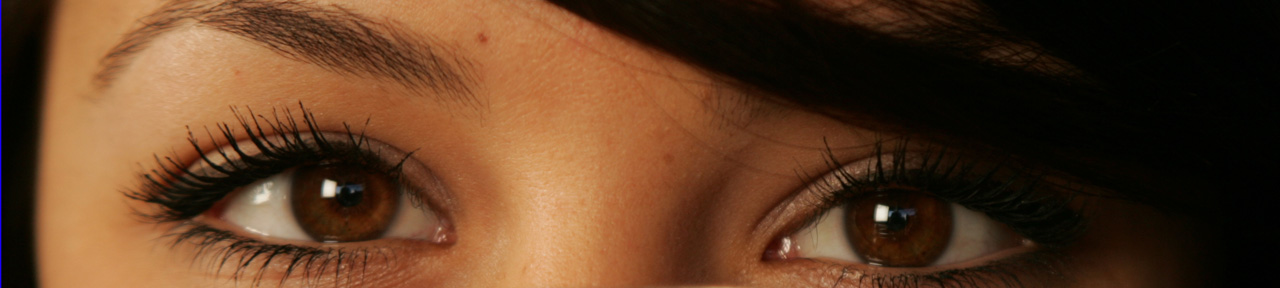
Body Language of Peering Over Glasses or Looking Over Glasses
 Cue: Peering Over Glasses.
Synonym(s): Looking Over Glasses.
Description: Happens by looking down and overtop of the glasses at another person. Sometimes the head is lowered and the eyes peer over top of the glasses, other times the glasses are pulled down onto the bridge of the nose coupled with a glare.
In One Sentence: Looking over the glasses signals distain, contempt, haughtiness, aggressiveness, and critical judgment.
How To Use it: Peer over the glasses to show others that you disagree with them or their ideas. The cue is reminiscent of the authoritative library trying to scold misbehaving students. Simply tilting the head without glasses can have the same effect. Research has shown that tilting the head down is a way to make the head appear wider and thus more dominant.
Mothers disapproving of children or wives disapproving of husbands can use the cue to show that actions or ideas are not being well received. Thus the cue signals the desire to keep a person ‘in their place’ and that one is morally superior. Therefore, use the cue when most appropriate.
Context: General.
Verbal Translation: “I’m peering over the top of my eye glasses and tilting my head forward because I’m scrutinizing you.”
Variant: The head might be tiled backwards with relatively the same effect. This is “looking down the nose” at someone. It is particularly powerful. See Head Tilted Back.
Cue In Action: The librarian wasn’t keen on the new group of rowdy students. After verbally berating them and warning of more severe punishment should they get disruptive, she’d occasionally peer over at them with lowered glasses to reinforce her commitment.
Meaning and/or Motivation: Disdain, contempt, haughtiness, aggressiveness, critical, condescending, and judgmental attitudes are all associated with this posture. The bearers of the posture assumes that they have the moral right to be looking down on other people from an elevated position.
Cue Cluster: Peering over the glasses is accompanied by a stern, closed facial expression, hard staring eyes, pursed lips, head forward and challenging, palms down and chin forward.
Body Language Category: Amplifier, Aggressive body language, Anger body language, Authoritative body language, Closed body language, Dislike (nonverbal), Dominant body language, Eye Language, Hostile body language, Evaluative body language.
Resources:
Beall, Alec and Jessica L. Tracy. The Puzzling Attractiveness of Male Shame. Manuscript submitted to Evolutionary Psychology. www.epjournal.net – 2014. 12(x): 1-39. http://bodylanguageproject.com/articles/male-nonverbal-shame-attractive/
Briñol, Pablo; Richard E. Petty and Benjamin Wagner. Body Posture Effects on Self-Evaluation: A Self-Validation Approach. European Journal of Social Psychology. 2009. 39(6): 1099-0992. DOI: 10.1002/ejsp.607. http://dx.doi.org/10.1002/ejsp.607
Costa, M., Menzani, M., and Ricci Bitti, P. E. Head canting in paintings: An historical study. Journal of Nonverbal Behavior. 2001. 25: 63–73.
Costa, M., and Ricci Bitti, P. E. Face-ism effect and head canting in one’s own and others’ photographs. European Psychologist. 2000. 5: 293–301.
Furley, Philip and Geoffrey Schweizer. “I’m Pretty Sure That We Will Win!”: The Influence of Score-Related Nonverbal Behavioral Changes on the Confidence in Winning a Basketball Game Journal of Sport & Exercise Psychology. 2013. 35:316-320. http://dx.doi.org/10.1123/jsep.2013-0199
Loser’s Nonverbal Behavior Boosts Confidence Of Winners, Study
Hehman, Eric; Jordan B. Leitner and Samuel L. Gaertner. Enhancing Static Facial Features Increases Intimidation. Journal of Experimental Social Psychology. 2013; 49: 747-754.
http://bodylanguageproject.com/articles/tilting-the-head-is-display-of-intimidation-study/
Hwang, Hyisung C. and David Matsumoto. Cultural Differences in Victory Signals of
Triumph Cross-Cultural Research. SAGE Publications 2014. 48(2):177– 191.
Keltner, D. The signs of appeasement: Evidence for the distinct displays of embarrassment, amusement, and shame. Journal of Personality and Social Psychology. 1995. 68: 441–454.
Johnson, Richard R. and Jasmine L. Aaron. Adults’ Beliefs Regarding Nonverbal Cues Predictive of Violence. Criminal Justice and Behavior. 2013. 40 (8): 881-894. DOI: 10.1177/0093854813475347.
Do You Wanna Fight? – Nonverbal Cues Believed To Indicate Violence
Krumhuber, Eva; Antony S. R.; Manstead; and Arvid Kappas. Temporal Aspects of Facial Displays in Person and Expression Perception: The Effects of Smile Dynamics, Head-tilt, and Gender. Journal Nonverbal Behavior. 2007; 31: 39-56.
DOI 10.1007/s10919-006-0019-x
Liu, C., Ishi, C. T., Ishiguro, H., & Hagita, N. (2012). Generation of nodding, head
tilting and eye gazing for human–robot dialogue interaction. In Human–Robot
interaction (HRI), 2012 7th ACM/IEEE international conference on (pp. 285–292).
IEEE Press.
Martens, Jason P.; Jessica L. Tracy and Azim F. Shariff. Status signals: Adaptive
benefits of displaying and observing the nonverbal expressions of pride and shame, Cognition & Emotion. 2012. 26(3): 390-406. DOI: 10.1080/02699931.2011.645281
Martina Mara and Markus Appel. Effects of Lateral Head Tilt on User Perceptions of Humanoid and Android Robots. Computers in Human Behavior. 2015. 44: 326-334. http://bodylanguageproject.com/articles/nonverbal-head-tilt-says-robot/
Martens, Jason P.; Jessica L. Tracy and Azim F. Shariff. Status signals: Adaptive
benefits of displaying and observing the nonverbal expressions of pride and shame, Cognition & Emotion. 2012. 26(3): 390-406. DOI: 10.1080/02699931.2011.645281
Mignault, Alain and Chaudhuri, Avi. The Many Faces of a Neutral Face: Head Tilt and Perception of Dominance and Emotion. Journal of Nonverbal Behavior. 2003 27(2): 111-132.
Marshall, Steven D. ; Low, Laura E. ; Holton, Nathan E. ; Franciscus, Robert G. ; Frazier, Mike ; Qian, Fang ; Mann, Kyle ; Schneider, Galen ; Scott, Jill E. ; Southard, Thomas E. Chin development as a result of differential jaw growth American Journal of Orthodontics & Dentofacial Orthopedics. 2011 139(4): 456-464.
Nelson, Nicole L and James A. Russell. Children’s Understanding Of Nonverbal Expressions Of Pride. Journal of Experimental Child Psychology. 2012; 111: 379-385.
Rule, Nicholas, O.; Reginald B. Adams Jr.; Nalini Ambady and Jonathan B. Freeman. Perceptions Of Dominance Following Glimpses Of Faces And Bodies. Perception. 2012; 41: 687-706 doi:10.1068/p7023
Rule, Nicholas, O.; Reginald B. Adams Jr.; Nalini Ambady and Jonathan B. Freeman. Perceptions Of Dominance Following Glimpses Of Faces And Bodies. Perception. 2012; 41: 687-706 doi:10.1068/p7023
Schubert, T. W. (2005). Your highness: Vertical positions as perceptual symbols of power. Journal of Personality and Social Psychology. 89, 1–21.
Sturman, Edward D. Invluntary Subordination and Its Relation to Personality, Mood,
and Submissive Behavior. Psychological Assessment. 2011. 23(1): 262-276 DOI: 10.1037/a0021499
Shariff, Azim F. and Jessica L. Tracy. Knowing Who’s Boss: Implicit Perceptions of Status From the Nonverbal Expression of Pride. Emotion. 2009.9(5): 631-639.
Can You Tell Who’s Boss By The Nonverbal Expression Of Pride?
Tracy, Jessica L. and Alec T. Beall. Happy Guys Finish Last: The Impact of Emotion Expressions on Sexual Attraction Emotion. American Psychological Association. 2011; 11(6): 1379–1387
Happy Guys Finish Last, Happy Women Finish First, Says New Study On Sexual Attractiveness
Tracy, Jessica L. and David Matsumoto. The Spontaneous Expression Of Pride And Shame: Evidence For Biologically Innate Nonverbal Displays. 2008; 105 (33) 11655-11660.
Tracy, Jessica L. and Richard W. Robins. The Nonverbal Expression of Pride: Evidence for Cross-Cultural Recognition. Journal of Personality and Social Psychology. 2008. 94(3): 516–530. DOI: 10.1037/0022-3514.94.3.516
Teixeira Fiquer, Juliana; Paulo Sérgio Boggio and Clarice Gorenstein. Talking Bodies: Nonverbal Behavior in the Assessment of Depression Severity. Journal of Affective Disorders. 2013. 150: 1114-1119.
Welker, Keith M.; Stefan M.M.; Goetz, Shyneth Galicia; Jordan Liphardt and Justin M. Carré. An Examination of the Associations Between Facial Structure, Aggressive Behavior, and Performance in the 2010 World Cup Association Football Players. Adaptive Human Behavior and Physiology (forthcoming in print, online July).
Wells, G. L., & Petty, R. E. (1980). The effects of head movement on persuasion: Compatibility and incompatibility of responses. Basic and Applied Social Psychology, 1, 219–230.
Weisbuch, Max ; Slepian, Michael L ; Eccleston, Collette P ; Ambady, Nalini. Nonverbal Expressions of Status and System Legitimacy. Psychological Science. 2013. 24(11): 2315-2321.