
Do You Wanna Fight? – How To Read Anger and Aggressive Body Language (or How to Avoid a Physical Confrontation) – A Case Study On the ‘Stop a Douchebag’ Movement
Christopher Philip
 For some time, I had wanted to do a case study on aggressive and violent nonverbal communication to grow the very limited peer reviewed literature in existence (see resources). The only study (that I am aware) on violence and nonverbal communication was conducted on children. See Hubbard et al., 2001. The study pitted children together in a competitive match in which one party wins by cheating against the other. This is not unlike situations children commonly face.
This study found the following signals of anger in children:
– “Inwardly furrowed eyebrows and mouth set in a hard line”
– Forceful, growling voice
– Nonverbal teasing (pointing and laughing or making faces)
– Stomping feet
– Pretending to cry
– Slapping one’s own head
– Punching one’s fist into one’s open hand
– Throwing objects
– Damaging property by hitting or kicking it
– Threatening peers by swinging a fist toward the peer’s face
The only other study of note with respect to violence and nonverbal communication was conducted by Johnson et al., 2019. Here he asked adults what cues they believed were associated with anger and aggression.
The subjects found four main cues to be uniformly associated with impending violence including:
– Assuming a boxer’s stance
– Invading personal space
– Clenched hands, and
– Threatening remarks
However, in the paper Johnson et al., 2019 clearly outlines the lack of empirical research in the field. He found that while many non-empirical websites cite cues of nonverbal anger and aggression which are “backed up by research,” they fail to cite the research itself.
Originally I undertook this project in order to look at road-side police and suspect interaction to catalog cues that indicated immanent threat of physical violence. The aim would be to assist police officers in reading potentially risky and volatile situations and prevent injury, and avoid loss of life. Avoiding physical confrontation would also improve their public perception.
I believe that once you’ve engaged in physical confrontation with a suspect that you’ve already lost. Therefore, any clues which can help identify, and thus avoid physical altercations, are paramount.
I also soon realized that my research presented below, while not peer reviewed or empirical, is as good as it gets in terms of cues which relate to anger, aggression and impending violence.
As others have likely realized the type of material required for this type of study is difficult to come by and often does not come in any significant quantity. There are also ethical implications to consider when creating a study which purposely immerses people in situations involving conflict. This may partially explain why few studies, despite its value to society, have been conducted in this area.
Let’s Stop A Douchebag!
Thankfully, the internet, and YouTube abide by few ethical considerations and if one searchers carefully, it’s possible to gather a complete data set. I was fortunate, however to find a set of videos that would work perfectly for my purpose.
Enter the “Stop a Douchebag” movement!
Not familiar? “Stop a Douchebag” is a Russian youth movement that uses vigilantly justice to “enforce the road traffic regulations in Russia.” One of the main issues, it seems, is that many motorists take it upon themselves to use pedestrian walk-ways to by-pass major traffic. This not only violates the road-rules, but also forces pedestrians to cede to the oncoming motorist. In other videos, the youths target motorists who park in designated bus lane and bus drop-off locations, as well as smokers who violate public smoking bans.
What does the “Stop a Douchebag” movement issue as a penalty for such infractions?
They make motorists back-up – all the way to their entry point. There’s no cutting back into traffic, no u-turns, or proceeding until the next intersection. Failure to do so will have the windscreen of your car “stickered” with a large circular tag that reads “I drive however I please.” Multiple stickers are applied in particularly resistant individuals.
Now you may wonder where our fascination with the movement originates.
The answer is simple. When the perceived rights of two factions collide there are two possible outcomes: #1 Both parties cooperate and form a new mutual agreement. #2 One party submits to the other.
In the videos I viewed, there were no cases where the “Stop a Douchebag” movement permitted the motorist to continue through on their path. If the person did not quickly acknowledge their misdeed and back out, the motorist was confronted with option #2, and only this option. Under no circumstances did the mob of pedestrians ever cede to the demands of the motorist.
In most cases, (I would assume – as the video is clearly edited) most people reversed and submitted to the mob’s justice and rationality. As the motorists were clearly wrong and were violating social norms and laws, there was little to debate. However, in a minority of cases conflict ensued between the “Stop a Douchebag” movement, and certain entitle motorists who, for whatever personal reasons, believe that the rules are okay for most, but not for them.
One could see how this might lead to conflict. Two parties meet at an impasse and are faced with no option but to submit – and for some, this is not written in their personalities. In this case, there is a physical and territorial confrontation. One party wishes to move unimpeded through the territory of another, and the other will not permit the intrusion.
The videos are interesting in that it provides a video casework of nonverbal communication indicating and associated with anger and aggression. The videos usually track from the beginning right through to the end of a confrontation encounter.
I have carefully reviewed the suite of videos to produce a comprehensive list of cues people exhibit when under emotional stress due to anger which can sometimes accompany aggression.
Nonverbal Results From The Video
A) Compliance (these cues indicate that someone is compliant and willing to submit and cede to “Stop a Douchebag”)
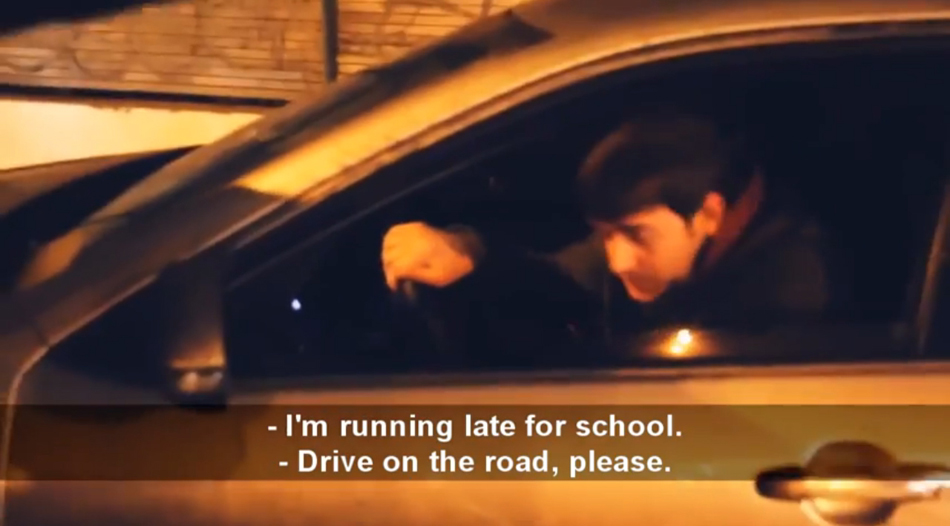
A typical submissive posture. The head is lowered, eyes averted. This person will not be putting up a fight.
– Immediate back up or escape (no confrontation i.e. submission – sometimes submission is a good thing!)
– Drop head/head down (See here for the head drop – first reaction)
– Head nod up and down (acknowledging)
– Verbal apology
– Brief glances followed by eyes averted or eyes down
– Palm to chest (a heartfelt apology)
Note that the following cues should be considered “threat displays” because they imply (though few actually follow through) that they have the desire and ability to back them up with physical force. This is debatable, however. It could be that these cues are merely elaborate “bluff displays” which are involved in a long negotiation process that precedes physical conflict – more research is necessary.
B) Verbal
– Insulting or calling names (i.e. “you have a small dick”, “go get a job”, “get a life”, “you must never get laid/have no girlfriend”, etc.)
– Swearing
– Threatening (to inflict physical harm or legal, one had a gun and cocked it, one threatened to call in friends or ‘thugs.’)
– Using a loud voice or yelling
– Talking forcefully/abruptly
C) Head and Eye (note that facial expressions were difficult to discern with respect to the video – especially microexpressions)
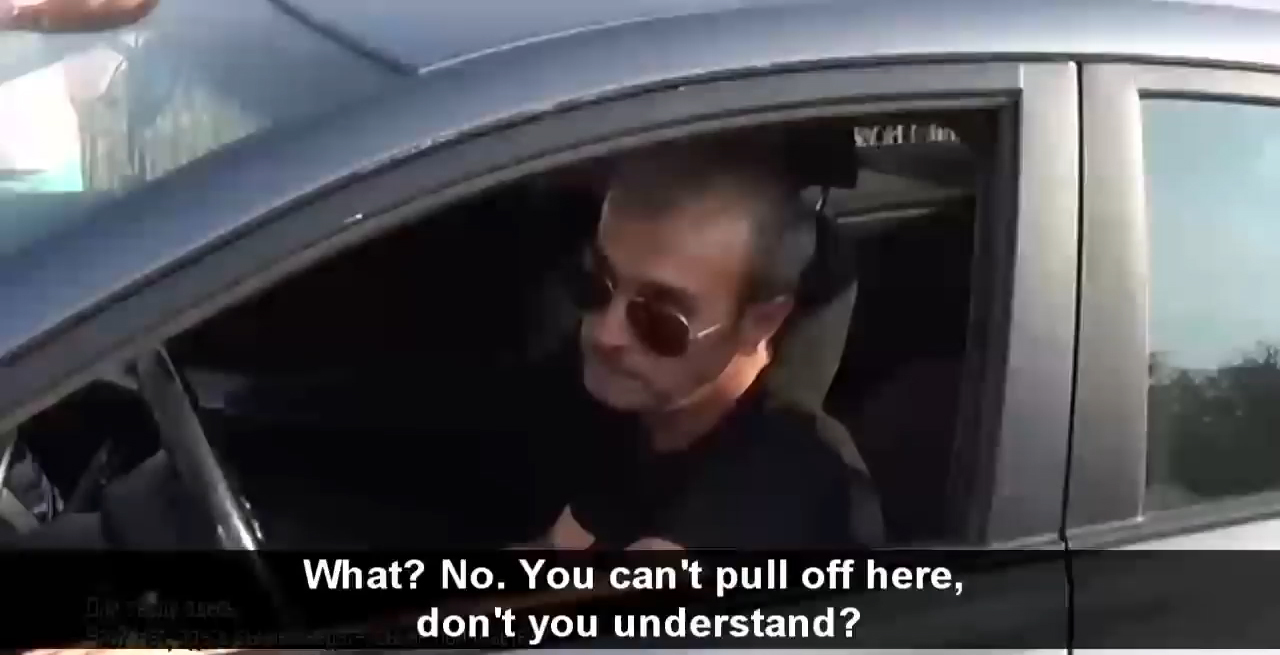
Facial expressions were difficult to code with the data set, but this lip purse was unmistakable.
– Direct eye contact, unblinking
– Widening the eyes and opening the face (making it more focused/wild eyed)
– Jutting the chin out
– Dropping the head down forcefully and the bringing it back up
– Dropping head in closer
– Moving/tossing the head sharply
– Lowering the brow
– Tilting the head
– Cocking the eyebrow
– Pursing and sucking in the lips
– “Head shoving” (more on this below – might be a true “fight indicator” rather than simply a bluff display.)
D) Hand/Arm
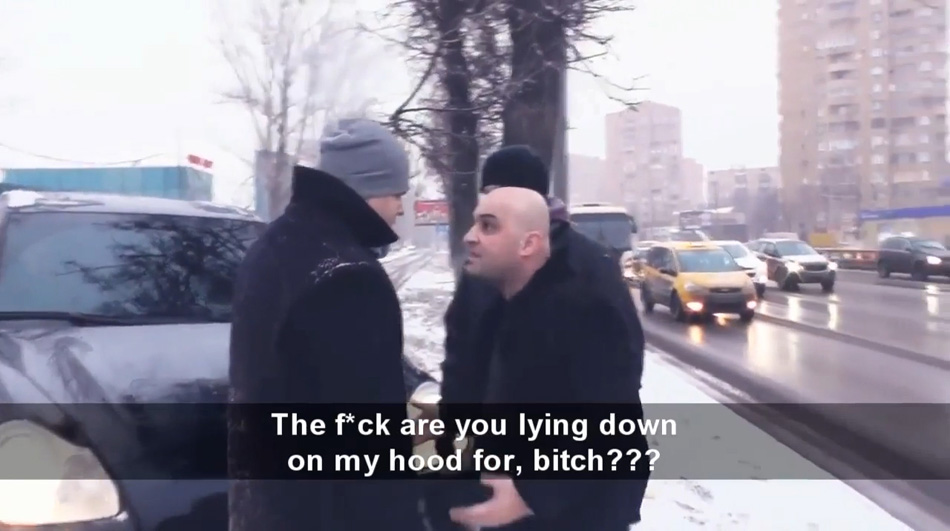
Head forward, palms up, erratic gesticulation.
– Pointing (at self and other)
– Jabbing with the index finger
– Palm up gesticulating
– Raising hands above mid-line
– Erratic gesticulation with palms and hands
– Throwing hands in unison as if throwing a large object
– Chopping hand motion
– Shaking hands up and down (bending at the elbow)
– Making a false punch/false charge, or false attack
– Making rude gestures
– Shrugging shoulders
– Aggressor touching aggressed head with hand (more on this below – might be a true “fight indicator” rather than simply a bluff display.)
E) Body
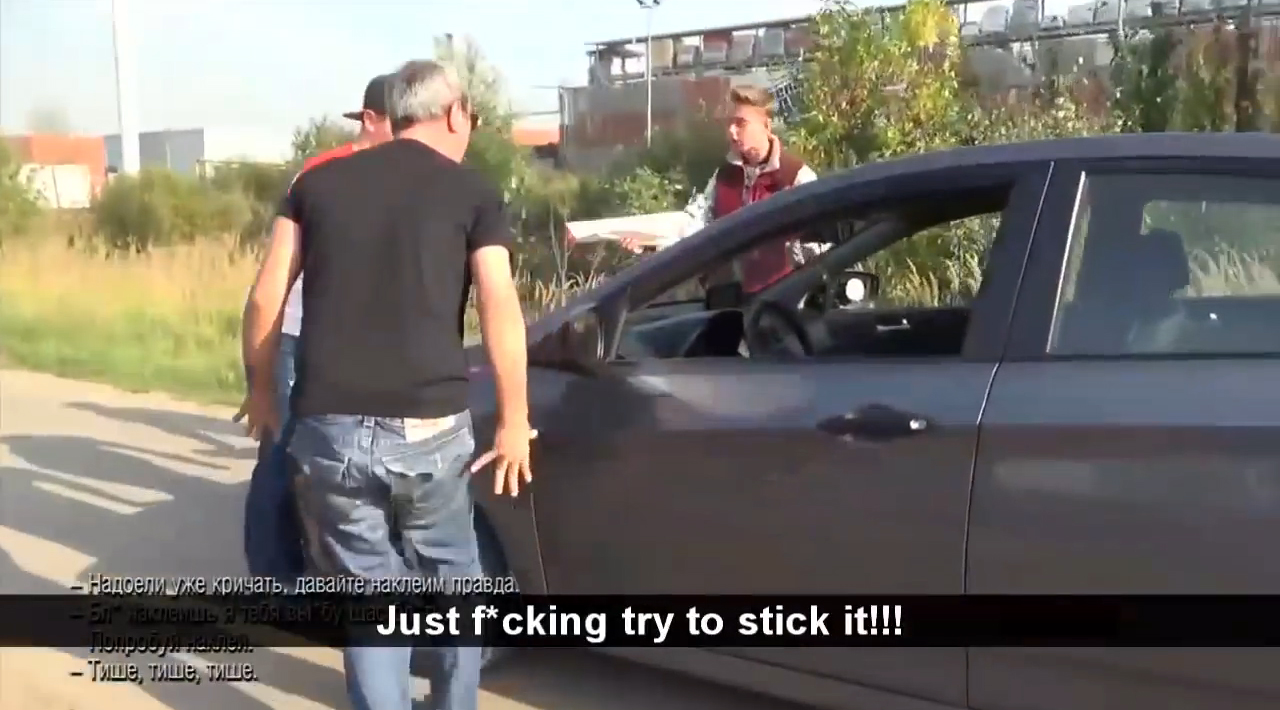
He was one of the more animated in the set. Watch him bar his chest, lean forward, reposition his body, and flair out his fingers.
– Encroaching on personal space
– Repositioning body (walking around to confront from new angle)
– Going toe-to-toe
– Leaning forward
– Chasing
– Baring the chest
– Walking briskly toward (more on this below – might be a true “fight indicator” rather than simply a bluff display.)
F) Physical
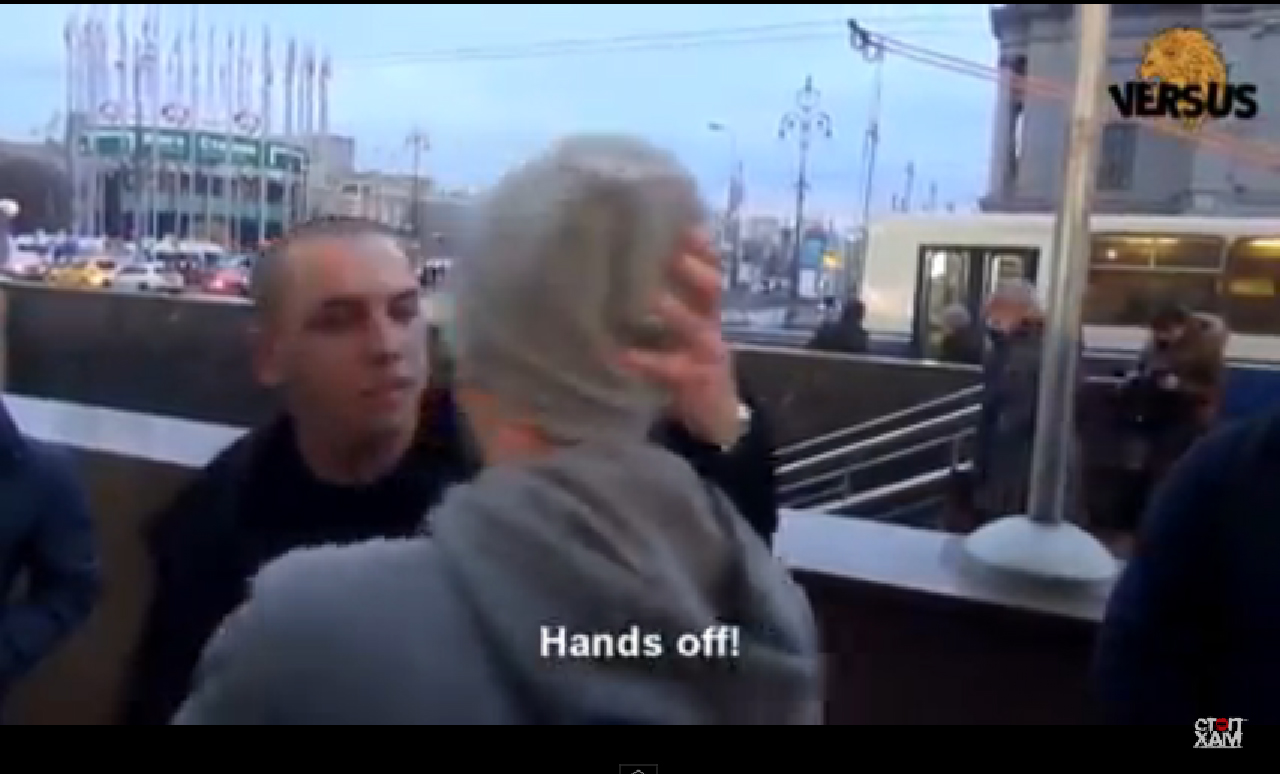
Actual physical conflict was rare, but head touching was usually a precursor to actual violence. The head, it seems is a key area were we don’t permit others to touch unless in conflict.
– Grabbing or swiping, swatting at another (swatting was usually done by women)
– Hitting the camera
– Bumping into people (i.e. with the shoulder)
– Throwing the sticker away
– Pulling the sticker away or knocking it out of the hands
– Running people down, driving with people on hood
– Shoving
– Threatening with a bar, gun or other weapon
– Opening door toward person so that it hits or comes close to hitting them
– Punching and kicking, wrestling (considered actual physical violence and the end result of a failed verbal and nonverbal negotiation)
G) Other
– Breathing shallow (difficult to discern)
– Slamming car door
– Honking the horn
– Removing clothing (when this occurred it was another cue that tended to predict physical violence)
H) Seeking A Pass (cues associated with seeking special treatment)

An appeal to chivalry with a coy glance, eye batting and submissive head lowering. When this didn’t work, she verbally shamed and insulted him.
– Verbal pleading to let aggressor through – sometimes calmly, sometimes with animation or emotionally such as sadness, being “honest” or as “amicably” (i.e. “one last time”, “just this once”, “I’m almost out of gas.”)
– Appealing to their good nature (i.e. asking for chivalry or a favour) See HERE
– Batting the eyelids – puppy dog eyes or acting coy (woman)
– Crying/appear sad or distressed
– Implying that backing up is too difficult
– Saying that they’re late/making excuses
– Trying to be funny, charismatic.
How To Read The Aggression Cues
The list above comprises a full arsenal of “negotiation tactics” taken against the immutable object (the “Stop a Doucebag” movement). I saw everything from verbal threats to threats of physical violence, to animated gesticulation, pointing, crying and emotional appeals, and so on, straight up to actual physical aggression.
These are ways people try to negotiation their way through a territorial impasse. Various actors are seen engaging in tactics to try to resolve the situation. What is interested is how the negotiations take place and how emotions boil, yet how infrequently physical harm actual comes from the intense situations.
Generally, there are two outcomes, as mentioned. The first and likely the most common and less risky maneuver was for the motorists to simply submit and turn around. This was characterized by a nonverbal drop of the head, head nod (as if acknowledging), eyes generally averted but with brief eye contact that was usually followed by eyes downcast as well as verbal apology.
If this was not undertaken, the motorist would engage the “Stop a Douchebag” movement by using various transactions to attempt to gain passage. This was varied from person to person, but likely employed a person’s best assets (whatever tactic worked for them most in past encounters). Men and women both tried various charismatic negotiations include trying to be funny. One female motorist appealed to the men’s chivarly and suggested that she was attractive and he should submit to her (he didn’t).
Threatening was the normal recourse. All involved some form of verbal negotiation, and verbal abuse such as name calling and shaming. Some threatened physical violence, calling upon others, threats of legal action, one man even threatened to call in his own ‘thugs.’
Forceful gesticulation above the waist and pointing were common, dropping the head, repositioning the body, encroaching on personal space, brushing up against another, and throwing the sticker back, were also usual.
Physical Conflict – When Bluff Displays Fail
There were a few definitive cues to indicate that actual physical threat was immanent. When physical touching occurred, it was usually light such as a swipe, bumping shoulders, a small shove, or walking briskly by and making light contact. Women were as likely as men to take part. In fact, it was common for women to shove the men or throw the sticker back in the men’s faces. However, when it came to more aggressive physical confrontation, the men were more likely to commit it including direct physical combat including kicking and outright punching. [ep 23 – kicking]. For our purpose I considered light touching and brief contact not actual physical conflict but was a simply another form of bluff display.
The important thing to realize is that all forms of aggressive emotional nonverbal communication is threat behaviour. It’s a warning that emotions are rising and compelling a person to act out.
It would seem that most people are hardwired and instinctive in their bluff displays and most are also wired not to partake in physical violence (since it occurred so rarely). This makes sense because physical combat is risky and can result in permanent or severely crippling injuries that can takes months to recover from. This likely explains why bluff displays were far more common than was actual physical violence.
The ones who used more dramatic physical violence tended to employ it by surprise and skipped over the bluff displays. In other cases, bluff displays occurred but where dropped when it become obvious to the aggressor that the displays were ineffective in convincing the aggressed to submit.
Bluffing and threatening are used to avoid physical conflict, but when it fails, and neither party cedes to the dominance of the other, then and impasse becomes less about two rational humans negotiation than between two objects impeding each other’s goals. You might think of the aggressor as being a machine such as a bulldozer and the aggressed as a rock in its path. If neither cedes to the other, then physical confrontation is required to move the object. This is also all about territory – one person wants to occupy the physical space which is currently occupied by another. To put this in real terms, conflict has been engaged when the aggressor’s fist occupies the exact same space as the aggressed face!
No doubt, in some instances, bluff may escalate to physical aggression, but the more severe physical confrontation happened, from the limited videos in this set, with little to no warning. In fact, the people who resorted to outright violence tended to behave more calmly than those taking part in protracted bluff displays. It’s as if at a certain point their mind had been decided, they dropped their bluff display, and calmly engaged in aggression in a real physical form.
While we will not deal specifically with this here, it may be related to a person’s use of proactive versus reactive aggression. Bluff or threat displays may be a way people react to the situation whereas proactive aggression, or actual violence, may be a way a person bullies through a situation. In one instance a person is showing their dislike for their perceived instance and reacting to it and in the other instance, a person is being proactive in trying to resolve their issue – with physical force.
How To Predict Physical Aggression – The “Head Shove” and “Hand-to-Head”
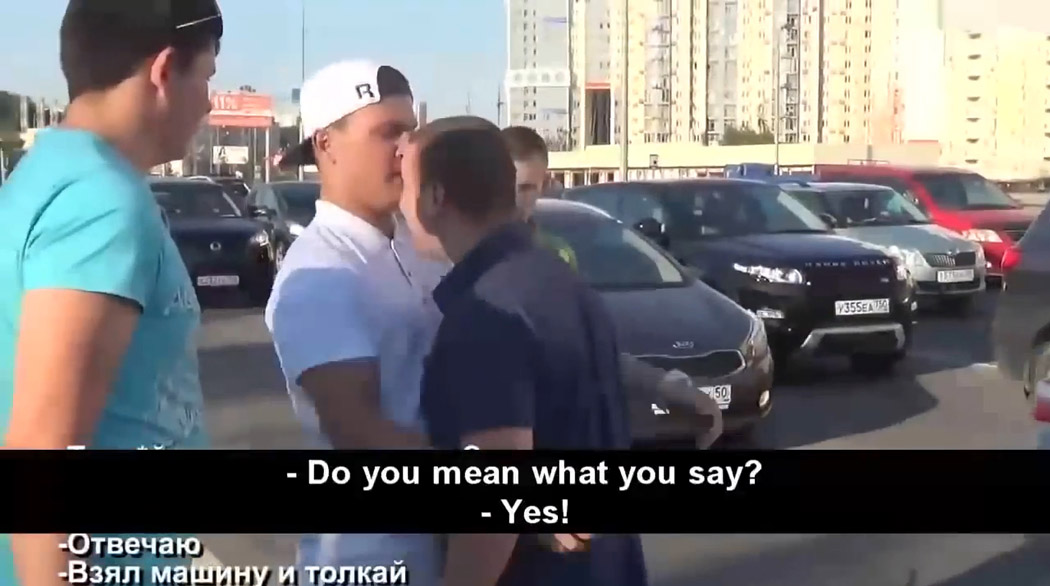
Physical conflict was extremely rare, even in these emotionally charged situations. However, one cue that was readily linked to physical violence was the “head shove” where one person literally shoves the head of their opponent with their own head.
Those who resorted to physical violence used fewer aggressive words and verbal threats and bluff displays, approached the aggressed with purpose, and encroached on their personal space quickly. In the few instances where physical confrontation occurred, the aggressor shoved his opponent’s head with his own head. I refer to this as a “head shove” and near as I can tell, this is the first time it has been identified. You can see this at around 4:16. Here’s another example. In the two instances where the “head shove” occurred, it resulted in full out physical aggression.
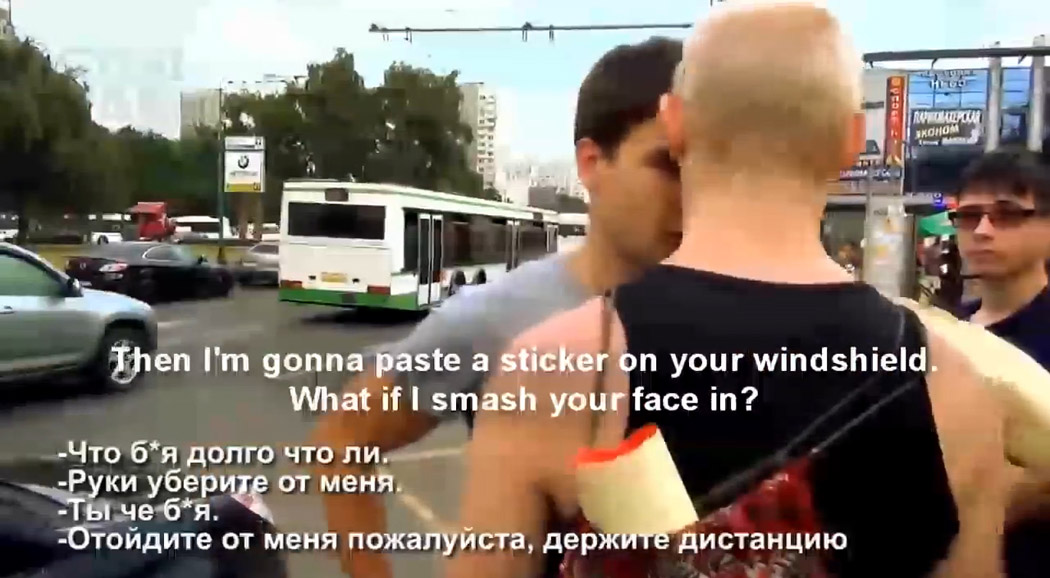
Another “head shove” which predicted physical conflict.
“Head shoving” is an interesting signal because it occurs so rarely in every day life, yet I observed it in at least two incidences where conflict was resolved by physical force. It certainly warrants further examination in a more empirical setting.
The next signal which preceded physical confrontation occurred when the aggressor made light contact with the aggressed head with their hand or shoved their head (see same video at 3:56). In one case it was as if the aggressor was nuzzling the aggressed or pulling them into a hug. See another example here. This was presumably to see if the aggressed would submit and back off and away from them thus ceding to them or conversely (and what I believe), it might be a tactic to instigate the first blow and commence physical engagement – a sort of nonverbal “fight protocol.”
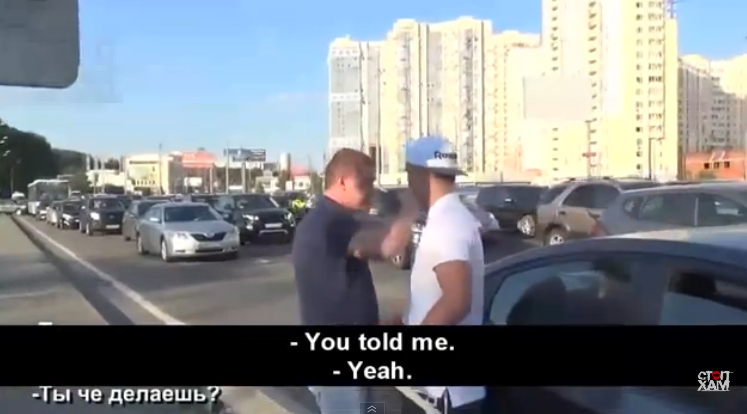
In the interaction the aggressor is not actually punching the aggressed. Rather he is lightly shoving he hand against his head. In the sequence he makes other rather awkward/taunting motions toward his opponents head.
Perhaps touching the head in this manner is a trigger which elicits the aggressed to engage and issue the first blow, thus signaling the beginning of physical conflict. As we know, metaphor is often grounded in the physical world so perhaps the “head shove” cue stems from aggressors “going head-to-head” or “head-to-head combat.” It may be why we have fighters take the stance during pre-fight promotions. You can see three examples of that here:
https://www.youtube.com/watch?v=v0zaOktqxyw
https://www.youtube.com/watch?v=yfgVix_XCjw
https://www.youtube.com/watch?v=0XblAzrrLtQ
It should be noted that in the instances observed, the “head shove” occurred between an aggressor who was willing to fight, and another person who was not (a passive non-violent actor). If it was the case that both agents were “fighters” by nature, it is quite probably that a lesser territorial encroachment or one of the many bluff displays would have been a sufficient trigger to engage or solicit physical conflict. It’s also noteworthy that the aggressed, in this case, operated in a group. This would have dramatically de-incentivized loan aggressors from physical action.
Drawing Conclusions About Physical Confrontation
To draw a few preliminary conclusion, it seems that physical confrontation, when it was possible to telegraph its occurrence, was predicted by two main nonverbal cues including the “head shove” or hand-to-head touching. Next was calm, purposeful striding into the personal space of the aggressed with limited verbal threat. As far as this latter cue, however, it provided little if any notice at all that aggression was immanent since it was quite abrupt and short in duration.
When physical conflict was used to resolve the incident, it usually did not involve a protracted threat display or negotiation period. Thus, it seems as though there are two main ways people resolve conflict, one is to threaten violence, and the other is to actually use it.
I would also like to conclude by saying that for an altercation to resort to physical violence at least one person must make the progressive leap from verbal and non-verbal threat displays to actual physical touching and territorial intrusion. However, sometimes this isn’t even enough to draw blows. Engaging in a physical altercation is a mutual decision but only requires the engagement of one person. That is, either party can escalate the interaction. As mentioned, two main cues predicted physical engagement, the “head shove” and head touching. These may be a way people take part in nonverbal “fight protocol” and engage the passive and unwilling aggressed into full blown physical conflict.
Analysis of interactions with more willing fighters or those prone to physical aggression may find that simple bluff displays are sufficient to engage in a physical fight. In other cases, fighting may simply arise from a surprise attack where no warning at all is issued (I found this to be the so in a good number of incidences).
It is of no doubt that recognizing the signals that foreshadow physical aggression will help reduce the level of risk for police officers and suspects alike, as well as individuals interested in reducing personal risk overall, so this is a worthy endeavor.
More research is necessary and I would be glad to examine other situations including actual police/citizen interaction as well as citizen/citizen interaction to see if these nonverbal displays have a universal origin and therefore a more practical application.
Videos of Note
1) “Stop a Douchebag” Ep.22 – Oh, Marat!
– Exhibits much of the stereotypical bluff-type aggressive nonverbal behaviour
2) “Stop a Douchebag” Ep.18 – Don’t Mess With the Hulk
– At start man submits (notice his typical submissive body language)
– Woman tries to be coy (coy glances)
– Another man submits (notice lack of eye contact)
3) “Stop a Douchebag” Ep.14 – Bully Vs. Wrestler 2
– Besides pulling out a weapon and threatening but not using it earlier, he gives no threatening nonverbal warning that he’s about to physically attack (maybe the shaved head and camo pants is a warning?)
– Cues seen, charging, a short skip and head down.
– He by-passes all the nonverbal threat displays (red alert!)
4) “Lion Versus” Ep.06 – Moscow vs. Saint Petersburg
– No warning, male companion to women strikes out of nowhere (they are asking her to smoke in the designated smoking area).
5) “Stop a Douchebag” Ep.13 – Bully Vs. Wrestler
– His arms are swaying calmly. There is no threat body language. He moves right into his personal space.
– This is as close as you get to a warning. He encroaches, pushes his head right into the other guy, puts his hands on the other guy and repeatedly invades his personal space and almost looks for him to strike as an indication of the permission to fight (by the way, the motorist has pretended to run out of gas by having to circle back – i.e. he was looking for or asking for a fight).
6) “Stop a Douchebag” Ep.6 – D-bag With a Gun and a Bat
– This is a woman exhibiting the same pattern of just walking up and physically assaulting.
– Most women would casually swat or shove the sticker back in the men’s faces, but this women repeatedly kicked and clawed.
7) “Stop a Douchebag” Ep.4 – MMA Fighter
– What clues does this guy give off that he might use physical force?
– He’s calm, uses very little gesticulation, struts right into people’s personal space, pushes his head into the other person.
– Perhaps his boxing shirt is a clue.
8) “Lion Versus” Ep.1 – Two Fights
– This is another good example of encroaching and also the light head butt or head-to-head occurring before coming to blows.
– He also goes hand to head a few times.
Spot the head shove early in this encounter.
Other Videos Showing Typical Aggressive and Anger Related Body Language
9) Dallas Airport Fight
– Blows come out of nowhere?
10) Clues that Aggression is Immanent (pushes into him, tries to “head shove” then surprise attack)
– Removing clothing may also be a key clue that aggression is immanent
11) The ritual we call “going head-to-head”
a) https://www.youtube.com/watch?v=KtSFUQkaoY8
b) https://www.youtube.com/watch?v=v0zaOktqxyw
c) https://www.youtube.com/watch?v=yfgVix_XCjw
d) https://www.youtube.com/watch?v=0XblAzrrLtQ
Resources
Arsenio, W. F., Cooperman, S., & Lover, A. Affective Predictors of Preschooler’s Aggression and Peer Acceptance: Direct and Indirect Effects. Developmental Psychology. 2000. 36: 438-448.
Hubbard, J. A. Emotion expression processes in children’s peer interaction: The role of Peer Rejection, Aggression, and Gender. Child Development. 2001. 72: 1426-1438.
Hubbard, J. A., Smithmyer, C. M., Ramsden, S. R., Parker, E. H., Flanagan, K. D., Dearing, K. F., Relyea, N., & Simons, R. F. Observational, Physiological, and Self-Reported Measures of Children’s Anger: Relations to Reactive Versus Proactive Aggression. Child Development. 2002. 73, 1101-1118.
1 comment for “Do You Wanna Fight? – How To Read Anger and Aggressive Body Language (or How to Avoid a Physical Confrontation) – A Case Study On the ‘Stop a Douchebag’ Movement”