Body Language of Tense Face
 Cue: Tense Face.
Synonym(s): Stressed Face, Uneasy Face.
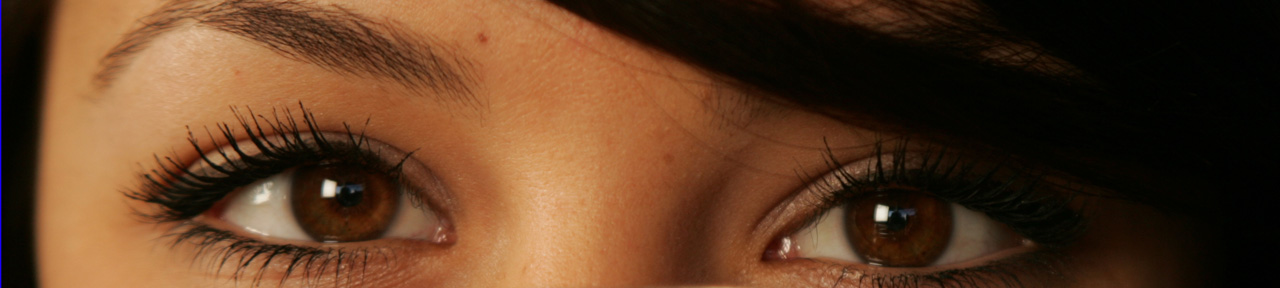
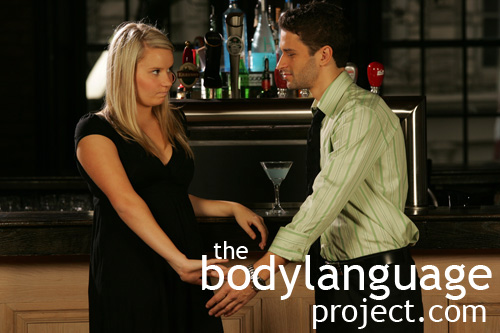
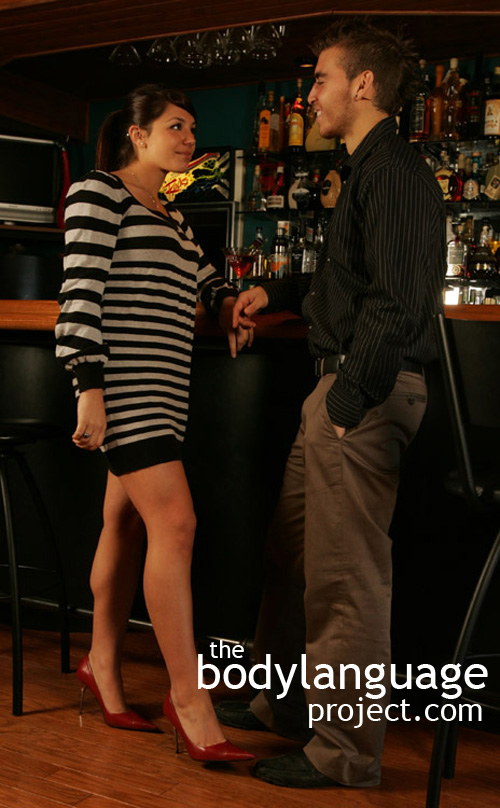
Description: A face that is compressed or contorted by various muscles such as the one between the eyebrows. This muscle will force the eyebrows together creating a wrinkle. The eyes are squinted and the lips are compressed or pursed.
In One Sentence: A tense face indicates stress, worry, and discomfort.
How To Use it: Use a tense face to show that you are not content in the situation. You can signal others that you are in emotional or physical pain by flexing muscles in the face. You may show a tense face when receiving negative news, when presented an unfavourable offer such as in negotiation, when seeing something visually distressing, and so forth. In other words, use a tense face when you want to show others your discomfort and dislike.
Context: General.
Verbal Translation: “I’m full of stress or worry and am uncomfortable, I hold some degree of negative thoughts which is shown through various muscular contractions in my face.”
Variant: See Eyebrows Knit or Oblique Eyebrows Of Grief, Relaxed Face.
Cue In Action: As the details of the contract became clear, his face began to show signs of disagreement. When the split was offered at 40/60, his eyes squinted. When there was an additional royalty added, his lips compressed. The deal breaker came when he stated the he would be completely bought out of the company at the five year mark. This caused his forehead to furrowed in anger. His body language clearly signaled that had enough with the contract and he wouldn’t sign it.
Meaning and/or Motivation: A tense face is one that shows discomfort and discomfort is a cue that delineates a lack of honesty and that the body is concerned with negative thoughts.
Bodies show additional discomfort through an increased heart rate, breath rate, sweating, a change in normal colour in the face or neck, trembling or shaking in the hands lips, or elsewhere, compressing the lips, fidgeting, drumming the fingers and other repetitive behaviours. Voices often crack when under stress, mouths might dry up producing noticeable swallowing, “hard swallows”, or frequent throat clearing.
Cue Cluster: The eyes are compressed, tense and focused, the arms and legs will cross, the lips purse and licked frequently, people will tighten their bodies up, they might stop speaking, legs and toes may face away from the negative stimuli and toward the door, breathing might be shallow or exaggerated as if ready for action, hands might be rubbed against one other or against the thighs, the face might be touched and the skin pinched, plucked or scratched.
Body Language Category: Confused body language, Closed body language, Closed facial gestures, Dislike (nonverbal), Disapproval cues, Emotional body language, Evaluative body language, Negative body language, Stressful body language, Worry body language.
Resources:
Arsenio, W. F., Cooperman, S., & Lover, A. Affective Predictors of Preschooler’s Aggression and Peer Acceptance: Direct and Indirect Effects. Developmental Psychology. 2000. 36: 438-448.
Aviezer H, Trope Y, Todorov A. Body cues, not facial expressions, discriminate between intense positive and negative emotions. Science 2012;338:1225–9.
Aviezer, Hillel; Ran R. Hassin; Jennifer Ryan; Cheryl Grady; Josh Susskind; Adam Anderson; Morris Moscovitch and Shlomo Bentin. Angry, Disgusted, or Afraid? Studies on the Malleability of Emotion Perception. Psychological Science. 2008. 19(7): 724-732.
Emotions Are Read In Context, Study
App, Betsy; Catherine L. Reed and Daniel N. McIntosh. Relative Contributions Of Face And Body Configurations: Perceiving Emotional State And Motion Intention. Cognition and Emotion. 2012. 26(4): 690-698.
Facial Expressions Versus Bodily Expressions in Nonverbal Communication
Aaron, Sell; Cosmides, Leda and Tooby, John. The Human Anger Face Evolved to Enhance Cues of Strength. Evolution and Human Behavior. 2014. 35(5): 425-429.
The Universal Anger Face
Ben-Zeev, Avi; Tara C. Dennehy; Rachel Sackman; Andres Olide and Christopher C. Berger. Flirting With Threat: Social Identity and the Perils of the Female Communality Prescription. Journal of Experimental Social Psychology. 2011. 47: 1308-1311.
Flirting With Danger – Women Flirt To Avoid Conflict
Bard, K. A. (2003). Development of emotional expressions in chimpanzees (Pan troglodytes). In P. Ekman, J. Campos, R. J. Davidson & F. B. M. De Waal (Eds.), Emotions inside out: 130 years after Darwin’s The Expression of the Emotions in Man and Animals (Vol. 1000, pp. 88-90). New York: Annals of the New York Academy of Sciences.
Baron, R. M., & Kenny, D. A. (1986). The moderator-mediator variable distinction in social psychological research: Conceptual, strategic, and statistical considerations. Journal of Personality and Social Psychology, 51(6), 1173-1882.
Biehl, M., Matsumoto, D., Ekman, P., Hearn, V., Heider, K., Kudoh, T., et al. (1997). Matsumoto and Ekman’s Japanese and Caucasian Facial Expressions of Emotion (JACFEE): Reliability Data and Cross-National Differences. Journal of Nonverbal Behavior, 21, 3-21.
Burton, Keith W. Habitual emotion regulation and the facial grimace. Psychological reports. 2011. 109(2): 521-32.
Burton, K. W., Hargrave, K., Myers, S., Warren, A., Wolsfeld, S., Tompkins, D., Qualls, M., & Reminger, S. (2008) Habitual emotion regulation and increased zygomaticus major activity evoked by negative images (or “grimacing”). Psychophysiology,
45, S118.
Carroll E. 1994. Innate and universal facial expressions: Evidence from developmental and cross-cultural research Izard, Psychological Bulletin. 115(2): 288-299.
de Waal, F. B. M. (2003). Darwin’s legacy and the study of primate visual communication. In P. Ekman, J. Campos, R. J. Davidson & F. B. M. De Waal (Eds.), Emotions inside out: 130 years after Darwin’s The Expression of Emotion in Man and Animals (pp. 7-31). New York: New York Academy of Sciences.
Daniele Marzoli, Mariagrazia Custodero, Alessandra Pagliara, and Luca Tommasi. Sun-Induced Frowning Fosters Aggressive Feelings. Cognition And Emotion. 2013; 27 (8): 1513-1521.
The Sun Can Produce Feelings Of Anger And Aggression – It Makes Us Frown
Daniel H. Lee, Reza Mirza, John G. Flanagan and Adam K. Anderson. Optical Origins of Opposing Facial Expression Actions. Psychological Science published online 24 January 2014 DOI: 10.1177/0956797613514451
Eyes And Facial Expressions May Be Biologically Controlled – Serve A Real Non-Emotional Purpose, Says Research.
Ekman, P. (1994). Strong evidence for universals in facial expressions: A reply to Russell’s mistaken critique. Psychological Bulletin, 115, 268-287.
Ekman, P., Friesen, W. V., O’Sullivan, M., Chan, A., Diacoyanni-Tarlatzis, I., Heider, K., et al. (1987). Universals and cultural differences in the judgments of facial expressions of emotion. Journal of Personality & Social Psychology, 53(4), 712-717.
Ekman, P., Levenson, R. W., & Friesen, W. V. (1983). Autonomic nervous system activity distinguishes among emotions. Science, 221(4616), 1208-1210.
Ekman, P., O’Sullivan, M., & Matsumoto, D. (1991a). Confusions about context in the judgment of facial expression: A reply to “The contempt expression and the relativity thesis.”. Motivation & Emotion, 15(2), 169-176.
Ekman, P., O’Sullivan, M., & Matsumoto, D. (1991b). Contradictions in the study of contempt: What’s it all about? Reply to Russell. Motivation & Emotion, 15(4), 293-296.
Elfenbein, H. A., & Ambady, N. (2002). On the universality and cultural specificity of emotion recognition: A meta-analysis. Psychological Bulletin, 128(2), 205-235.
Ekman, Paul. 1986. A new pan-cultural facial expression of emotion. Source: Motivation and Emotion Ekman. 10(2): 159-168.
Ekman, Paul and Friesen, W. V. 1987. Universals and cultural differences in the judgments of facial expressions of emotion. Journal of Personality and Social Psychology. 53(4): 712-717.
Ekman, Paul; Friesen, Wallace V. 1971. Constants across cultures in the face and emotion. Journal of Personality and Social Psychology. 17(2): 124-129.
Ekman, Paul. 1972. Universals and cultural differences in facial expressions of emotion. In J. Cole (Ed.), Nebraska Symposium on Motivation, 1971. 19: 207-282. Lincoln: University of Nebraska Press.
Fulcher, J. S. “Voluntary” facial expression in blind and seeing children. Archives of Psychology, 1942. 38: 272.
Friesen, W. V. 1972. Cultural differences in facial expressions in a social situation: An experimental test of the concept of display rules. Unpublished doctoral dissertation, University of California, San Francisco.
Grezes, Julie; Le´onor Philip; Michele Chadwick; Guillaume Dezecache; Robert Soussignan and Laurence Conty. Self-Relevance Appraisal Influences Facial Reactions to Emotional Body Expressions. PLoS ONE. 2013. 8(2): e55885. doi:10.1371/journal.pone.0055885
Your Face Reacts To Body Anger – How Our Brains Are Wired To Process Emotional Body Language
Huang, Ding-Hau; Shih-Wei Chou; Yi-Lang Chen and Wen-Ko Chiou. Frowning and Jaw Clenching Muscle Activity Reflects the Perception of Effort During Incremental Workload Cycling. Journal of Sports Science and Medicine. 2014. 13: 921-928.
Physical Strain Leads To Jaw Clenching And Frowning Body Language
Hatz, Jessica L. and Martin J. Bourgeois. Anger as a Cue to Truthfulness. Journal of Experimental Social Psychology. 2010. 46: 680-683.
Anger As A Nonverbal Cue To Truth Telling
Hareli, Shlomo; Noga Shomrat and Ursula Hess. Emotional Versus Neutral Expressions and Perceptions of Social Dominance and Submissiveness. Emotion. 2009 9(3): 378-384. DOI: 10.1037/a0015958
Dominance Expression Conveyed By Different Facial Expressions In Men And Women
Johnson, Richard R. and Jasmine L. Aaron. Adults’ Beliefs Regarding Nonverbal Cues Predictive of Violence. Criminal Justice and Behavior. 2013. 40 (8): 881-894. DOI: 10.1177/0093854813475347.
Do You Wanna Fight? – Nonverbal Cues Believed To Indicate Violence
Kret, Mariska Esther and Beatrice de Gelder. Social Context Influences Recognition of Bodily Expressions. Exp Brain Res. 2010. 203:169-180. DOI 10.1007/s00221-010-2220-8
Context Matters When Judging Body Language
Kret, M. E. and B. de Gelder. When a Smile Becomes a Fist: The Perception of Facial and Bodily Expressions of Emotion in Violent Offenders. Exp Brain Res. 2013. 228: 399-410. DOI 10.1007/s00221-013-3557-6.
Reading Bodily Postures And Facial Expressions Incorrectly Can Be Disastrous – Just Ask Violent Offenders
Levenson, R. W., Ekman, P., & Friesen, W. V. (1990). Voluntary facial action generates emotion-specific autonomic nervous system activity. Psychophysiology, 27(4), 363-384.
Levenson, R. W., Ekman, P., Heider, K., & Friesen, W. V. (1992). Emotion and autonomic nervous system activity in the Minangkabau of West Sumatra. Journal of Personality & Social Psychology, 62(6), 972-988.
Lang, P. J., Greenwald, M. K., Bradley, M. M., & Hamm, A. O. (1993) Looking at pictures: affective, facial, visceral, and behavioral reactions. Psychophysiology, 30,
261-273.
Larsen, J. T., Norris, C. J., & Cacioppo, J. T. (2003) Effects of positive affect and negative affect on electromyographic activity over zygomaticus major and corrugator supercilii. Psychophysiology, 40, 776-785.
Mori, K., & Mori, H. (2010) Examination of the passive facial feedback hypothesis using an implicit measure: with a furrowed brow, neutral objects with pleasant primes look less appealing. Perceptual and Motor Skills, 111, 785-789.
Matsumoto, D. (1989). Cultural influences on the perception of emotion. Journal of Cross-Cultural Psychology, 20(1), 92-105.
Matsumoto, D. (1992). American-Japanese cultural differences in the recognition of universal facial expressions. Journal of Cross-Cultural Psychology, 23(1), 72-84.
Matsumoto, D. (2001). Culture and Emotion. In D. Matsumoto (Ed.), The Handbook of
Culture and Psychology (pp. 171-194). New York: Oxford University Press.
Matsumoto, D., & Ekman, P. (1989). American-Japanese cultural differences in intensity ratings of facial expressions of emotion. Motivation & Emotion, 13(2), 143-157.
Matsumoto, D., Keltner, D., Shiota, M. N., Frank, M. G., & O’Sullivan, M. (2008). What’s in a face? Facial expressions as signals of discrete emotions. In M. Lewis, J. M.
Haviland & L. Feldman Barrett (Eds.), Handbook of emotions (pp. 211-234). New York: Guilford Press.
Matsumoto, D., & Willingham, B. (2009). Spontaneous Facial Expressions of Emotion of Congenitally and Non-Congenitally Blind Individuals. Journal of Personality and Social Psychology, 96(1), 1-10.
Mesquita, B., & Frijda, N. H. (1992). Cultural variations in emotions: A review. Psychological Bulletin, 112, 197-204.
Marzoli, Daniele; Mariagrazia Custodero; Alessandra Pagliara and Luca Tommasi. Sun-Induced Frowning Fosters Aggressive Feelings. Cognition And Emotion. 2013; 27 (8): 1513-1521.
How To Avoid Anger On Sunny Days
Mondloch, Catherine J.; Nicole L. Nelson and Matthew Horner. Asymmetries of Influence: Differential Effects of Body Postures on Perceptions of Emotional Facial Expressions. PLOS one. September 2013. 8(9): e73605.
Facial Expressions Versus Bodily Expressions In Nonverbal Communication
McClure, Erin B 2000. A meta-analytic review of sex differences in facial expression processing and their development in infants, children, and adolescents
Psychological Bulletin. 126(3): 424-453.
Mead, M. 1975. Review of “Darwin and facial expression.” Journal of Communication, 25: 209-213.
Nao, Misako Sawada and Motonobu Ishii. Development of the Movements Impressions Emotions Model: Evaluation of Movements and Impressions Related to the Perception of Emotions in Dance. Journal of Nonverbal Behavior. 2013. 37:107-121.
DOI 10.1007/s10919-013-0148-y
How To Convey Emotion Nonverbally Through Dance, A Study
Nelson, Nicole L and James A. Russell. Children’s Understanding Of Nonverbal Expressions Of Pride. Journal of Experimental Child Psychology. 2012; 111: 379-385.
Can Children Read Pride Body Language?
Navarro, Joe. 2008. What Every BODY is Saying: An Ex-FBI Agent’s Guide to Speed-Reading People. William Morrow Paperbacks.
Peleg, G., Katzir, G., Peleg, O., Kamara, M., Brodsky, L., Hel-Or, H., et al. (2006). Heriditary family signature of facial expression. Proceedings from the National Academy of Sciences, 103(43), 15921-15926.
Russell, James A. 1995. Facial Expressions of Emotion: What Lies Beyond Minimal Universality? Psychological bulletin. 118(3): 379-391.
Russell, James A. 1994. Is There Universal Recognition of Emotion From Facial Expression? A Review of the Cross-Cultural Studies. Psychological Bulletin. 115(1): 102-141.
Russell, James A.; Naoto Suzuki and Noriko Ishida. 1993. Canadian, Greek, and Japanese freely produced emotion labels for facial expressions. Motivation and Emotion. 17(4): 337 -351
Reed, Lawrence, Ian; Peter DeScioli and Steven A. Pinker. The Commitment Function of Angry Facial Expressions. Psychological Science. 2014 DOI: 10.1177/0956797614531027
Anger Facial Expression Gets People To Do What You Want
Susskind, Joshua M and Adam K Anderson. Facial Expression Form and Function. Communicative Integrative Biology. 2008. 1(2): 148–149. PMCID: PMC2686004
How Did Emotional Facial Expressions Evolve?
Sell, A., Cosmides, L. and Tooby, J., The Human Anger Face Evolved to Enhance Cues of Strength. Evolution and Human Behavior. 2014, doi: 10.1016/j.evolhumbehav.2014.05.008
Human Anger Face Signal Of Strength
Sinke, C.B, Sorger, B, Goebel, R, and de Gelder, B. Tease or Threat? Judging Social Interactions From Bodily Expressions. Neuroimage. A Journal of Brain Function. 2009. 49:1717-1727. doi: 10.1016/j.neuroimage.
Friend or Foe? Let Body Language Decide
Stienen, Bernard M. C.; Akihiro Tanaka and Beatrice de Gelder. Emotional Voice and Emotional Body Postures Influence Each Other Independently of Visual Awareness. PLoS ONE. 2011. 6(10): e25517. doi:10.1371/journal.pone.0025517.
Body Language Is Read Quickly And Subconsciously, Study
Schubert, Thomas W. The Power In Your Hand: Gender Differences In Bodily Feedback
From Making a Fist. Society for Personality and Social Psychology. 2004. 30(6): 757-769. DOI: 10.1177/0146167204263780
Men View Power Body Language Different Than Women – Bodily Feedback Of Making A Fist
Sell, A., Tooby, J., and Cosmides, L. Formidability and the Logic of Human Anger. Proceedings of the National Academy of Science. 2009. 106(35), 15073-78.
Teixeira Fiquer, Juliana; Paulo Sérgio Boggio and Clarice Gorenstein. Talking Bodies: Nonverbal Behavior in the Assessment of Depression Severity. Journal of Affective Disorders. 2013. 150: 1114-1119.
Using Nonverbal Behaviour To Assess Depression Severity
Thompson, Erin H. and James A. Hampton. The Effect of Relationship Status on Communicating Emotions Through Touch,. Cognition and Emotion. 2011. 25(2): 295-306. DOI: 10.1080/02699931.2010.492957.
Using Touch To Convey Emotion
Wilkowski, Benjamin M. and Brian P. Meier. Bring It On: Angry Facial Expressions Potentiate Approach-Motivated Motor Behavior. 2010. Journal of Personality and Social Psychology. 98(2): 201-210.
Anger Facial Expression Elicits Approach Not Avoidance, Study
Zieber, Nicole; Ashley Kangas; Alyson Hock; and Ramesh S. Bhatt. Infants’ Perception of Emotion From Body Movements. Child Development. 2014. 85(2): 675-684.
Be Careful! Infants Perceptive At Reading Body Language
Zhao, Ke; Wen-Jing Yan; Yu-Hsin Chen; Xi-Nian Zuo and Xiaolan Fu. Amygdala Volume Predicts Inter-Individual Differences in Fearful Face Recognition. PLOS one. August 2013. (8): 8: e74096. doi:10.1371/journal.pone.0074096.g001
Fear – It’s In Your Amygdala
Zeinstra, Gertrude G.; M.A. Koelen; D. Colindres ; F.J. Kok; C de Graaf. Facial Expressions in School-Aged Children are a Good Indicator of ‘Dislikes’, but not of ‘Likes.’ Food Quality and Preference. 2009. 20: 620-624.
How To Read Kid’s Dislike For Food – Facial Expressions Accurate For Detecting Dislike But Not Like In Children