Cellphones, text messaging, crack and glazing over: the truth about ‘multitasking’ and the nonverbal effects on real to life people
Christopher Philip
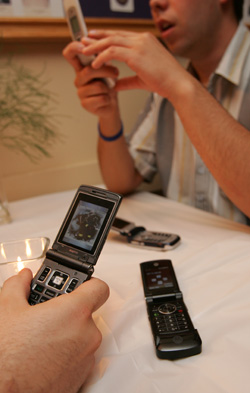
 I’m writing this essay after just having returned from a ‘social gathering’ with ‘friends’. I’m priming you with this warning because this important detail might be reflected in the passion with which the following words have been written, so please excuse me in advance. The quotation marks in ‘social gathering’ are to make a strong point. The ones in ‘friends’ is motivated more so by tongue-in-cheek. Social was the intent of the meeting and that included a few drinks, video games and unfortunately a blackberry and a cell phone. You might be familiar with the video game, it involved instruments and a rock theme. Most notable about the evening wasn’t the fun and drinks though, it was the use of personal devices, text messaging, breaks for phone calls and two new girlfriends. That’s right, two of our guests had new girlfriends and the PDA served as the social brakes (read breaks) in the event. Cell phones are the most intense digital leash, perhaps of our times, so shame on you women and the men who succumb to their powers.
We might think that technology improves our lives, frees us from desks and connects us to other people, but text messaging and cell phones is definitely one creation that in actual fact, destroys it, especially when used improperly. Little by little, it alienates real to life bonds and creates fury in others who have actually taken time out of their schedule to show their physical presence. Think; it takes no time to text from wherever you are, but if someone physically shrinks the distance to meet you, it’s much more significant, meaningful and you shouldn’t take this for granted.
While this essay might sound a little like a rant about the evening, proper use of these devices is a real social problem. At the core root is an obsession, but since my main focus and expertise deals with regards to nonverbal language and human nature, I deal with these most.
At the helm of ‘everything’ is the nature of humans. As computers became more efficient with processing information, we fooled ourselves into thinking that our brains were capable of performing similar tasks as computers and in similar ways. We thought we could ‘multitask’ just like our machines could. With the help of a computer we can write a letter while our computer renders a video. Hey, that’s two things at once, we realized! The powers have finally permitted us to us our brains to its fullest potential, or so we thought. Our computers can play music, or even play a video in combination (a music video!). Add to this any task. How about holding a web page open (I say nothing about actually surfing the page, which is entirely different), or even multiple pages? Indeed our computers can do all of these things, but how many of these task can we focus on? The answer, unfortunately for personal device users is only one. That’s right, one! Of the above listed, we can do either one of surf a website, write a text document, edit a video or listen to music. We think listening to music is passive and it can be, but we couldn’t actively listen to music, learn the musical notes, the lyrics or offer a critic without ceasing all other activity. Our computers can process multiple things, but only the ones we are actively focused on get any actual attention from us, the rest simply sit stagnant unchanged on our computers. Now imagine what effect our multitasking has on real people. While we text, do our real life inactions stagnate and remain unchanged or do we get more things done? Perhaps we can build multiple relationships all at once and quicker, faster, stronger and better?
If you watch someone work on multiple projects, there is a clear start/stop phase when someone ceases advancing on one job, in order to advance on another. This idea is pervasive and happens everywhere. It’s so popular it has a name. It’s called switch-tasking. You can’t write a text document while talking on the phone. For those of you with doubt, give it a try. Call a friend and converse with them in a free flowing manner while texting another. I doubt the conversation would last long at all and our minds would struggle to come up with words to both type and speak. Incidentally females are better at multitasking, but this is only a side issue for our purpose and let us not forget the ability to put some tasks into autopilot like driving for example.
Our minds aren’t even equipped to passively watch the television while speaking on the phone since neither process allows us to force one task into the subconscious. Communicating with other humans is a complicated affair and requires full attention. If we think we can do both, in actual fact, we do neither, or perform each task poorly. This reminds me of the futon, which tried to be a couch and a bed and did neither well. You can probably think of other tools that perform two task poorly instead of one task well. Unfortunately, our minds are simply not built to do more than one thing at once and what ends up suffering are our social contacts. While we can talk on the phone if it’s our active intent, when we try to focus on the television, we see what I like to call ‘glazing over’. We’ve seen every cell phone textor glaze over on us doing this very thing. My point is that device users need to understand that televisions and other inanimate objects won’t feel bad if you ignore them, but real people will.
Now let’s take the example of the cell phone and blackberry where it’s necessary to perform two tasks at once. One is to show a presence with those around you and the other is to text to someone who isn’t present. Who suffers and why?
As we begin our text message, those whom are actually present quickly notice this ‘glazing over effect’. The person temporarily and effectively becomes a non-person. Eye contact stops, they lose the ability to respond, listen and even feel. Their minds have left us in order to deal with another, and we sense this. When they complete there message, they snap back into existence to the people around them and they attempt to catch up from their sudden departure. We usually then hear them start up with questions ‘so what was it we were talking about’ or ‘sorry about that I was just talking to so and so’. It is these cues that indicate to us our true inability to multitask.
Other times, the conversation stagnates or dies altogether as those around them are stunned by the ignorance of the vacancy presented by their company. Imagine if I were to suddenly place my head face down on the table, close my eyes and block my ears. Would you think I was nuts? How would you tolerate my ignoring you? What if I did this every ten minutes for over four hours? At which point would you give up our friendship? We do this every time we text on a cell phone regardless of whether or not a conversation is currently in progress. Even checking for messages has the same effect. It’s not only the lack of nonverbal messaging that suffers when someone texts, or places or answers a phone call, it is the importance that someone subconsciously attempts to command by forcing others to ‘wait’ for them to return from their glaze. The command of space and time is a trait held by dominant individuals. While a boss can stop a conversation dead to take a phone call, an employee could/should not. He understands that the boss’ time is important and he shows this by ignoring outside distractions. What do our friends tell us when they make us hold as they answer their phone? It tells us that their time and needs are more important then ours and that it is reasonable that we should wait for them to return.
What effect does it have to the people around you when you glaze over suddenly? It’s extremely off-putting as it sends a very strong nonverbal message that their task is more important than the connectivity with the people around them. Regardless of what cell phone users think, they can’t text and be present and active with those in their immediacy at the same time. To their company, they are left dealing with an evolutionary brain hardwiring that tells them something isn’t right. Naturally, we code this as being less important. Fortunate for us, our brains know that this person is glazing over to speak to someone else, as we might otherwise think that something is truly wrong with them and call for immediate medical attention in order to assist them in their non-responsiveness. However, our conscious minds despite knowing this, still codes their signals as an insult.
So one might ask, what are the risks of ignoring a text or phone call? What effect does someone have when a text or phone call is ignored or avoided? Wouldn’t this extend the dismissal to another person of equal value? To hardcore users, the answer might surprise them. In fact, the answer is very little, since there are no nonverbal messages being sent to someone that isn’t physically present. True, they might wonder why you haven’t answered or what you are doing, but they’ll likely come to the conclusion that you are away from your phone, the battery is dead, or your cell phone was left at home (as you should). By the shear physical presence of being ignored while someone ‘multitasks’ leads us to code it as being shut-out. No such messages are sent if you leave your devices at home or even ignore an incoming message. Setting up a voice-mailbox or an out of the office auto-responder can also quickly fix this issue. No such primers can help social encounters. No matter what you say or do, your message will always be negatively understood by those you ignore.
The truth of the matter is that answering the phone or responding to a text has nothing at all to do with the person at the other end and their needs. Rather it is a reward born by the end user. There is a pay-off achieved from sending the message and this is the real reason text and phone calls are answered perpetually. The real question therefore, lies in the reason for this need and why these people aren’t happy enough to simply be around us. Why do they need to reach out beyond their immediate border to converse with other people? I have no answer for this, this is person specific, but this is the dialogue that happens inside our heads as we wait for them to shake their glaze.
The text and images are provided to you by www.BodyLanguageProject.com and are not to be reprinted or posted without prior written consent by the author. We take our copyright seriously. If you would like to use or reprint any material on this site, please contact us with your information including the website you intend to use it on, along with all pertinent details. In most cases, we will be more than happy to oblige!