
Odds are you’ll get a date
Martin Dobrovosky

If you’re not going on as many dates as you’d like, it’s because you’re simply not making the effort. At least that’s the suggestion behind the results of an experiment in the Journal of Psychology and Human Sexuality. In fact, it seems that the important lesson to be learned from the experiment, conducted by Russell Clark and Elaine Hatfield, is that you really don’t have to make much of an effort at all. Clark and Hatfield had college men, who varied in appearance from slightly unattractive to moderately attractive, stroll across the campus of Florida State University until they found an attractive woman they wanted to date. The men had to approach the woman and say: “I have been noticing you around campus and I find you to be very attractive.” Then they were to ask them one of three questions: (1) “Would you go out with me tonight?” (2) “Would you come over to my apartment tonight?” or (3) “Would you go to bed with me tonight?” First, we’re sorry to have to report that none of the women agreed to sex – responses ranged from “You’ve got to be kidding” to “What’s wrong with you, creep, leave me alone.” But, 6 percent agreed to the apartment invitation, while an encouraging 56 percent agreed to a date! So, if you choose to ask women to your apartment (which could very easily lead to sex if you play the right music and serve the right wine) then you only have to approach 17 women before you find one who’s up for it. Better yet, if you stick to the date question, you only have to ask 2 women before you find one who’ll go out with you. That’s every other woman! So, basically, just suck it up and ask.

Your Task: Run your own experiment – We did
Those were the results of one experiment. Well, we here at The Body Language Project, being the investigative journalistic types as we are (Geraldo Rivera has nothing on us!), thought it wise to see if we could duplicate the results. We headed to the local University early one afternoon and found a willing male subject in the on-campus bar. He agreed to ask ten women out on a date.
Here, more specifically, is what we had him do:
Male subject is instructed to approach average to attractive women and say:
“Hi, my name is ____________. I’ve noticed you around. I was wondering if you wanted to go out sometime.”
(Mentally note response)
“Would it be okay if I got your number so I could call and set something up?”
(Mentally note response)
We also wanted to get some information from those women who agreed to a date and had a separate form for this purpose. Ambitious, we know.
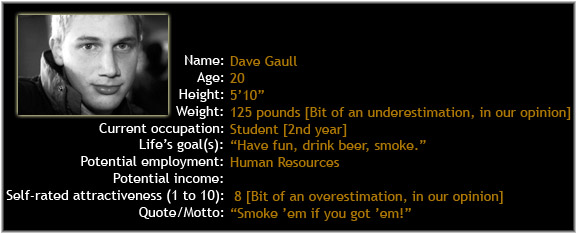
Our subject, Dave, asked three women out. The first two said they had boyfriends; the third, however, agreed to a date and gave Dave her number. We approached her with our other form to get her information – but, sadly, it wasn’t to be.
Our first female subject of the day shut down and wouldn’t give us any information. She bolted. (Trust us, we’re not that frightening.) We went back to our friend Dave to continue with the experiment, but – get this! – suddenly he wasn’t interested anymore. He too bolted. No matter, we thought, we have his phone number.
Well, at this point we could have scouted for another male subject who would, hopefully, stick around to complete the experiment. But it had been a long day. About a dozen potential male subjects refused to even take part in the experiment before we had a taker in Dave Gaull, and after Dave bailed on us, we had had enough. We felt despair for the male condition. Where were the balls, we wondered? And when we returned to Headquarters we realized that our experiment was potentially more instructive than if we had merely reached the same conclusions as were discovered in the original experiment by Clark and Hatfield.
As it was, our experiment revealed that 1 in 3 women would agree to a date, as opposed to the 1 in 2 as concluded by Clark and Hatfield. Still very good odds, but we really didn’t gather sufficient data to be able to say this conclusively. What was interesting was the fact that Dave bailed on us. Why exactly did he bail? We had our suspicions. We waited a few weeks then phoned him to find out.

First, we asked if he had phoned Tina. He said he had – two days after he got her number.
He obviously wasn’t concerned about appearing overeager. He said they talked for about 10 minutes, about school and other “small talk.”
Then we asked if he had discussed the experiment with her. “A little bit,” answered Dave. “That’s how I opened talking to her. I just said, ‘That’s why I wanted to talk to you, but if you still wanted to go out sometime, it’d be cool.’ She liked that. She was like ‘Yeah, that sounds cool’” but he hadn’t called her back yet. He planned on calling her after exams were over, in about a week to see if she’d be around during the summer.
So, he was clearly interested in pursuing something with her.
We asked him if she was offended that he approached her. “No, I don’t think so,” answered Dave. “After I talked to her she thought it was kind of funny, so I don’t think she was offended. She felt kinda weird and taken aback at first. She wasn’t really too sure how to react. Same as myself.”
No, I guess it doesn’t happen every day, that somebody hands you a set of balls.
Then we posed the big question: “Why did you choose to quit the experiment when you did?” Dave said: “I just felt a little uncomfortable, I felt awkward afterwards.”
“Yeah, why?” we asked.
“I just felt bad for the other person, the girl. After you guys went up and spoke to her, it felt ignorant a little bit, like that’s the only reason I went and talked to her was ’cause of that.” Well, Dave, that was the only reason you went up and talked to her. Why kid yourself?
Then we asked, “Where do you normally approach women?” Dave answered: “Usually at the bar. Or through friends. If we go out as a group and then some new girl’s there, I’ll talk to her, I’ll approach her then.” Dave’s single and searching. So how well’s that method working for him?
“How do you approach women at the bar?”
“Usually I just make myself stand out in the group of friends I’m with by being energetic, and if somebody notices me from there, I’ll go up and talk to them. That’s my role in the group.”
“What, Energy Man?”
“Yeah.”
Okay, Dave, whatever you say. Your cape is what color?
It was indeed as we had suspected. Dave had settled! And here’s who he settled on:

Remember this timeworn adage, men: “Nice guys finish last.” Sure, Dave got himself a date, but why did he stop at one? Remember this adage, too: “There are plenty of fish in the sea.” But most importantly, remember: “Variety is the spice of life.” Who knows how things are going to turn out with Dave and Tina? They might go well, but why didn’t Dave get more numbers while he could say he was doing it for science, for the good of men all over the world? Why wouldn’t he go on as many dates as possible before he wakes up in Vegas one day with a mother-of-a-hangover and a ball-and-chain around his ankle? He limited his options because he felt like he was being an asshole. Fact is, chicks dig assholes. They like to know you’re a go-getter, that you’ll stop at nothing to get what you want, even if it means stepping all over other people. It’s a sign of dominance and power. Women want to be swept away by a strong and powerful man, like how Kong handles his love interest, Fay Wray, in the 1933 classic King Kong. Well, maybe not quite like that…
Interesting to note is the fact that Dave didn’t put anything down for “Potential income.” Perhaps what he put down as his life’s goals says something: “Have fun, drink beer, smoke.” Well, Dave, be sure and contact us when you find someone willing to pay you for that.
The text and images are provided to you by www.BodyLanguageProject.com and are not to be reprinted or posted without prior written consent by the author. We take our copyright seriously. If you would like to use or reprint any material on this site, please contact us with your information including the website you intend to use it on, along with all pertinent details. In most cases, we will be more than happy to oblige!