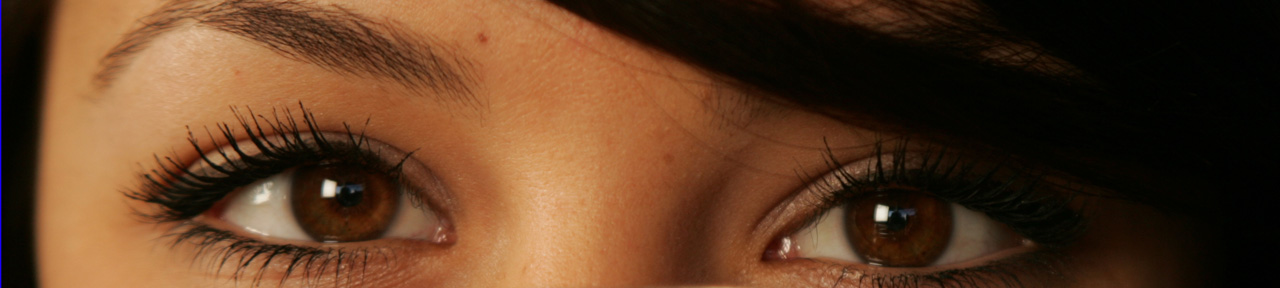
The Secrete Meaning Behind The Forehead Bow Body Language
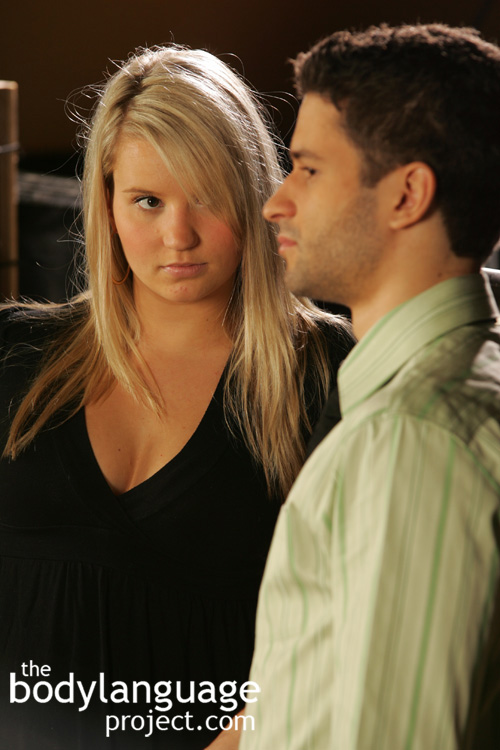 Cue: Forehead Bow (The)
Synonym(s): Come-Hither-Look, Downward Titled Head With Upcast Eyes, Looking Up Through The Forehead or The Looking-Up Cluster, Dipping The Head, Looking Up Cluster, Head Down With Eyes Up.
Description: The forehead bow is a posture done by artificially lowering the head, then looking up from under the eyebrows. It is often coupled with a titling of the head at forty-five degrees to the side and when done by women in a dating context, batting the eyelashes.
In One Sentence: The forehead bow signals the desire to submit in a coy fashion.
How To Use it: The forehead bow is effective when trying to play submissive in order to gain extra favours. Children can use this effectively to gain special permission, as can women whom are trying to manipulate men. In dating, eyes cast upward makes women look childlike and this can be arousing due to its submissive origin. Cast the eyes upward whenever you wish to gain special treatment and sympathy from others. However, the cue is far less effective when done by men as compared to women and children. In other words, the cue, requires a sympathetic audience to gain any traction.
Context: a) General b) Dating.
Verbal Translation: “I’m weak and vulnerable, pleading, just watch how I look coyly and submissively up at you from my lowered position with big eyes. I need your sympathy, care, attention, permission and assistance – can you please help and care for me.”
Variant: See Sideways Glance Over Raised Shoulder.
Cue In Action: a) His daughter wanted a new pony so she stuck out her lip, cast her eyes up pleading, batted her eyes and tilted her head to the side. How could a Dad refuse? b) She wanted a new BMW so she stuck out her lip, cast her eyes up pleading, batted her eyes and tilted her head to the side. How could her husband refuse?
Meaning and/or Motivation: The forehead bow is a posture done by artificially lowering the head, then looking up under the eyebrows in a “come hither” fashion. It has roots in the bow (greeting gesture) since it exposes the top of the head making it vulnerable to attack.
Just like neck and wrist displays, it indicates that trust is present. It also comes off as a childlike gesture primarily because children are shorter than adults and habitually peer up at them.
The posture is a reflection back into early childhood as children look up at us seeking our approval or permission. It is designed to appear vulnerable and pleading. As we age, we recall these gestures and go back to them when wish to revive juvenile submissive feelings and evoke protective feelings in others. The opposite to the forehead bow happens by tilting the head back and looking down one’s nose at someone, which is a judgment posture and is seen negatively.
The forehead bow is a submissive posture and can be done by anyone but is especially prevalent during courtship. When done by women towards men it is a “come hither” look and when done by children shows shyness and submission. Either way, it is a submissive posture aimed at gaining sympathy, protection and favours from others.
Cue Cluster: It is often coupled with a titling of the head at forty-five degrees to the side and when done by women, batting the eyes.
Body Language Category: Body size reduction, Courtship displays, Eye Language, Indicators of sexual interest (IOsI), Pseudo-infantile gestures, Power play, Remotivating, Submissive body language.
Resources:
Aviezer, Hillel, Yaacov Trope, Alexander Todorov. Science 338, 1225 (2012).
Body Cues, Not Facial Expressions, Discriminate Between Intense Positive and Negative Emotions. http://bodylanguageproject.com/articles/body-language-trumps-facial-expressions-read-my-body-not-my-lips/
Beall, Alec and Jessica L. Tracy. The Puzzling Attractiveness of Male Shame. Manuscript submitted to Evolutionary Psychology. www.epjournal.net – 2014. 12(x): 1-39
Blidstein, Gerald J. The Nonverbal Language of Prayer (review).Shofar: An Interdisciplinary Journal of Jewish Studies. 2007 25(2): 195-196.
Cunha, U. ; Leduc, M. ; Nayak, U.S.L. ; Isaacs, B.. Why do old people stoop?
Archives of Gerontology and Geriatrics. 1987 6(4): 363-369.
Costa, M., Menzani, M., & Ricci Bitti, P. E. Head canting in paintings: An historical study. Journal of Nonverbal Behavior. 2001. 25: 63–73.
Costa, M., & Ricci Bitti, P. E. Face-ism effect and head canting in one’s own and others’ photographs. European Psychologist. 2000. 5: 293–301.
Clark, A. Attracting Interest: Dynamic Displays of Proceptivity Increase the Attractiveness of Men and Women. Evolutionary Psychology. 2008., 6(4), 563-574.
Dunn, Cynthia Dickel. Speaking politely, kindly, and beautifully: ideologies of politeness in Japanese business etiquette training. Multilingua: Journal of Cross-Cultural and Interlanguage Communication. 2013. 32(2): 225(21).
Furley, Philip and Geoffrey Schweizer. “I’m Pretty Sure That We Will Win!”: The Influence of Score-Related Nonverbal Behavioral Changes on the Confidence in Winning a Basketball Game Journal of Sport & Exercise Psychology. 2013. 35:316-320. http://dx.doi.org/10.1123/jsep.2013-0199
Loser’s Nonverbal Behavior Boosts Confidence Of Winners, Study
Ginsburg, Harvey J. ; Pollman, Vicki A. ; Wauson, Mitzi S. Odom, Richard D. (editor). An ethological analysis of nonverbal inhibitors of aggressive behavior in male elementary school children. Developmental Psychology. 1977 13(4): 417-418.
Keltner, D. The signs of appeasement: Evidence for the distinct displays of embarrassment, amusement, and shame. Journal of Personality and Social Psychology. 1995. 68: 441–454.
Keltner, D., & Buswell, B. N. (1997). Embarrassment: Its distinct form and appeasement functions. Psychological Bulletin. 122: 250–270.
Krumhuber, Eva; Antony S. R.; Manstead; and Arvid Kappas. Temporal Aspects of Facial Displays in Person and Expression Perception: The Effects of Smile Dynamics, Head-tilt, and Gender. Journal Nonverbal Behavior. 2007; 31: 39-56.
DOI 10.1007/s10919-006-0019-x
Hehman, Eric; Jordan B. Leitner and Samuel L. Gaertner. Enhancing Static Facial Features Increases Intimidation. Journal of Experimental Social Psychology. 2013; 49: 747-754.
Hwang, Hyisung C. and David Matsumoto. Cultural Differences in Victory Signals of
Triumph Cross-Cultural Research. SAGE Publications 2014. 48(2):177– 191.
Hareli, Shlomo; Noga Shomrat and Ursula Hess. Emotional Versus Neutral Expressions and Perceptions of Social Dominance and Submissiveness. Emotion. 2009 9(3): 378-384. DOI: 10.1037/a0015958.
Dominance Expression Conveyed By Different Facial Expressions In Men And Women
Martens, Jason P.; Jessica L. Tracy and Azim F. Shariff. Status signals: Adaptive
benefits of displaying and observing the nonverbal expressions of pride and shame, Cognition & Emotion. 2012. 26(3): 390-406. DOI: 10.1080/02699931.2011.645281
Martina Mara and Markus Appel. Effects of Lateral Head Tilt on User Perceptions of Humanoid and Android Robots. Computers in Human Behavior. 2015. 44: 326-334
Matsumoto, D., & Willingham, B. (2006). The thrill of victory and the agony of defeat: Spontaneous expressions of medal winners of the 2004 Athens Olympic Games. Journal of Personality and Social Psychology, 91(3), 568–581.
Mouterde, S. C., Duganzich, D. M., Molles, L. E., Helps, S., Helps, R., & Waas, J. R. (2012). Triumph displays inform eavesdropping little blue penguins of new dominance asymmetries. Animal Behaviour, 83, 605–611.
Modigliani, A. (1971). Embarrassment, facework, and eye contact: Testing a theory of embarrassment. Journal of Personality and Social Psychology, 17, 15–24.
Mara, Martina and Markus Appel. Effects of Lateral Head Tilt on User Perceptions of Humanoid and Android Robots. Computers in Human Behavior. 2015. 44: 326-334
Nelson, Nicole L and James A. Russell. Children’s Understanding Of Nonverbal Expressions Of Pride. Journal of Experimental Child Psychology. 2012; 111: 379-385.
Navarro, Joe. 2008. What Every BODY is Saying: An Ex-FBI Agent’s Guide to Speed-Reading People. William Morrow Paperbacks.
Oosterwijk, Suzanne; Mark Rotteveel; Agneta H. Fischer and Ursula Hess. Embodied Emotion Concepts: How Generating Words About Pride and Disappointment Influences Posture. European Journal of Social Psychology. 2009. 39: 457–466. DOI: 10.1002/ejsp.584
The Embodiment of Nonverbal Posture – Thinking About Pride or Shame Literally Changes Body Language
Pease, Barbara and Allan Pease. 2006. The Definitive Book of Body Language Hardcover. Bantam.
Pablo Briñol; Richard E. Petty and Benjamin Wagner. Body Posture Effects on Self-Evaluation: A Self-Validation Approach. European Journal of Social Psychology. 2009. 39(6): 1099-0992. DOI: 10.1002/ejsp.607. http://dx.doi.org/10.1002/ejsp.607
Pitterman, Hallee ; Nowicki Jr, Stephen. A Test of the Ability to Identify Emotion in Human Standing and Sitting Postures: The Diagnostic Analysis of Nonverbal Accuracy-2 Posture Test (DANVA2-POS). Genetic, Social, and General Psychology Monographs. 2004. 130(2): 146-162.
Petrican, Raluca; Christopher T. Burris and Morris Moscovitch. Shame, Sexual Compulsivity, and Eroticizing Flirtatious Others: An Experimental Study. Journal of Sex Research. 2015. 52(1), 98–109, 2015. DOI: 10.1080/00224499.2013.829796
Riskind, John H. Manis, Melvin (editor). They stoop to conquer: Guiding and self-regulatory functions of physical posture after success and failure. Journal of Personality and Social Psychology. 1984 47(3): 479-493.
Rule, Nicholas, O.; Reginald B. Adams Jr.; Nalini Ambady and Jonathan B. Freeman. Perceptions Of Dominance Following Glimpses Of Faces And Bodies. Perception. 2012; 41: 687-706 doi:10.1068/p7023
Sturman, Edward D. Invluntary Subordination and Its Relation to Personality, Mood,
and Submissive Behavior. Psychological Assessment. 2011. 23(1): 262-276 DOI: 10.1037/a0021499
Shariff, Azim F. and Jessica L. Tracy. Knowing Who’s Boss: Implicit Perceptions of Status From the Nonverbal Expression of Pride. Emotion. 2009.9(5): 631-639.
Can You Tell Who’s Boss By The Nonverbal Expression Of Pride?
Schouwstra SJ, Hoogstraten J (1995) Head position and spinal position as determinants of perceived emotional state. Percept Mot Skills 81: 673–674. doi: 10.2466/pms.1995.81.2.673.
Tracy, Jessica L. and Richard W. Robins. The Nonverbal Expression of Pride: Evidence for Cross-Cultural Recognition. Journal of Personality and Social Psychology. 2008. 94(3): 516–530. DOI: 10.1037/0022-3514.94.3.516
Tracy, Jessica L. and Alec T. Beall. Happy Guys Finish Last: The Impact of Emotion Expressions on Sexual Attraction Emotion. American Psychological Association. 2011; 11(6): 1379–1387
Happy Guys Finish Last, Happy Women Finish First, Says New Study On Sexual Attractiveness
Tracy, Jessica L. and David Matsumoto. The Spontaneous Expression Of Pride And Shame: Evidence For Biologically Innate Nonverbal Displays. 2008; 105 (33) 11655-11660.
Tracy, J. L., & Matsumoto, D. (2008). The spontaneous expression of pride and shame: Evidence for biologically innate nonverbal displays. Proceedings from the National Academy of Sciences, 105(33), 11655–11660.
Tracy, J. L., & Robins, R. W. (2007). The prototypical pride expression: Development of a nonverbal behavior coding system. Emotion, 7(4), 789–801.
Walsh, Joseph ; Eccleston, Christopher ; Keogh, Edmund. Pain communication through body posture: The development and validation of a stimulus set. Pain. 2014. 155(11): 2282-2290.