
Women Really Do Like Taller Men, But Their Dreams Are Not Always Realized, Study
Christopher Philip
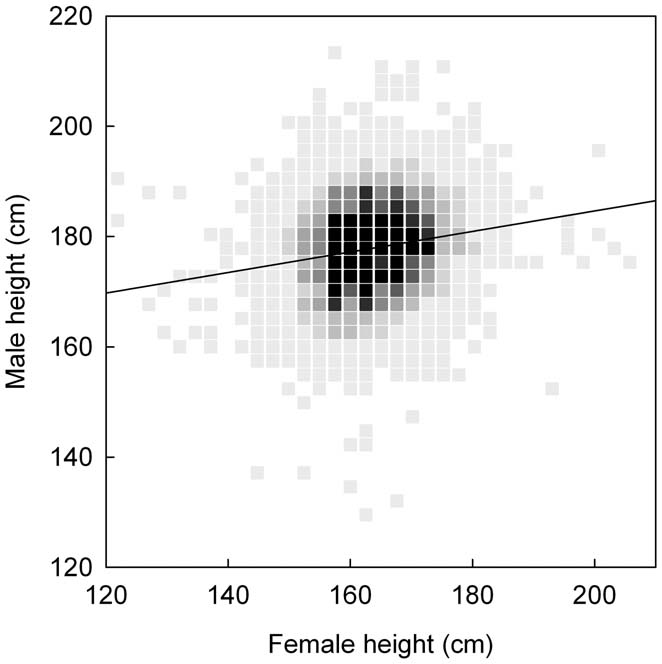
Figure 1. The positive correlation between female and male height (r = .18). Lumination indicates frequency of occurrence (lightest color ,20 couples; darkest color .200 couples). doi:10.1371/journal.pone.0054186.g001
Gert Stulp, Department of Psychology, University of Groningen, The Netherlands led a team of researchers on a quest to see if the male-taller-norm has an actual basis in how men and women really pair up. In other words, they wanted to verify real life data on male-female pairings.
The study examined data collected from the Millennium Cohort Study (MCS) which tracks 18,819 babies born in the United Kingdom in the year 2000. Response rate was over 68% and heights were self reported. Women reported an average height of 163.76 cm (5’5”) and men 177.86 cm (5’10”).
Assortative Mating
Results showed that men and women mated assortatively. Meaning that choices were not “random” but due to specific factors. It was found that 1) taller women had taller partners. For every 1 cm increase in female height, male partner height increased by 0.19 cm. However, in other studies women’s actual desired preference is for a 0.77 cm for each cm of own height. Thus, while women prefer men to be much taller, in the end, they actually settle for shorter men (with respect to their preferences) overall.
Mall-Taller-Norm
In 92.5% of the cases, the man was taller than the women, thus leading support to the male-taller-norm. Additionally, when the male-taller-norm was violated, it only occurred with a slight height variation. Thus, when men were shorter than their partners, they were only slightly shorter.
Male-Not-Too-Tall Norm
Overall, women express a universal desire for their male partners not to be too tall and the results bear this out. In only 13.9% of couples was the male 25 or more cm taller than her partner. Additionally, when the male-not-too-tall norm was violated, it was only violated slightly. Thus a difference in height of 25-30 cm was far more likely than a difference as high as 30-35 cm.
However, when actual couples were compared to chance coupling, that is, each man and each woman were paired with each other without any regard at all to choice, the actual pairings versus the random pairs did not differ much. For example, the male-taller norm was violated only in 26% fewer pairs than expected by chance alone and the male-not-too-tall norm was violated less than 12% than expected by chance.
Thus, real pairings, preferences set aside, were only moderately carried out in real life. By-in-large, pure random pairings where the man is taller than the woman, is born out by biological factors due to sexual dimorphism more so than active decision making.
However, this makes the chances of the male not-too-tall and the male-taller norms to be easily carried out in real life, rather than some other arrangement. In other words, nature helps match women and men based on their ideal preferences.
Own Height And Partner Height Ratios
Results showed that taller men had greater height differences than shorter men and also that shorter women had greater height differences than taller women.
Results also showed that shorter women and taller men were more likely to have greater partner height differences, whereas shorter men and taller women were more likely to have smaller height differences.
However, when compared to random mating, the same trend was found indicating that mating preferences have much to do with simple natural height differences rather than actual desires being born out.
Discussing The Findings
Results showed evidence for each of the rules including assortative mating and male-taller-norm where the man is taller than the woman and the male-not-too-tall where men are not far taller than their partner. However, when the results where compared to random mating, they did not differ much, showing a rather weak execution of the preferences. In other words, men and women could adhere more stringently to the height “rules” than they actually did.
A few reasons explain why this is so. For example, men prefer less height differences than women do, such that while an average women might prefer a taller man, he prefers a women who is more in line with his own height than she does. Thus, she might not be his ideal partner candidate (and his opinions matters too). Additionally, she is in direct competition with other women who might be taller and more attractive, and because of his height, he is more readily able to attract a taller, more attractive woman. The end result is that men end up partnering with women closer to their own height.
Additionally, height is but one aspect of mate choice. Previous studies have shown that height, weight, and BMI all fall into equal weightings with respect to preferences. Not to mention other qualities including facial attractiveness, and of course, personality.
While women generally have ideals set in their mind with respect to ideal height, the execution of these choices to not occur in a perfect world or in isolation of decisions made by others. Random chance, however, says that in most cases, the man will be taller than the woman. However, in most cases, too, a taller man will seek a woman closer to his own height, as height, even in women, is highly attractive. The important take-away message is that in the real world, ideal preferences are not always carried out due to other constraints and we certainly see this in action with respect to partner height and personal preferences.
Resources
Stulp, Gert; Abraham P. Buunk; Thomas V. Pollet; Daniel Nettle and Simon Verhulst. Are Human Mating Preferences with Respect to Height Reflected in Actual Pairings? January 2019. 8(1): e54186. doi:10.1371/journal.pone.0054186.g001