
The Power Of A Balled Fist – Making A Fist Makes Men Feel More Powerful
Christopher Philip
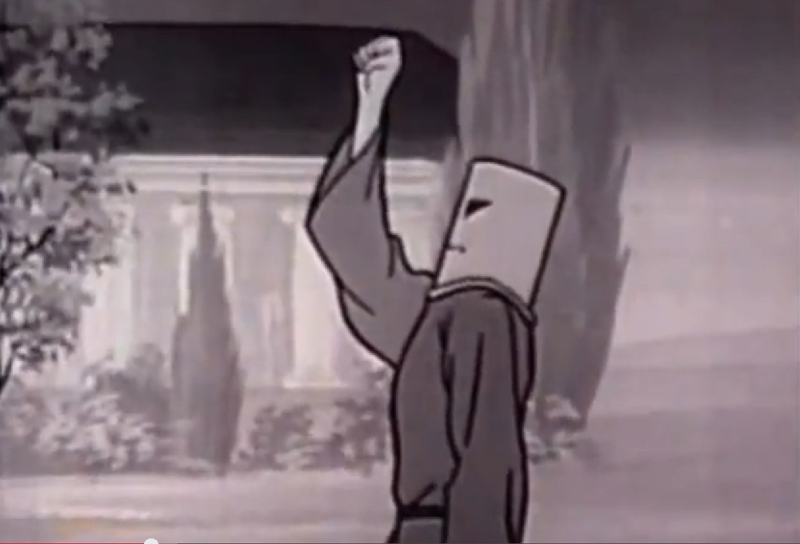
Murtis dons the Mask of Vulcan and becomes indestructible.
According to researchers Thomas Schubert and Sander Koole if you want to activate your center of power, make a fist, but only if you’re a man. Over the course of two studies, the researchers found that making a fist led male subject’s to perceive themselves as more assertive and esteemed and to associate more with the self-concept of power. No such effect was found in female subjects.
At first blush, making a fist, one might assume, is related to the celebration of achievement. However, in such cases, achievement might actually be conflated with power. This idea led researchers to test the validity of the association.
In the first experiment researchers set the subjects up with a ruse. Upon arrival, they were reminded of the rock-paper-scissors game and then shown an image of one of the gestures. This primed them to hold the gestures throughout the experiment. In one condition, subjects held the rock gesture from the game (a fist), in another, scissors (the neutral gesture, done by splitting the index and ring fingers while holding the remaining fingers down). The researchers predicted that making a fist would lead men, but not women, to perceive themselves as more assertive and more socially esteemed.
As predicted, men and women were affected differently by making a fist. Men felt more assertive and more esteemed while women did not. The results of the second study added more weight to the assertion that men see the fist as power whereas women do not.
Another recent experiment found that when women make a fist, they assume fewer possibilities of control and to judge male targets as less friendly and more hostile.
Additionally, previous studies have found that women actually perceive their environment when making a fist as more negative suggesting that the use of force is less of a source of power for women then it is for men. Women, therefore find the use of bodily force to be more associated with frustration and loss of control rather than a source of power, as men do.
The researchers suggest that this may be biological in origins; it also may have roots in socialization and culture. Nevertheless, that men find power in the fist, whereas women do not, presents as an interesting gender difference in embodiment of nonverbal communication. An interesting follow up study, as mentioned in the paper, would be to measure the same effect in female boxers or female martial arts fighters. Perhaps this target group, who has experienced the force of making a fist firsthand would experience greater sense of power.
Regardless, the male participants in the study were not professional fighters or boxers. Thus one must realize that making a fist was still a source of felt and embodied power for men and not women. This suggests that embodied physical power and displays of dominance are rooted in biology.
Discussion Of The Findings
It has been suggested that self concept is more than what is contained within the brain, rather it is a collection of things we perceive visually from our own body – it’s contours, shape of the face, qualities of the skin, its overall height and size, not to mention more (or less) elective nonverbal characteristics such as posture, facial expressions, gait, muscle flexation or relaxation (such as jaw clenching), and gesture.
As shown in the research, making a fist is not done to showcase success, but rather power. The fist is associated with the willingness to use physical force or induce bodily harm in the form of hitting or striking in order to claim social influence and likely some scarce resource (such as political leadership or a trophy in professional sports).
As we know, making a fist can sometimes be an expression of anger as a person readies to strike, but as we have seen here, it is also an indication of pride and as this study points out – power.
That men associate making a fist with power is likely due to the fact that men are more willing to both accept and use bodily force. Making a fist, therefore, is a good signal that someone is thinking about power and likely willing, and able to activate their bodies to achieve it.
If this nonverbal communication is observed, one should be wary – either they are coming for you, or something that you have. This is especially so if the fist is balled up in men.
When women hold a fist, it likely indicates feelings of powerlessness and loss of control due to either socialization or culture or innate biological factors.
Take Away Message
If a man makes a fist, be cautious and prepared to battle, however, if a women holds a fist understand that while she probably won’t resort to physical confrontation, she is experiencing the same feelings of loss of control and frustration.
The study is interesting because it shows how carrying a posture or gesture can change the cognition of a person in significant ways. Training programs to reduce aggression, or if you find yourself nearing physical conflict such as in a bar, should begin with modifying body language – specifically by dropping the balled fist from a person’s repertoire which will move them away from aggression.
The research shows the embodiment of nonverbal communication demonstrating that posture influences self-concept. By altering people’s postures, we can change their self-views.
Resources
Schubert, Thomas W. and Sander L. Koole. The Embodied Self: Making A Fist Enhances Men’s Power-Related Self-Conceptions. Journal of Experimental Social Psychology. 2019; 45: 828–834.
Learn More Starting Today!
Learn the basics of body language quickly and easily by taking one of our tailor-made video courses!
Short on cash? Then read an ENTIRE comprehensive book on body language – it’s totally FREE!
Which body language video course will you start with?
1. “The Secrets of Body Language”