
Tall Men Not Affected By Dominance Like Short Men
Christopher Philip
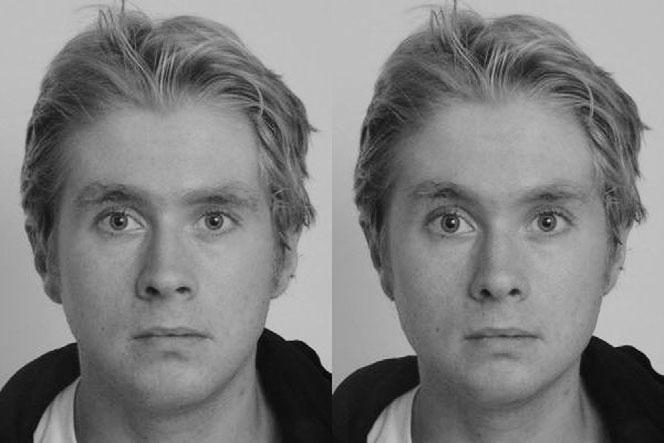
Figure 1 Examples of masculinized (left) and feminized (right) face images
used to assess men’s perceptions of facial dominance in our study.
A research team led by Christopher Watkins, School of Psychology, University of Aberdeen has found that tall men don’t read the faces of other men for dominance the same way that short men do.
The study began by collecting voice recordings from 10 men whom were instructed to say “Hi, I’m a student.” The recordings where then altered to sound both more dominant by lowering the voice pitch and more submissive by raising the voice pitch.
Alongside the voice recordings, the subjects were also to be presented with images of the faces of the men. These images were also digitally manipulated such that they were more dominant or masculinized and more submissive or more feminized.
Therefore, in total there were 10 pairs of voice recordings, one low pitched and one high pitched along with 10 pairs of images, one masculinized and one feminized.
Fifty male participants then listened to the 10 pairs of voices. This task had the subjects rate which of the pair they felt was more dominant. Each subject listened to the high and low pitched recording from the same voice. The subjects were asked about the relative difference between the masculinized and feminized voices. They could say that the deeper voice sounded “much more dominant”, “more dominant”, “somewhat more dominant” or “slightly more dominant” than the higher pitched voice.
The same process was repeated with the images of the faces which were also paired and from the same person.
The subject’s height was measured and they offered a self-assessment of their own perceived dominance on a scale from 1-7.
The results showed that as men’s height increased, their sensitivity to the cues of other men declined.
The general trend also showed that regardless of height, deeper voices and more masculine faces, created a higher perception of dominance.
Taller men also tended to rate themselves as more dominant than shorter men.
The researchers suggest that previous encounters with other men that may have resulted in conflict or aggression may have something to do with how shorter men perceive taller men.
Certainly, height is a high predictor of strength and men are likely quite cognoscente of physical cues when conflict arises or particularly when a physical challenge is issued. Even if men escape physical conflicts, they may still have lost battles in sports and certainly have the hardwiring through evolution to be able to equate size or height to strength and therefore dominance.
Throughout our evolutionary past, and even to a certain degree today, conflict with aggressive and dominant men would have been quite costly and to be avoided – but only if the relative differences indicated that it was likely a losing proposition.
Resources
Watkins, Christopher D. and Paul J. Fraccaro. Taller Men Are Less Sensitive to Cues of Dominance in Other Men. 2019. Behavioral Ecology; 21: 943-947.