
Stop Mirroring Me You’re Giving Me The Chills
Christopher Philip
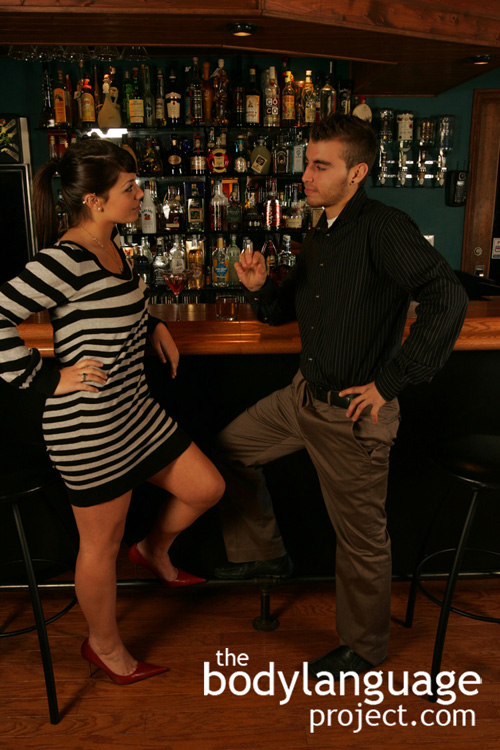 According to researchers led by Pontus Leander, behavioural mimicry, while beneficial in small doses, can be overdone – especially in the wrong context.
In the study, subjects faced a confederate whom either used “suspicious” levels of mimicry or none at all.
As we know, there is a standard amount of mimicry during social interactions. When done appropriately, mimicry builds social cohesion, trust, and liking through shared actions – a dance. When one person takes a drink, the other may wait a few seconds, then mirror or mimic the act. A person may brush themselves down while grooming, the other may follow. Certain postures may also be adopted such as crossing the legs toward or leaning in the same direction.
Mirroring says “We agree to be the same because we get along.”
However, as the researchers learned in this study, there can be too much of a good thing – especially when it comes to mirroring.
In fact, when that line is crossed from normal to abnormal, people suffer an embodied reaction and literally report feeling cold. Coldness is the body’s way to signal that something odd and antisocial is happening. In other words, feeling cold is how the body interprets feelings of isolation – cold and lonely.
The researchers do not detail exactly how much mimicry is the correct amount but they do suggest that it is largely based on intuition. A large part what is acceptable has to do with specific company and of course, context.
Interestingly too, the type of experimenter with which people interact with, also mattered. When the confederate was “affiliative” people felt colder when they were not
mimicked than when they were. However, they felt colder when mimicked by a “task-oriented” experimenter than when they weren’t. Thus, not only does context matter, but so too does personality.
The researchers summarize the findings by say that it “was not the amount of mimicry per se that moderated felt coldness; rather, felt coldness was moderated by the inappropriateness of the mimicry given implicit standards set by individual differences.”
To summarize, while some mimicry is good, a lot is probably bad, especially if you’re not actually sharing positively in the experience. Forcing a dance with an unwilling partner is likely to push them away and make them feel cold and isolated rather than welcomed.
Resources
Leander, N. Pontus; Tanya L. Chartrand and John A. Bargh. You Give Me the Chills Embodied Reactions to Inappropriate Amounts of Behavioral Mimicry. Psychological Science. 2019. 23(7): 772-779. Published online before print May 18, 2019, doi: 10.1177/0956797611434535. http://pss.sagepub.com/content/23/7/772