
Does Skimpy Clothing Lead To Larger Tips? – How To Boost Tips Using Nonverbal Communication
Christopher Philip
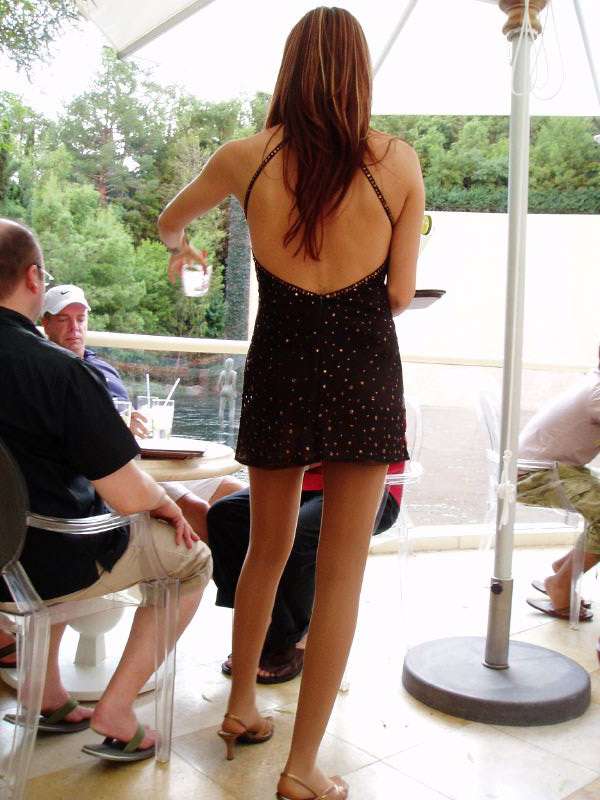 Female servers as well as their managers often wonder how best to influence the amount of tips they earn. Specifically one might wonder what effect behaviour and attire has on desire to tip.
While research has found that mirroring patron’s gestures, touching them lightly, smiling, repeating their order back to them, squatting next to the table, moving closer to the table rather than further away, writing a personal message such as a joke or patriotic phrase on the bill, giving more than one candy with the bill, wearing more makeup, and introducing themselves by name are a few ways to create a quick bond and thus influence tipping in a positive manner, few have taken attire into account.
More specifically, though, no study has looked at the relationship between the amount of clothing worn and tipping behaviour.
Toward this end, researchers Aris Karagiorgakis and Danielle Malone, Black Hills State University devised a study in a bar setting examining this very condition.
In the study, a female bartender wore various levels of clothing including: “little,” “medium,” “full,” and “regular.” Each condition was varied in the amount of skin being revealed.
The study examined over one thousand male and female patrons over 15 weeknights from 10 pm until 2 am in a small city in South Dakota.
The server was a female undergraduate student of average attractiveness as rated by her peers. The study was careful to maintain similar makeup and hair throughout each condition.
The four clothing conditions for the study included:
 1) Little: A black tank top and black form-fitting shorts.
2) Medium: A black V-neck t-shirt and black form-fitting Capris pants.
3) Full: A black long sleeve shirt and black pants.
4) Regular (or baseline): the same black V-neck t-shirt as in the “Medium” condition, but worn with blue jeans.
Results showed that overall mean tip percentages were not significantly different between clothing conditions. They were as follows: Little = 24%; Medium = 23%; Full = 18%; and Regular = 23%.
However, when patrons tipped in cash rather than credit, there was a significant difference in tipping amounts between the levels of clothing worn. The less the server wore, the more she earned in tips, but only if the patron paid in cash rather than credit.
More to this, however, revealing a lot of skin is not paramount, what seemed to be important was that servers revealed some skin. To illustrate this, the regular condition produced 29%, whereas the full produced 20% (in cash it was 29% and 19% respectively).
The researchers surmised that showing more skin helped to boost the overall mood of the patrons and this lead to their desire to produce larger tips.
However, why did patrons not tip more generously when paying by credit?
The researchers say that this may be because tipping by credit is less visible and so there is less incentive to appear generous. Also, it may be that paying by credit interrupts the immediacy of the clothing as a patron works through the complex task of inputting their passcode or writing their signature as well as computing the tip size. Using cash is more immediate and therefore more impulsive.
The take-away message is quite clear, though limited. Female servers can certainly benefit from larger tips by showing skin, but the amount of skin is not terribly important so long as some is visible. The effect though, may be limited by the method of payment so when dealing with cash payments, the immediacy of dressing in more revealing attire will likely produce better results than when paying by credit.
Finally, over email, I asked Karagiorgakis if he figured that a stronger trend would have been found if male and female data was analyzed separately. He clarified that such a trend could be possible, but given how hectic was the data collection, it was nearly impossible to track.
In past research it was however discovered that men rather than women are unilaterally affected by other superficial qualities including red lipstick and blonde hair when worn by women – so the possibility that men are in fact more influenced by level of dress and tipping is certainly possible.
Image Credit: Michael Lehet
Resources
Karagiorgakis, Aris and Danielle Malone. The Effect of Clothing and Method of Payment on Tipping in a Bar Setting. North American Journal of Psychology. 2019. 16(3): 441-452.