
We Shake Hands To Share Human Scent – The Curious Case Of Hand Sniffing Body Language
Christopher Philip
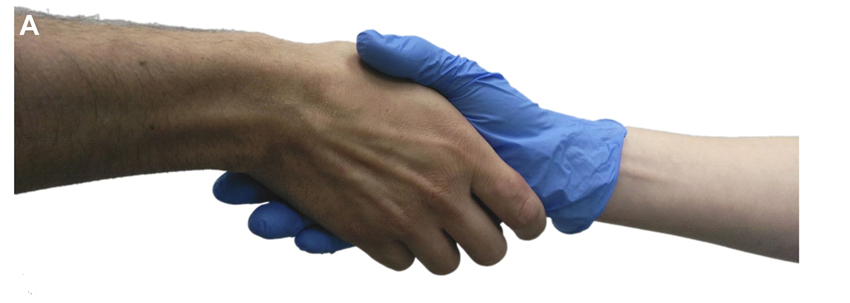
Scientists find that people use the touch of a handshake to sample and sniff signaling molecules. A sterile glove was used to identify signaling molecules transmitted via a handshake. Credit: Frumin et al.
According to researchers from Israel’s Weizmann Institute handshakes are a way for us to transmit and collect chemical signals between people. This may explain why the greeting has evolved to begin with.
Other studies have found that human chemosignals play a role in mate selection including estrous — that women smell better when they ovulate and that men smell more attractive when dominant. Other studies have found that scent can convey fear and even alter brain activity. Scent also seems to play a role in synchronizing women’s menstrual cycles.
The current experiment observed 280 people as they greeted one another, either with or without a handshake. Interestingly, the study found that in about 22% of the cases, people seemed to constantly be sniffing their own hands. They also found that those who shook hands during the greeting, also tended to touch their faces with the same hand used in the handshake.
This gave the researchers reason to believe that the handshake was a way to collect the chemical molecules from others and subtly sample them in order to nose out secret information about the person they had just greeted.
 To verify that scent could actually be collected in this fashion, the researchers fitted subjects with nasal catheters to measure airflow. The results showed that when the hand was in close proximity, that airflow through the nasal passages doubled. This was an indication that the subjects were indeed taking in more air through their noses. This once again, suggested that they were in fact sniffing the scents that had been exchanged through the handshake.
“It is well-known that we emit odours that influence the behaviour and perception of others but, unlike other mammals, we don’t sample those odours from each other overtly,” says Professor Noam Sobel, Chair of Neurobiology at the Weizmann Institute of Science.
“Instead, our experiments reveal handshakes as a discreet way to actively search for social chemosignals,” he said.
The results also found that men and women both significantly increased hand sniffing after shaking hands with members of their own gender, but did not do so across gender.
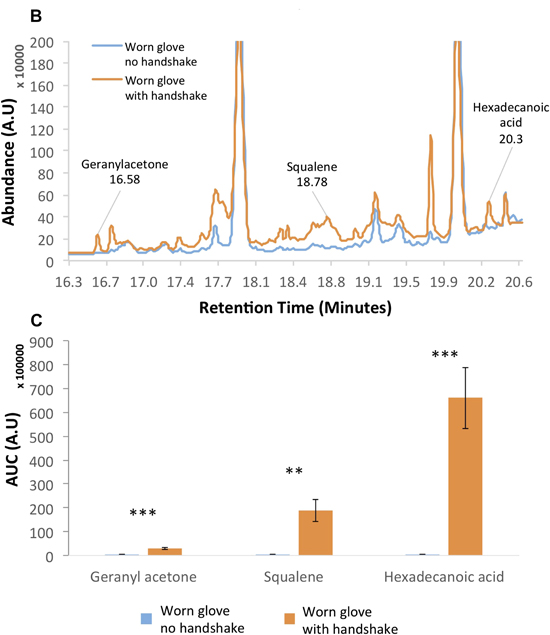
To conclude the study, the researchers collected scent samples from a handshake with a sterile latex glove. They then measured the glove for traces of scent. They found squalene and hexadecanoic acid were indeed transferred onto the gloves. These are both chemicals thought to play a part in social signaling in dogs and rats.
“Handshaking is already known to convey a range of information depending on the duration of the gesture, its strength and the posture used,” says Professor Sobel. “We argue that it may have evolved to serve as one of a number of ways to sample social chemicals from each other, and that it still serves this purpose in a meaningful albeit subliminal way.”
In their paper the researchers are clear in stating that human are “not only passively exposed to social chemosignals, but rather actively search for them.”
I would strongly encourage you to click the videos to view the evidence yourself:
VIDEO 1: Humans often sniff their own hands
This is an assortment of scored events from across the data (before, during, and after greet), demonstrating that humans often apparently sniff their own hands. Note that these are not the ‘best cases’, as typically subjects who engaged in very overt self-sampling did not later consent to use of their video in publication.
LINK: http://dx.doi.org/10.7554/eLife.05154.006
VIDEO 2: Hand sampling is concurrent with sniffing
The video is from the control experiment that included a nasal cannula for nasal airflow recording. The airflow cursor is time-locked with the video. Note that when the subject was scored as sampling, he concurrently sniffed. A second example is in Video 4. This individual is obscured by pixalization to reflect requested level of privacy.
LINK: http://dx.doi.org/10.7554/eLife.05154.007
Video 3: Humans sample the hand that shook
Several greet events with ensuing behavior. The text in the upper left corner denotes the scored condition. Again, these are far from ‘best cases’, as typically subjects who engaged in very overt self-sampling did not later consent to use of their video in publication. Finally, some individuals are obscured by pixalization to reflect requested level of privacy.
LINK: http://dx.doi.org/10.7554/eLife.05154.010
Video 4: Pronounced sniffing of the hand that shook.
An example from the control experiment that included a nasal cannula for nasal airflow recording. Although this may seem like a staged dramatization, it is not. This is raw data, with an explicit self-sample that occurred the moment the experimenter ended the greet and left the room. As the frozen image at the end highlights, this self-sampling behavior was perfectly timed with a pronounced sniff.
LINK: http://dx.doi.org/10.7554/eLife.05154.011
Resources
Frumin, Idan; Ofer Perl; Yaara Endevelt-Shapira; Ami Eisen; Neetai Eshel; Iris Heller; Maya Shemesh; Aharon Ravia; Lee Sela; Anat Arzi and Noam Sobel. A Social Chemosignaling Function for Human Handshaking. eLife 2019. 4:e05154
DOI: http://dx.doi.org/10.7554/eLife.05154.