
Seriously, Stop Touching Me! – How We Use Nonverbal Signaling To Manage
Unwanted Touching In Busy Public Areas
Christopher Philip
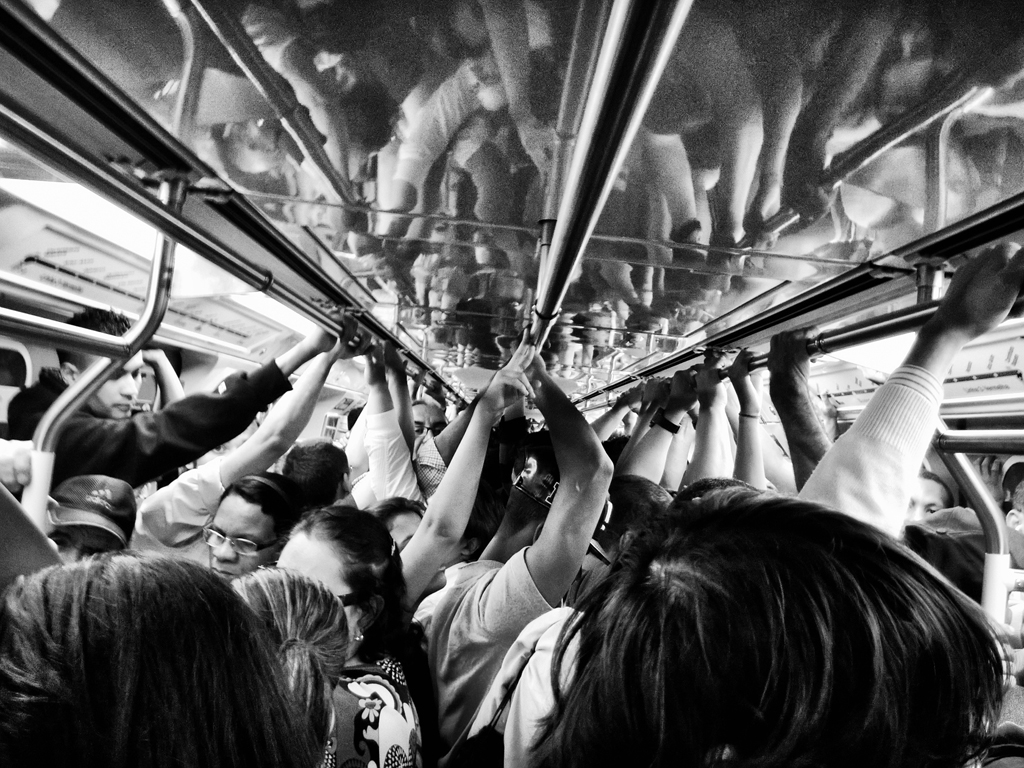 Someone bumps into you on a crowded subway, what do you do? Do you speak up and tell the person to mind your space, give them a dirty look, or do nothing and hope it doesn’t they don’t repeat the insult?
According to researchers Martin Aranguren and Stephane Tonnelat you might not do any of the above, but rather, you are likely to signal your discontent nonverbally following a very specific cross-cultural pattern.
 That pattern might go something like this.
A touches P, P raises and lowers eyebrows, followed by P looking down.
Does that seem effective?
In most cases, and according to the research, this is often enough for people to deal with the emotional discomfort of these routine innocuous territorial intrusions that are becoming more and more common in overcrowded public areas.
In their study, Aranguren and Tonnelat tracked hundreds of these nonverbal “corrective interchanges” in the Paris subway. Later, Aranguren extended the findings to a subway in Delhi, India.
The researchers found that the sequence usually involved specific nonverbal expressions of facial muscles or Action Units (AUs). Action Units are an unbiased way to monitor facial expressions with each AU linked to a specific muscle in the face.
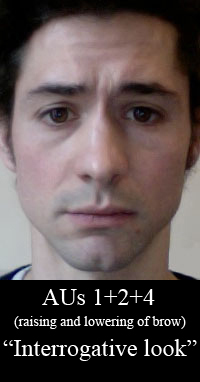
Upon contact, a person will usually contract AUs 1+2+4 which AUs 1 (inner brow raiser), 2 (outer brow raiser) and 4 (brow lowerer). Together this forms the following objectively visible facial pattern: “bulges at the inner corner of the brows, a downward curve between the inner corners and the middle portion of the brow, an oblique bunching running from the medial part of the forehead to the inner corners of the brow, and exposure of the outer portion of the upper eyelid.”
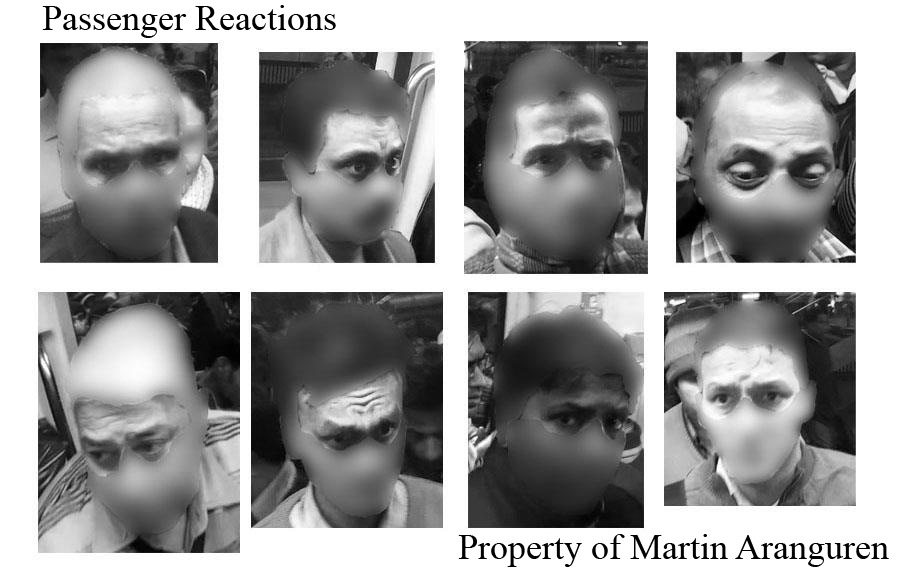
Passengers may raise and lower the brow (AUs 1+2+4) when they are touched. Upper eyelid raise (AU5) is also visible on most of the faces.
Aranguren found that in many cases this pattern was the facial component of a larger unit of behaviour that he called an “interrogative look.” An interrogative look is made up of three successive components: 1) The toucher touches the touched 2) The touch displays AUs 1+2+4+5 followed by 3) The touched turns their head toward the toucher.
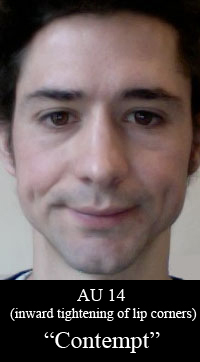
If this message was not received by the toucher, then the touched would turn their head once again toward the toucher, even slightly, or in more extreme cases establish outright eye contact. In some cases this is followed by AU 14 by the touched. When Action Unit 14 flexes, we read the expression as contempt, and the entire sequence as disproval of the toucher.
As an alternative to the disapproval sequence just described, passengers may accomplish a “corrective exchange” or “repair sequence.” In this situation, rather than the contempt expression of the touched, the sequence ends with the toucher’s downcase, which in this context functions to appears the touched.
Most cases of touching were resolved in this low risk nonverbal fashion. In fact, verbal contact or insults were rare despite tracking hundreds of such incidences.
When repeated touching happens passengers work harder to correct the touchers behaviour by establishing eye contact through head and eye movements followed by facial changes to signal discontent. In this sequence the eye contact or head turning serves to draw the attention of the toucher to the touched in order to silently signal nonverbal discontent via facial expressions which follow.
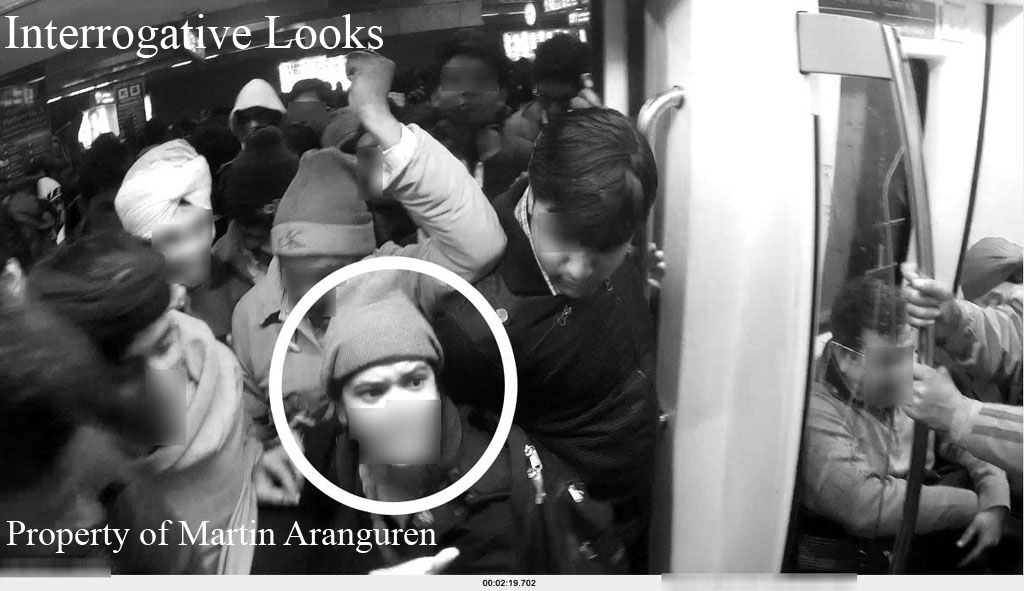
Facial component of the interrogative look. The woman tries to get off but is pushed back in by the crowd.
Therefore a more complex touch sequence involving repeated touching is coded as follows:
(contact P,1+2+4 P, turns_head covisibility A, looks_away P,AU14) containing
(contact P,1+2+4 P, looks_A) (contact P,1+2+4).
Here:
P = The toucher
A = The touched
AU= Action Unit and the numbers refer to which muscles in the face are activated
1+2+4 = simultaneous brow lowering and raising the “interrogative look”
AU14 = inward tightening of lip corners – the “contempt expression”
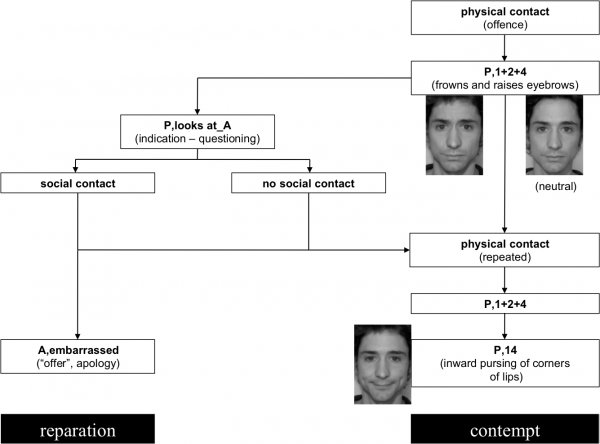 No matter how often touching occurred, it was nearly always met with the nonverbal “interrogative look.” This was surmised to be due to the fact that people universally experience unwelcome touching from strangers as a territorial violation. Blinking and eyelid raising in response is similar to a startle response. When we’re touched we accomplish a process of “nonverbal repair.” Our facial expressions are sometimes used by the toucher to apologize by showing embarrassment. This is called a nonverbal “offer” since it is given in effort to excuse the touch and seek pardon from the touched.
When this does not occur, the touched displays silent disapproval with the contempt expression. “Nonverbal repair” helps to re-affiliate the victim with the offender whereas disapproval serves to disaffiliate.
The researchers found that people cross-culturally disapprove of touching and do not become accustomed to touching even at high densities. People manage unwanted touching in public areas by using very specific patterns of nonverbal communication as a way to avoid verbal exchanges or potential escalation to insult.
Image Credit: Diego Torres Silvestre
Resources
Aranguren, Martin. “Nonverbal interaction patterns in the Delhi Metro: interrogative looks and play-faces in the management of interpersonal distance.” Interaction Studies. 2019. 16(1) forthcoming.
Aranguren, Martin and Stephane Tonnelat. Emotional Transactions in the Paris Subway: Combining Naturalistic Videotaping, Objective Facial Coding and Sequential Analysis in the Study of Nonverbal Emotional Behavior. Journal of Nonverbal Behavior. 2019. 38:495–521. DOI 10.1007/s10919-014-0193-1
IMAGES: Courtesy of Martin Aranguren
To Access Martin Aranguren’ Research and Profile: https://ehess.academia.edu/MartinAranguren