
Science Describes The Trustworthy Face
Christopher Philip
 As part of the natural human condition, people often, if not always ascribe certain traits onto people by their looks alone. For example, we look at other people’s clothing including its relative provocativeness or sexiness including tightness, reveal of skin or its conservativeness as well as its conformity or originality. However, a person’s style is but one aspect of a person and it is, in nearly all instances, a trait people consciously choose.
We feel comfortable reading people on their fashion because we figure that since they are electing to wear it, that it reflects who they really are, rather than what they have been ascribed through their genetics.
However, what if the look of our face, its underlying bone structure, its morphology, actually has meaning? What if our genes actually play a role in not only determining our personality, but also the bones that hold up our faces as well as the distribution of fat and muscle? More importantly, does the process of ascribing personality to faces neatly tie into what faces actually depict?
On the other hand, perhaps, it is the case that our tendency to ascribe traits to people with certain faces in certain ways, that leads these people to behave accordingly.
While these questions remain to be answered, some evidence is mounting suggesting that people do, in fact, commonly ascribe characteristics to faces and that, in part, these are determined by underlying hormones which tie neatly into a person’s personality, thus offering real world predictable applications.
For example, previous research has shown that women rate men with facial masculinity as dominant and that these are tied to an abundance of the male sex hormone testosterone. Digging deeper, we can expect that men with dominant masculine faces with high testosterone are also likely to behave in masculine stereotypical ways including aggressiveness. Thus women who select for men with high facial masculinity for dating, are also likely to find that these men are also driven to succeed and rise easily in dominance hierarchies.
In the current study, a team of researchers led by Constantin Rezlescu, University College London, United Kingdom conducted a study looking at what they call “unfakeable facial configuration.” As opposed to emotional facial expressions which can be faked or consciously controlled, unfakeable facial configurations represent the underlying structure of the face which remains constant. They figured that the look of a face will affect how it is perceive by others in a significant way and that these persist regardless of the expression made.
Experiment #1
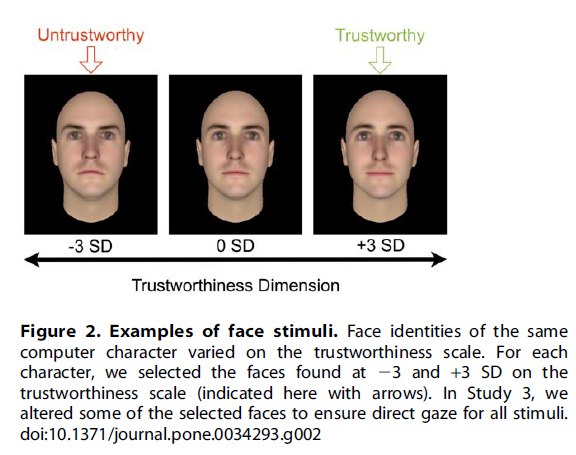
In the first experiment subjects were asked to invest in computer generated characters modified over a spectrum including trustworthiness and dominance (untrustworthy). Importantly the images had no additional external factors such as hair, jewelry and have even skin texture and colour. Thus the only differences in behaviour was due entirely to the factors changed in the trustworthiness of the face.
Out of 40 rounds of games, it was found that subjects were willing to invest more, on average, in the trustworthy faces 13 out of 15 times. In terms of dollars (pounds), the average invested in the trustworthy looking faces was $61.91, while untrustworthy characters only received $61.91. That’s a difference of 42%.
According to the study author’s it clearly demonstrates that stable facial features associated with perceived trustworthiness drives people’s investment decisions. Likewise, untrustworthy looking characters attracted much smaller investment.
This “trustworthiness premium,” say the researchers “goes a step further by demonstrating, holistically, the influence of unfakeable facial features (those that naturally individuate faces and cannot be deliberately modified, except through cosmetic surgery).”
Experiment #2
In the second study, the researchers wanted to see if the effects of the trustworthy looking face effect had enough strength to remain salient when additional information about a person is known. Naturally, this is something people encounter regularly in daily life as we don’t interact with faces alone, but rather whole people.
In this study, the researchers created profiles for various trustworthy looking faces. In a rational sense, people should focus more on the past behaviour of a person’s trustworthiness, rather than their outward trustworthiness appearance.
As expected, people placed more value on the history than the facial trustworthiness. The results showed that the characters with “good” histories attracted an average of $67.39 whereas the “bad” histories attracted an average of $20.65.
Interestingly, the researchers calculated the “penalty” and “bonus” ascribed by facial untrustworthiness and trustworthiness respectively. This was possible because the “good” and “bad” histories were also presented by themselves. Thus, the penalty and bonus could be calculated against the histories by themselves to see just how strong the effects were.
Results showed that the mean facial trustworthiness bonus, averaged across participants
and characters, was $1.57 VP and the mean facial untrustworthiness penalty was $21.83.
Therefore, having a trustworthy face is additive with respect to a good history but also helps reduce the negative effects of a bad history. On the other hand, having an untrustworthy face coupled with a bad history leads people to be more certain about your untrustworthiness.
Experiment #3
The third experiment was used to confirm the results of the previous experiment, except that it offered a real monetary reward raising the incentive to choose more carefully.
In this experiment subjects were only shown a trustworthy looking face or an untrustworthy looking face and were asked if they would like to invest in them or not. This was done over 20 faces split evenly between trustworthy and untrustworthy.
Results were similar to the first experiment where participants, on average, invested 40% more in the trustworthy faces than the untrustworthy faces.
Discussing The Findings
Results showed that when no other cues are present, people will invest more into a face that is trustworthy than untrustworthy.
When a trustworthy face is coupled with a good history, it commands a bonus, but when an untrustworthy face is coupled with a bad history, it results in a penalty.
“These features are particularly interesting,” say the researchers “because they are generally impossible to fake and unfakeable cues to trustworthiness are more likely to be reliable than adjustable ones (such as hairstyle, glasses, etc.).”
The authors caution that they do not suggest that unfakeable facial configurations are actually diagnostic of trustworthiness. Rather, they suggest, that should the clues be found in an economic context, that they would be difficult to mimic. This would then reduce their value as cues to trustworthiness.
Resources
Rezlescu C, Duchaine B, Olivola CY, Chater N. Unfakeable Facial Configurations Affect Strategic Choices in Trust Games with or without Information about Past Behavior. 2019. PLoS ONE 7(3): e34293. doi:10.1371/journal.pone.0034293
1 comment for “Science Describes The Trustworthy Face”