
Research Says Blondes Fair Better In Tips, Courtship, Donations And Spontaneous Helping
Christopher Philip
 Dark hair colours account for more than 90% of all natural hair worldwide, blond hair for 2%, whereas red only accounts for 1%.
In various studies men reported a preference for women with light coloured hair and report them to be more attractive than brunettes and redheads. However, other research has found mixed preferences between hair colour using various methodology. Other studies have not controlled for hair length and age. Some have used line drawings and others used photos. Thus, the methodology may play some effect into the inconsistent findings.
Across four separate studies, French researcher Nicolas Guéguen, Université de Bretagne-Sud found that blond hair, over other hair colours, led to more positive outcomes for women in various situations.
One important feature of Guéguen research is that he uses real life situations and uses the same confederates in each study, only modifying for their hair colour with the help of coloured wigs. This controls for other effects and does not rely on subjective surveys and questionnaires but rather real-to-life behaviour including tips, courtship requests, donations, and helping behaviour.
Experiment #1 – Tips and Hair Colour
In the first experiment, 11 waitresses in their early 20’s were instructed to wear blond, red, brown or dark coloured wigs as they served food in several restaurants. Participants were made up of 847 restaurant customers who were dining alone.
The results showed that waitresses wearing blond wigs received more tips, but only from the male patrons. The colour of the waitress’ hair had no effect on the effects of women’s tipping behaviour (non-significant results).
Results are as follows:
For Male Customers (Men tip blondes more):
Blond: 52.2%
Black: 43%
Brown: 38.8%
Red: 34.1%
For Female Customers (non-significant difference):
Black 36.7%
Brown 32.2%
Blond 27.8%
Red 25%
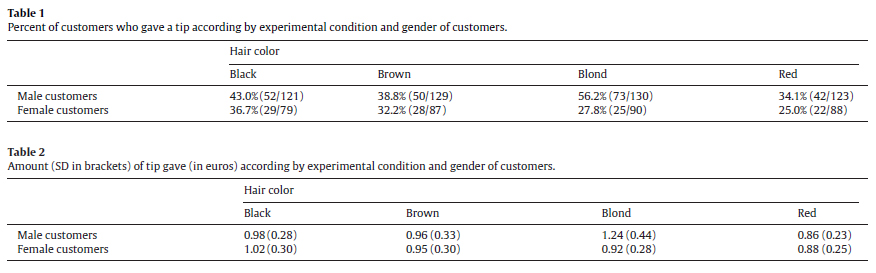 Overall, blond hair was associated with an increase in male tipping behaviour. Men were more likely to give tips to the waitresses with blond hair and also gave larger amounts of money when they did. In fact, men gave blond haired waitresses tips that were 25% higher when compared to the other three colours combined.
This amounts to an increase in working wage from $8.38 to $8.89 per hour. Thus, the women wearing blond wigs received a 6.1% raise over the other hair colours.
Experiment #2 – Hair Colour on Courtship (findings for men and women)
In this second experiment Guéguen observed men and women wearing different coloured wigs in a nightclub to measure the effect of hair colour on courtship.
In the first part of the experiment 12 women in their early 20’s were outfitted with four different wigs of various colours. The wigs were all mid-length and in current style. Each confederate was instructed not to wear makeup and wear the same clothing between trials.
The female confederates were instructed to sit for 1 hour and look at people dancing on the dance floor. She was instructed not to look at men in the eyes. Observers to the study were told to measure the number of approaches made by men during the 1 hour period. If an approach was made, the confederate was instructed to tell the man that she was “waiting for her boyfriend” in order to quickly end the interaction.
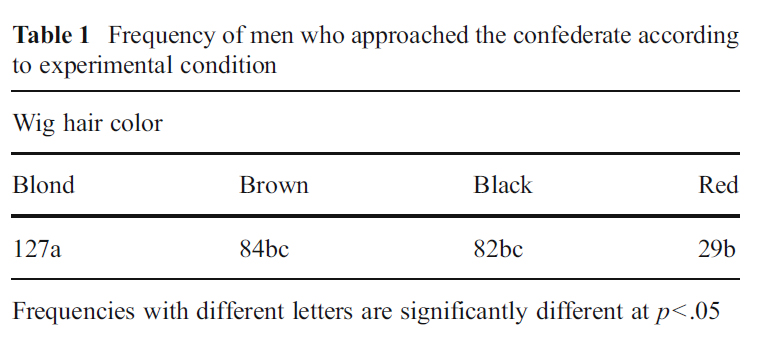 Results showed that the number of approaches by hair colour was 127 for blondes, brown 84, black 82, red 29.
In the second part of the experiment, four men were outfitted with various wigs. They were instructed to approach women as slow songs were playing in a nightclub. The male confederate was instructed to approach women who were single or in a group of women. He was told to say “Hello. My name’s Antoine. Do you want to dance?” If he was rejected he was to say “Too bad. Maybe another time?” He was then to move a few steps away and solicit another young woman. If the woman accepted, she was debriefed and told she was part of a social experiment.
The results for the men showed that black hair was highest at 35%, followed by brown 30%, blond 27.5% and red 13.8%.
Overall results showed that women with blond hair faired far better than women with other hair colours and when men had blond hair they didn’t fair much better unless compared to red hair. In both cases, red hair fair far worse than other hair colours suggesting that it is perceived as far less attractive. The results clearly show that men prefer blondes whereas women show a preference for men with darker hair, but are far less discriminating in hair colour unless his hair is red.
As Guéguen explains, there is a social stigma against red hair which partially explains why they are not regarded by either sex in a positive light. On the other hand, blond hair in women could be perceived to be linked to youthfulness as blond hair is much more common in children which decreases with age. This may also explain why women generally prefer men with darker hair as it is linked to greater age and therefore greater status.
Experiment #3 – Hair Colour on Donations
In the third ‘man-on-the-street’ experiment, women where once again outfitted with various coloured wigs. This time they were stationed to collect donations for a French Telethon. In total 1200 men and 1200 women between the ages of 25 and 60 were solicited in various locations during the study. As before, the confederates were instructed not to wear makeup and wear the same outfit under each condition.
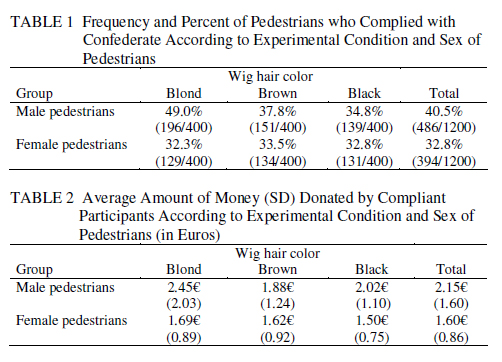 Results showed that only men responded differently to the request for a donation based upon the hair colour. Men donated 49% in the blond hair condition as opposed to, 37.8% in brown, and 34.8% in black. Women were about evenly split at around 30% under each of the hair colours. Men also donated more money to the women wearing blond hair 2.45 pounds, 1.88 brown and 2.02 black. Women split their donations evenly at around 1.6 pounds regardless of hair colour. Additionally, men were more generous overall when compared to the women.
Overall the results show that women receive greater donations from men when they wore blond wigs than when they wore dark coloured wigs, and overall, men were more generous with donations than women.
Guéguen explains the findings be stating that by wearing blond wigs, the women were able to boost their physical attractiveness.
Experiment #4 – Hair Colour on Spontaneous Helping
In this experiment 10 women were outfitted with blond, brown and dark wigs. They then walked along a pedestrian area and “accidentally” dropped a glove seemingly without awareness. The frequency with which the glove was returned was measured. In total, the process was repeated for 600 men and 600 women.
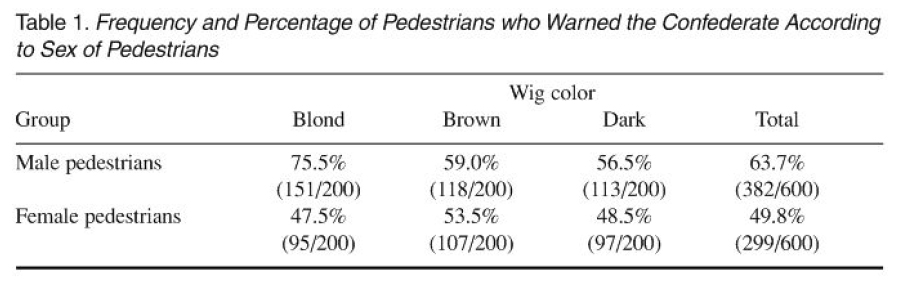 Results showed that men returned the glove 75.5% of the time when the women wore a blond wig, 59% wearing brown and 56.6% with a dark wig. Women returned the glove with about equal frequency under each wig condition (around 50%). As well, once again, men were significantly more likely to help than the women in all conditions overall regardless of the hair colour.
Thus, again, men were more likely to help women whom had blond hair over women with darker hair whereas women showed no difference and helped women with about equal frequencies.
Discussing The Overall Findings
Across four independent studies it was found that men were more likely to help women if they had blond hair than if they had darker hair. We could only assume as to the reasons for this, however, it is likely that men found women wearing blond hair to be more attractive which motivated their desires to help. We can therefore conclude that men are more likely to help women if they find them attractive.
That being the case, women did not differentiate helping based on hair colour and helped women regardless of the colour hair they had with equal frequencies In other words, women did not judge other women based on their physical appearance or at least didn’t differentially assist or help them.
However, while men were preferentially helpful to attractive blond women, they also helped women more overall when compared to women, regardless of their hair colour. Though, as men did select whom was most worthy, they felt all women were more worthy of assistance than did women. This was statistically significant.
Thus, while one might say that men are superficial in their assistance, and their help comes with different frequencies across physical attributes, they still helped more often than did women.
The take-away from this study is that while women are more likely to get help from men, they can receive the lion’s share by modifying their looks in specific ways that please the ideals of men. They can also count on other women to help regardless of their outer appearance, but with a lesser frequency than they can expect to get from men.
Another common theme throughout the research and not mentioned until now, is that while women benefit from physical attractiveness cues with respect to helping as demonstrated empirically herein, they tend to benefit less when it comes to specific achievement. For example, other studies have found that red-headed women are far more often to be represented in high powered jobs as they are seen as more capable and competent. Blond women, on the other hand, tend not to be as represented in more prestigious jobs. Thus, it is likely that stereotypes affect, to some degree, how we perceive others and while we may ascribe helplessness (or attractiveness) to women who are blond, people may also ascribe competency to women whom are red-head.
Applying The Findings
By understanding the effect of hair colour, one is able to modify their appearance to suite their goals. A blond wig can be a great investment if one is a server and wishes to maximize tips or if one wishes to solicit for dates or donations, but a poor investment if one wishes to climb the corporate ladder since it may inhibit the embodiment of independence and intelligence.
Many women have also caught onto the benefits of being blond and routinely use hair colouring to lighten their hair in a semi-permanent fashion. The wisest, however, have taken to avoid going full bleach and instead use highlights to selectively add blond and create a dual image of dark haired competence paired with blond youthfulness.
Resources
1. Guéguen, Nicolas. Hair color and wages: Waitresses with Blond Hair Have More Fun. The Journal of Socio-Economics. 2019. 41: 370-372.
2. Guéguen, Nicolas. Hair Color and Courtship: Blond Women Received More Courtship Solicitations and Redhead Men Received More Refusals. Psychol Stud. 2019. 57(4):369–375. DOI 10.1007/s12646-012-0158-6
3. Guéguen, Nicolas. Brief Report: Women’s Hair Color and Donations: Blonds Receive More Money. North American Journal of Psychology. 2019. 13(3): 367-372.
4. Guéguen, Nicolas. The Sweet Color of an Implicit Request: Women’s Hair Color and Spontaneous Helping Behavior. Social Behavior and Personality. 2019. 40(7): 1099-1102.