
The Powerful Nonverbal Effect Of The Raised Middle Finger – Persistent Brain Consequences And Pairing
Christopher Philip
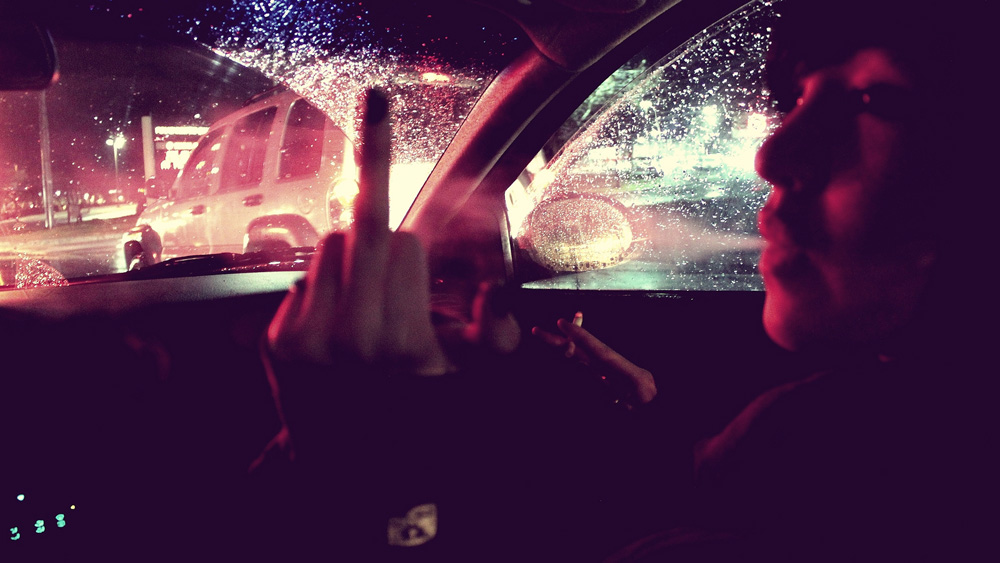 We know that nonverbal behaviour is important, but we often don’t realize just how profound this visible, yet silent communication, can really be.
A team of researchers led by Matthias Wieser discovered just how deep simple body language runs.
In the study, negative, positive and neutral gestures were paired with neutral human faces; a classic aversion conditioning situation.
As the faces were viewed, subjects were connected to electroencephalogram or EEG’s to measure brain activity.
Results found that pairing a face with a raised middle finger, an aversive gesture, produced larger visually evoked steady-state potentials or ssVEP amplitudes. The faces paired with the middle finger were also rated more as arousing and unpleasant.
Importantly the faces in each condition were neutral suggesting that it was the gesture it was paired with which elicited the reaction. No such effect was found with the other conditions including the neutral gesture (pointing) and positive gesture (thumbs-up)
“This learning process has been referred to as social conditioning,” say the researchers. “In everyday life, affective nonverbal gestures may constitute important social signals cueing threat or safety, which therefore may support aforementioned learning processes.”
When the aversive middle finger gestures were stripped away, the faces associated initially with the negative cue, still remained offensive.
“These results suggest that cortical engagement in response to faces aversively conditioned with nonverbal gestures is facilitated in order to establish persistent vigilance for social threat-related cues,” say the researchers in their paper.
In other words, this kind of social conditioning between nonverbal gestures allows a people to predict which person they should fear or see as a threat; hint, it’s the guy holding up his middle finger!
It is also interesting that the social cues, raising the middle finger, which has no universally known origin, rather than pointing or the thumbs up gesture, is able to generate a specific threat type brain pattern.
The researchers suggest that these processes may be active in general anxiety and anxiety disorders through a “social learning experience.” Only in this case, other factors not normally seen as particularly aversive are paired or conditioned to become linked. When one factor is shown, an aversive reaction takes place. This takes place automatically and outside of our ability to control it.
In this study specifically, subjects paired nonverbal social cues (the raised middle finger) with anxiety or social stress producing a learned behaviour. In this case, the brain quite literally reacted in a predictable and logical way to observing the negative nonverbal cue.
Thus, when people see a culturally driven emblematic gesture such as the raised middle finger, it falls in line with the requirement for urgent action due to social threat.
Image Credit: trizoultro
Resources
Wieser, Matthias J.; Tobias Flaisch and Paul Pauli. Raised Middle-Finger: Electrocortical Correlates of Social Conditioning with Nonverbal Affective Gestures. 2019. PLoS ONE 9(7): e102937. doi:10.1371/journal.pone.0102937