
The Naked Body Rivals The Naked Face – Study Looks At How The Brain Responds to Nude Bodies
Talya Kuun and Christopher Philip
 In a study led by Lore Legrand, University of Geneva it was found that a nude body is perceived quickly by the brain and at a faster rate that has been previously measured by the face. The results suggest that human brains are hardwired to respond to nude bodies quickly and at rates which rival faces and facial expressions.
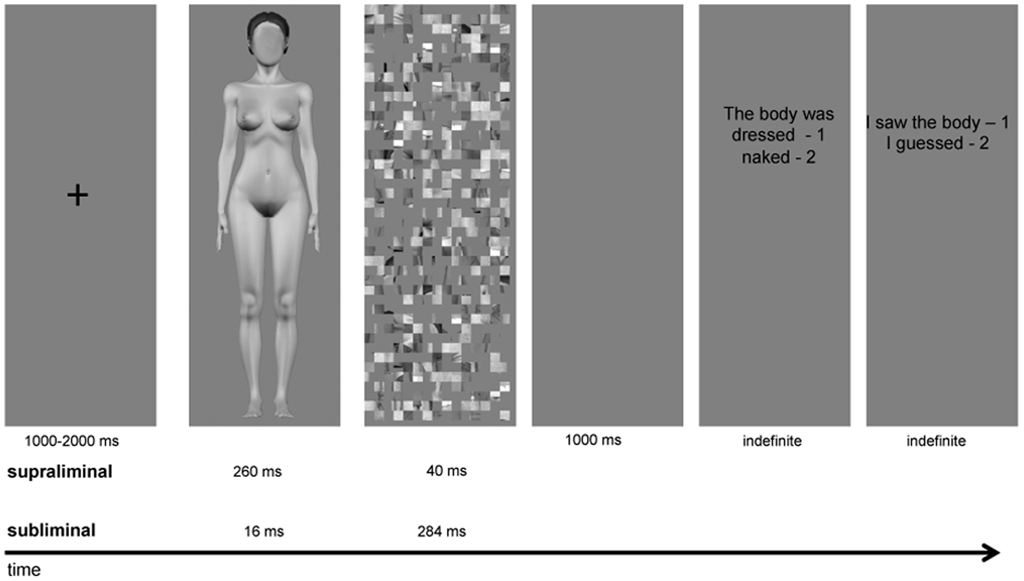
In the current study, 20 subjects were presented with images of dressed and naked figures, both supraliminally (above the threshold of conscious awareness; consciously perceivable) and subliminally (below the threshold of conscious awareness; not consciously perceivable). The figures were grayscale images of bodies in neutral positions with blurred faces that were either dressed or naked, which featured varying skin tones, body ratios and of both men and women. By neutralizing the images’ details, which were inconsequential for the purpose of this study, the researchers were able to measure the effects of the fundamental variables – that is naked versus dressed.
The subjects were randomly presented with a computer image of either a dressed or naked body, either subliminally or supraliminally. In order to produce a subliminal presentation of the stimulus the figure was only presented for 16 milliseconds, as opposed to 260 milliseconds for the supraliminal presentation of the image.
When the image is only presented for 16 milliseconds the person is not consciously aware of the stimulus.
Interestingly, however, this does not mean that the brain has not processed the stimulus!
The computer then prompted the subject with two questions. First, it asked the subject to choose whether the body was dressed or naked. Then, it asked the subject if they had either consciously seen the body or not
During the entirety of the investigation, electrodes producing an EEG recording were used to monitor brain activity levels in the subject. The varying levels of neural activity were contrasted with the different variable: naked vs. dressed bodies, opposite sex stimuli vs. same sex stimuli, and supraliminal stimulus presentation vs. subliminal stimulus presentation.
When analyzed, it was determined that in the supraliminal condition, the participants were consistently able to identify whether they had seen a dressed or naked body. In the subliminal condition, the accuracy of the participants’ responses was at chance level meaning, that as expected, they hadn’t consciously ‘seen’ the image.
The hit rate for naked versus dressed bodies was at 99% in the supraliminal condition but was only 58% in the subliminal condition.
The results showed that naked bodies produce a greater N1 response, meaning that the naked bodies are more quickly recognized and processed over clothed bodies. An N1 response simply means that the brain is processing the information very quickly.
Also, for the first time the electrophysiological method showed an increased N1 response, even in the subliminal viewing condition.
When viewing opposite-sex naked versus dressed bodies, several primary areas of the brain lit up including the extrastriate and fusiform regions in supraliminal as well as subliminal presentations, cortical (insula) and subcortical activity (amygdala, hippocampus, and thalamus). Together these brain structures make up the body processing areas, primary visual areas and additional structures related to emotion processing.
On the other hand, when viewed subliminal images only the visual and body processing areas were activated In other words, the naked body produces more salient information to the brain and it is processed much quicker (under 200 ms) and in a different way than clothed bodies.
Human nakedness, thus, produces a quick reaction in the brain even when it is not consciously perceived. This suggests that brains are wired to read and decode nude bodies.
Previously, it has been argued that bodies are not as salient as are faces in detecting emotion. However, it is argued here that naked bodies, particularly of those of the opposite sex are in fact quite relevant and produce similar brain patterns to those found when presented images of emotional faces.
For example, the facial expression of fear delivered subliminally, activates the N1 response, and as shown here, naked bodies of the opposite sex, also has the same effect. Thus, say the authors, both stimuli are in fact biological and thus socially relevant.
The authors continue by saying “We would therefore conjecture – that opposite-sex naked bodies (in heterosexual persons) in fact trigger a more powerful response due to their behavioral relevance and their biologically high significance and value as stimuli, consequently giving rise to a strong N1 enhancement.”
Therefore, they say “It appears that, similarly to what has been reported for emotional faces, sexual features benefit from automatic and rapid processing, most likely due to their high relevance for the individual and their importance for the species in terms of reproductive success.”
In other words, the human body is as relevant as the human face, especially when it comes to its sexual features.
Drawing Conclusions And Future Research
A natural extension of this research should examine the reaction the brain has to emotional body language from nude bodies. While, except for make-up and the occasional piercing, the human face is generally uncovered and exposed unlike the human body. In such cases, it may be likely that the human body, as seen here, is just as salient to processing emotion as the human face – and in some cases perhaps even as, or even more, expressive!
Take, for example, the face covered by sunglasses and head covered in a hat or even a burka and compare this to the body covered neck to toe in clothing. Logic tells us that exposed skin is the real human body, whereas clothing and sunglasses simply mask relevant information. In fact, by adorning the human body in clothing, it is turned from a human body into a clothing rack – an object. An object can not have emotion and our brains seem to understand this.
Recent research has shown that the morphology of the face itself gives people reliable clues to the person who possess it as well as their underlying personality, thus, in future research, a naked body may be found to rival that of a naked face.
 Talya Kuun is an undergraduate student at the University of Guelph currently studying psychology and neuroscience.
Resources
Legrand, Lore B; Marzia Del Zotto; Remi Tyrand and Alan J. Pegna. Basic Instinct Undressed: Early Spatiotemporal Processing for Primary Sexual Characteristics. PLOS one. 2019. 8(7): e69726. doi:10.1371/journal.pone.0069726