
Mirror My Cold – How Our Nonverbals Influence Real Body Temperate In Others
Christopher Philip
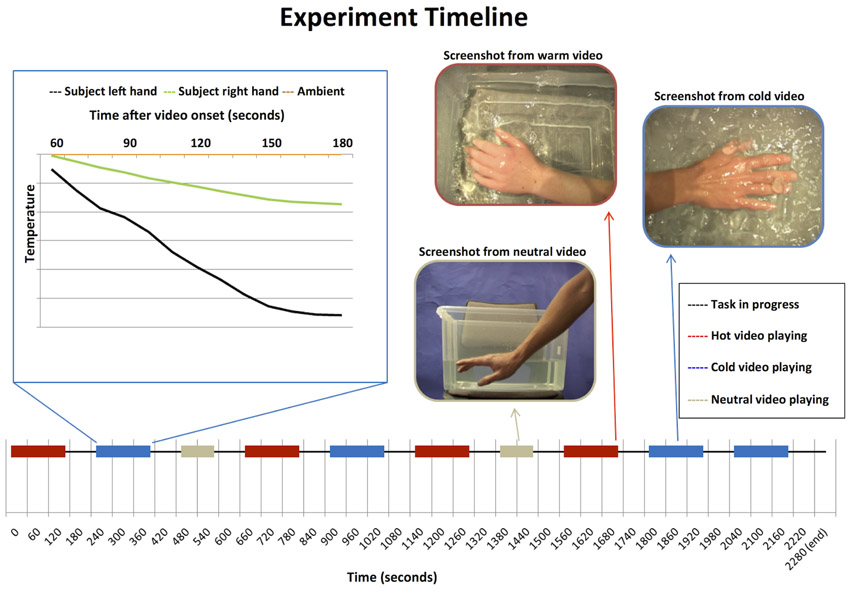 A new study published in PLOS ONE suggests that people, when they see someone else suffer from cold, actually begin to suffer themselves. In other words, temperature is “contagious.”
In fact, after watching other people suffer from putting their hands in chilly water, their hands actually began to get colder. The temperature drop was not dramatic at an average of 0.4 degrees Fahrenheit, but still enough to generate a positive significant reading.
According to Dr. Neil Harrison University of Sussex, United Kingdom, the ‘sympathetic coldness’ experienced by onlookers could be an adaptive trait. “Humans are profoundly social creatures, and much of humans’ success results from our ability to work together in complex communities,” he explains.
“This would be hard to do if we were not able to rapidly empathize with each other and predict one another’s thoughts, feelings, and motivations.”
When the subjects viewed people putting their hands in warm water, however, no noticeable effect occurred. As Harrison explains, this could be because they did a better job demonstrating coldness as they had block of ice throughout the video whereas in the hot water condition, they only showed steam briefly at the start.
In another complimentary experiment, however, it was found that a warm cup of coffee helped foster warmer relationships.
Thus, both experiments serve to demonstrate the sort of wiring that drives us. We are designed to be social and when we see someone suffer, we suffer in kind; we empathize.
(In another experiment, being social excluded also led to a body temperature drop.)
This sort of empathy helps likely us navigate a complex social environment and build constructive relationships.
Finally, it also shows that our minds and bodies are wired together working as one unit – embodied cognition!
What we see, we feel.
Click for a totally FREE comprehensive book on body language.
Our FREE nonverbal cue catalog (over 200 cues)!
Resources
Cooper, Ella A.; John Garlick; Eric Featherstone; Valerie Voon; Tania Singer; Hugo D. Critchley and Neil A. Harrison. You Turn Me Cold: Evidence for Temperature Contagion. PLoS ONE 9(12): e116126. doi:10.1371/journal.pone.0116126. http://journals.plos.org/plosone/article?id=10.1371/journal.pone.0116126