
Judging a Book By Its Shelf – How To Use Office And Bedroom Nonverbals To Predict People’s Personality
Jenny Galvao
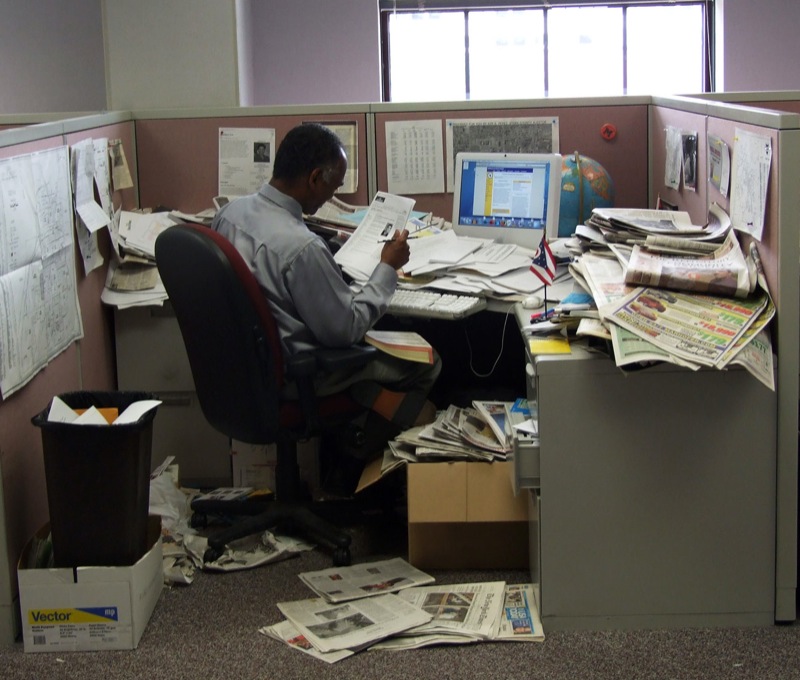 According to researchers, it’s possible to tell who dwells in a room simply by observing the characteristics of the room itself.
Individuals like to use their rooms as a place to “express themselves”, and because of this, those who pay attention to the finer details of a room are able to make correct inferences about the room’s owner.
“Research provides strong support for the assumption underlying this test—much can be learned about persons from the spaces in which they dwell …elements in the environment can serve as a kind of lens through which observers indirectly perceive underlying constructs,” say the researchers in their paper entitled “A Room With a Cue: Personality Judgments Based on Offices and Bedrooms.”
In this study, participants in five office locations (a real estate office, a retail bank, an advertising agency, an architectural firm, and a business school) in the US volunteered to participate. Eight observers examined the workspaces and made ratings (relating to the “big 5” personality traits) based on what was visible to them as they examined the work area. In the second part of the study, bedrooms were examined including rooms in private houses, apartments, dormitories, co-ops, and Greek-system housing situated in an urban setting close to a public university (below is a list of the cues the participants evaluated).
Next, self-reports were obtained of the participants whose offices had been examined. Also, two friends who knew the office occupants well were also asked to complete peer-reports measuring the same personality dimensions.
The results found that the observers, with no knowledge of whom the offices belonged to, were accurate in their assumptions. However, they were more accurate in predicting certain traits.
For example, they found that observers had the strongest (or most accurate) judgements of openness to experience, followed closely by conscientiousness and extraversion. Agreeableness also showed some accuracy, but the least consensus was found for emotional stability.
According to the researchers “occupants may craft their environments to project specific impressions that they deem desirable. For example, they may display socially desirable symbols (e.g., an award for public service), [or] they may fabricate behavioral residue (e.g., a made-up bed)”
Do our rooms really reflect our personalities? Is it because we spend so much time there that we become like the room, or does the way we design our room always reflect ourselves from the get-go?
The accuracy that observers had on judgements of personality from simply viewing a workspace for a limited time highlights how nonverbal cues found in a person’s domain can be used to make reliable predictions about the owner of that space. The study shows that we are very much like the areas in which we dwell, and that how we design these areas suite our personality. In other words, we create these areas in our image and likeness as an extension of ourselves or who we desire to be.
In some cases, a cover can be a pretty good way to judge a book, and, as far as people go, so can the room in which we dwell.
Study This Clues About A Room To Learn About The Dweller:
Strong (vs. weak) odor
Noisy (vs. quiet) in room
Noise (vs. quiet) in house
Noise (vs. quiet) outside
Well lit (vs. dark) [overall]
Well lit (vs. dark) [natural light]
Well lit (vs. dark) [artificial light]
Drafty (vs. stuffy)
Fresh (vs. stale)
Hot (vs. cold)
Good (vs. poor) condition
Decorated (vs. undecorated)
Cheerful (vs. gloomy)
Colorful (vs. drab)
Clean (vs. dirty)
Organized (vs. disorganized)
Neat (vs. messy)
Cluttered (vs. uncluttered)
Clothing everywhere (vs. none visible)
Clothing strewn around (vs. organized)
Full (vs. empty)
Roomy (vs. cramped)
Expensive (vs. cheap)
Comfortable (vs. uncomfortable)
Inviting (vs. repelling)
Large (vs. small)
Distinctive (vs. ordinary)
Stylish (vs. unstylish)
Modern (vs. old fashioned)
New (vs. old)
Multiple (vs. single) purpose
Many (vs. few) books
Organized (vs. disorganized) books
Varied (vs. homogenous) books
Many (vs. few) magazines
Organized (vs. disorganized) magazines
Varied (vs. homogenous) magazines
Many (vs. few) CDs
Organized (vs. disorganized) CDs
Varied (vs. homogenous) CDs
Many (vs. few) items of stationery
Organized (vs. disorganized) stationery
 About the Author: Jenny Galvao is an undergraduate student at the University of Guelph studying psychology.
Image Credit: Joseph Novak
Resources
Gosling, Samuel, D.; Sei Jin Ko, Thomas Mannarelli; Margaret E. Morris. A Room with a Cue: Personality Judgments Based on Offices and Bedrooms. Journal of Personality and Social Psychology. 2002. 82(3): 379-398. DOI: 10.1037//0022-3514.82.3.379