
An Interview With Dr. David B. Givens – Toward A Much Deeper Understanding of
The Origins of Nonverbal Communication
Christopher Philip

Dr. David B. Givens, Director of the Center for Nonverbal Studies in Spokane, WA
Dr. David B. Givens, is Director of the Center for Nonverbal Studies in Spokane, WA. He is the author of Your Body at Work: Sight-reading the Body Language of Business, Bosses, and Boardrooms (2019), Crime Signals: How to Spot a Criminal Before You Become a Victim (2008) and Love Signals: A Practical Field Guide to the Body Language of Courtship (2005). He has also published a Nonverbal Dictionary offered free as an online reference tool.
1. In your nonverbal dictionary you often make “Neuro notes” and specifically link these back to certain gestures and postures (e.g. http://center-for-nonverbal-studies.org/dominate.htm). How does a person’s neural network and muscular system play a role in nonverbal communication? Does this mean that nonverbal communication is “hardwired” and unconscious? Please illustrate with an example.
Just as the brain’s newer speech centers (e.g., Broca’s area) control language communication, earlier areas of the nonverbal brain control communication apart from words. Knowing its parts and wiring helps us decode nonverbal messages. Our nonverbal brain consists of six interrelated divisions, which merged in an evolutionary process from circa 500-to-two million years ago: Aquatic brain and spinal cord, amphibian brain, reptilian brain, mammalian brain, primate brain, human brain (see: http://center-for-nonverbal-studies.org/nvbrain.htm for more detail).
Also mirror neurons enable us to read others’ nonverbal body movements as if they were our own. Consider Vittorio Gallese’s abstract for the 2019 conference on “Mirror Neurons: New Frontiers 20 Years After Their Discovery”: “ ‘Embodied Simulation’ (ES) provides a new empirically based notion of intersubjectivity, viewed first and foremost as intercorporeity. ES challenges the notion that Folk Psychology is the sole account of interpersonal understanding. Before and below mind reading is intercorporeity as the main source of knowledge we directly gather about others. By means of ES we do not just see an action, an emotion, or a sensation and then understand it through an inference by analogy. By means of ES we can map others’ actions by re-using our own motor representations, as well as others, emotions and sensations by re-using our own viscero-motor and somatosensory representations. ES provides an original and unitary account of basic aspects of intersubjectivity, demonstrating how deeply our making sense of others living and acting bodies is rooted in the power of re-using our own motor, emotional and somatosensory resources.”
Further, “. . . we used to think that sensory systems and the motor systems [of the brain] are completely separate. This processing of sensory information [is such that] your movement [e.g., picking up a pencil] is [also] occurring in [the observer’s] motor system. So a fraction of the cells [in the observer’s brain] that are involved in picking up [a] pencil will respond when you pick up your pencil. It’s in the motor system that he [Giacomo Rizzolatti] discovered this remarkable thing. So he made us realize that the motor systems have sensory cognitive capabilities. It’s an extraordinary advance.”
(Source: Comments by Eric Kandel [with David Givens’s edits, in brackets, for clarity] on PBS’s “Charlie Rose Show” (“The Social Brain,” January 10, 2019); http://www.charlierose.com/download/transcript/
2. First, why is it important to locate and cite regions of the brain that control emotional body and facial expressions in nonverbal communication? Second, how are brain regions identified specifically as they pertain to nonverbal emotional body and facial cues?
Let’s illustrate with a couple examples:
With amphibians, 1. the pontine reticular excitatory system becomes more elaborate. The pontine tegmentum’s link to the spinal cord’s anterior horn motor neurons and muscle spindles raised the body by exciting antigravity extensor muscles (e.g. antigravity sign). 2. The vestibulospinal pathway elaborated–from receptors in the inner ear via the vestibular nerve (cranial VIII), and via cerebellar fibers to the vestibular nucleus in the upper medulla–running the length of the spinal cord for body posture (i.e., basic stance) in relation to gravity. 3. The tectospinal tract evolved, consisting of the superior (and inferior) colliculus and its links, via the brain stem, running a. to cervical cord interneurons, then b. to anterior horn motor neurons, then c. to spinal nerves, and finally reaching d. muscle spindles for postural reflexes to sights and sounds. 4. And the rubrospinal tract further evolved: paleocircuits from the red nucleus of the midbrain running a. to thoracic cord interneurons, then b. to anterior horn motor neurons, and finally c. to muscles and muscle spindles for postural tone of the limbs’ flexor muscles.
Skipping forward in time we see the “Human brain”. With hominids, 1. the corticobulbar tract further evolved: corticobulbar pathways to the facial nerve (cranial VII) permitted intentional facial expressions. 2. Broca’s cranial pathways evolved: Broca’s-area neocircuits via corticobulbar pathways to multiple cranial nerves permitted speech. 3. And Broca’s spinal pathways evolved: Broca’s-area neocircuits via corticospinal pathways to cervical and thoracic spinal nerves permitted manual sign language and linguistic-like mime cues.
3. Is there any part of our nonverbal communication that is conscious or do you believe that most nonverbal communication stems from the ancient pathways such as the “amphibian brain” and merely sequentially repeated and predictable behaviors?
Nonverbal communication is 1. The process of sending and receiving wordless messages by means of facial expressions, gaze, gestures, postures, and tones of voice. 2. Also included are grooming habits, body positioning in space, and consumer product design (e.g., clothing cues, food products, artificial colors and tastes, engineered aromas, media images and computer-graphic displays). Nonverbal cues include all expressive signs, signals and cues (audio, visual, tactile, chemical, etc. — which are used to send and receive messages apart from manual sign language and speech.
Each of us gives and responds to literally thousands of nonverbal messages daily in our personal and professional lives–and while commuting back and forth between the two. From morning’s kiss to business suits and tense-mouth displays at the conference table, we react to wordless messages emotionally, often without knowing why. The boss’s head-nod, the clerk’s bow tie, the next-door neighbor’s hairstyle–we notice the minutia of nonverbal behavior because their details reveal a. how we relate to one another, and b. who we think we are.
4. Are nonverbal signal learned or innate?
Body-language signals may be a. learned, b. innate, or c. mixed. Eye-wink, thumbs-up, and military-salute gestures, for instance, are clearly learned. Eye-blink, throat-clear, and facial-flushing cues, on the other hand, are clearly inborn or innate. Laugh, cry, shoulder-shrug, and most other body-language signals are “mixed,” because they originate as innate actions, but cultural rules later shape their timing, energy, and use.
Body-language researchers do not always agree on the nature-nurture issue, however. Like Darwin, human biologists suppose that many body-motion signs are inborn. Like Birdwhistell, many cultural anthropologists propose that most or even all gestures are learned, while others combine the biological and cultural approaches. Research by psychologist Paul Ekman and his colleagues has shown that the facial expressions of disgust, surprise, and other primary emotions are universal across cultures.
5. What percent of our communication is nonverbal?
According to Kramer, “94% of our communication is nonverbal, Jerry” (Seinfeld, 1998). Kramer’s estimate (like the statistics of anthropologist Ray Birdwhistell [65%; Knapp 1972] and of psychologist Albert Mehrabian [93%; 1971]) are hard to verify. But the proportion of our emotional communication that is expressed apart from words surely exceeds 99%.
6. What role does the limbic system play in nonverbal communication?
The limbic system are those interlinked modules and pathways of the brain in charge of emotions, feelings, and moods. Phylogenetically, the limbic lobe is the oldest part of the cerebral cortex. The limbic system includes the amygdala, anterior thalamic nucleus, cingulate gyrus, fornix, hippocampus, hypothalamus, mammillary bodies, medial forebrain bundle, prefrontal lobes, septal nuclei, and other areas and pathways of the brain. The hypothalamus, a key player, mediates nonverbal behaviors through the brain-stem reticular nuclei. When excited, the reticular nuclei arouse cerebral as well as spinal circuits.
A great deal of our nonverbal communication reflects happenings in the limbic system. For example when shopping for consumer products, we often heed limbic rather than rational thought. Nonverbal signs, signals, and cues disclose limbic emotions and attitudes more openly and with greater honesty than words. In human beings, the limbic system grew in tandem with the cerebral cortex. Thus, ours is the most emotional–as well as the most intellectual–species on Earth
7. Do you believe that nonverbal communication cues, for example, dominance displays, such as puffing out the chest, standing tall, placing the arms akimbo, tilting the head back, and so forth, developed at random or are linked to some primitive function, or origin?
The high-stand display is a vertically looming stance in which the body “enlarges” through extension of the limbs. It is a primeval “pushup” intended to lift the quadrupedal body higher off the ground. The high-stand is an antigravity display used to show a superior, confident, haughty attitude or mood. It is a forerunner of the aggressive pushup used by some lizards, and of our own assertive palm-down cue as well.
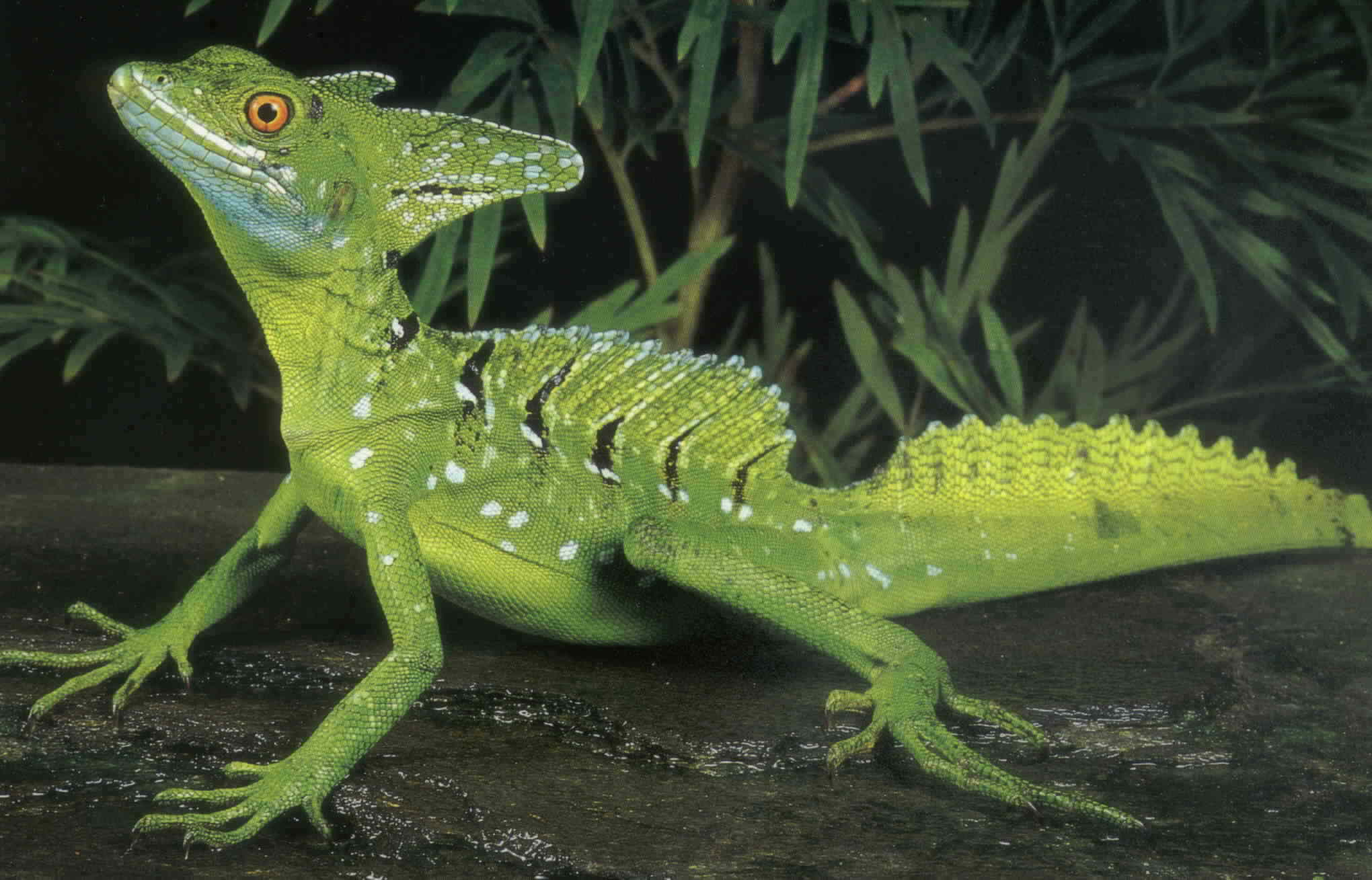
Double-crested basilisk (Basiliscus plumifrons; Costa Rica) – “Looking as tall as possible and expanding the chest is universally employed by human beings as a means of intimidating an adversary, as witness the behavior of small boys.” ~ Hans Hass (The Human Animal, p. 146)
Image Credit: Copyright by Gail Melville Shumway.
It is likely that paleocircuits for “standing tall” developed in sea creatures before animals set foot on land. Fossil evidence is lacking, but in living fishes, such as gobies, status and rank vary in proportion to physical body size. The very big dominate the merely large, who in turn dominate the small. Gobies and other piscines, however, may appear “bigger” through an array of nonverbal illusions. To loom larger, a goby stiffens and raises its fins, lifts its head, puffs out its throat, and flares its gill covers. Cichlid fish, e.g., erect vertical fins and turn to display a “bigger” broadside (e.g. broadside display). Puffer fish balloon in size, cod fish bulge their heads and jut out their pelvic fins to threaten, and mudskippers raise their bodies on vertical fins in aggressive displays.
In land animals, forelimb extension lifts the body’s front end to more vertically imposing heights. Doing a pushup makes living iguanas and lizards, e.g., look “bigger” than they appear with their bellies lowered to the ground. The Australian frilled lizard rears and erects its frill, while the cobra rears and spreads its hood. Research on “Sociality, Stress, and the Corpus Striatum of the Green Anolis Lizard” (Greenberg 2003) confirms the fact that the anole lizard’s pushup to a high-stand is mediated by brain modules of the basal ganglia.
Mammals push up in aggressive stiff-walk postures. Bulls, for example, take several stiff-steps to loom “large” before galloping ahead at full charge. Bears, coyotes, and wolves strut with a stiff-legged gait to carry their bodies higher off the ground. A dominant wolf stands over its submissive foe. Primates show dominance by straightening their legs and widening their arms. A gorilla, e.g., displays with a stiff-legged bluff charge. An aggressive chimpanzee rises to a bipedal stance, widens its bristling arms, and swaggers from side to side to seem “big.” Rearing on the hindlegs is a posture directed by adult or young adult baboons at other baboons in the wild; it can prelude attack or escape (Hall and DeVore 1972).
To embody the vertebrate’s natural weapon, sheer size, we assume a John-Wayne stance, i.e., we stand tall, bristle, square our shoulders, broaden our bodies with the hands-on-hips gesture, talk in deep tones, and toe-out to military oblique. (That the vertebrate eye responds to changes in size makes it possible for different species to understand each other’s cues. Park rangers advise, e.g., that we stand up and wave our arms to threaten mountain lions encountered in the wild.
Paleocircuits mediating the high-stand display consist of small networks of spinal-cord interneurons in charge of the muscle stretch reflex. These mini-networks mediate antigravity responses, i.e., the muscular contractions which automatically extend our limbs to keep us standing upright (without our consciously deciding to do so).
8. Many people believe that “body language” is nothing more than normal affect (to make the body feel more comfortable, to scratch an itch, etc.) and its underlying emotional interpretation merely subjective. What evidence exists that nonverbal communication is more than just guesswork?
The study of nonverbal communication and body language involves more than guesswork. It employs the scientific method–the same rigorous methodology used in physics, chemistry, neuroscience, and medicine.
9. What work still needs to be done in the field of nonverbal communication and what discoveries do you expect to come in the future?
More work needs to be done on the relationship between verbal and nonverbal communication. Beginning some 500 million years ago in the ancient chordate spinal cord and hindbrain–in a shared caudal hindbrain, rh8-upper-spinal compartment–circuits for vocal-laryngeal and gestural-pectoral communication provide neural linkage between voiced words and bodily gestures. This connection needs more study.
More work, too, is needed on the role of mirror neurons in nonverbal communication. Mirror neurons provide brain circuitry that enables us–intuitively–to decode and understand the meaning of palm-up cues. When we see a palm-up hand gesture, mirror neurons set up a motor template, a prototype or blueprint in our own brain that allows us to read the cue. Through links to the limbic system, there are also mirror neurons to help us decode its emotional nuances and meanings. We are seemingly wired to interpret the palm-up actions of others as if we ourselves had enacted them.
10. What future research should we expect from the Center for Nonverbal Studies?
We expect to continue exploring the neurological basis of encoding and decoding nonverbal signs, signals, and cues.
Resources
Givens, David B. (1977). Shoulder Shrugging: A Densely Communicative Expressive Behavior. In Semiotica (Vol. 19:1/2), pp. 13-28.
Givens D. The nonverbal basis of attraction: Flirtation, courtship, and seduction. Psychiatry. 1978. 41: 346.
Givens, David B. (1982). From Here to Eternity: Communicating With the Distant Future. In Et Cetera (Vol. 39, No. 2), pp. 159-79.
Givens, David B. (forthcoming). Reading Palm-up Signs: Neurosemiotic Overview of a Common Hand Gesture (Accepted for publication [March 4, 2019] in Semiotica).
Givens, David B. (1978). Social Expressivity During the First Year of Life. In Sign Language Studies (20), pp. 251-274.
Givens, David B. (1978). Greeting a Stranger: Some Commonly Used Nonverbal Signals of Aversiveness. In Semiotica (Vol. 22), pp. 351-67.
1 comment for “An Interview With Dr. David B. Givens – Toward A Much Deeper Understanding of The Origins of Nonverbal Communication”