
Interview Dr. Aaron Sell – The Anger Face Confers Strategic Benefit
Christopher Philip
 Dr. Aaron Sell is the Undergraduate Program Director (Mount Gravatt Campus), School of Criminology and Criminal Justice and Senior Lecturer, School of Criminology and Criminal Justice, Griffith University. His research focuses on anger and its evolution. One of his main tenants is that anger is adaptive and used as a bargaining tool in favor of the displayer. That is, by using the expression one is offered specific gains in light of those who observe it. Thus, anger is a tool of negotiation and used in order to provide an advantage to those who display it. Read more about his research here: http://www.cep.ucsb.edu/grads/Sell/
1. I think most people are aware that emotional expressions are useful in indicating how a person is feeling in a more non-selfish way. That is, people feel anger, or happiness, or sadness and emit cues which indicate that this is so. However, in your research you assert that anger is an adaptive display which has been passed down through evolution because it confers an advantage to the person using it. Can you outline why you believe this is so, and provide an example for the readers about how it might benefit the user of the expression (perhaps at the expense of the reader)?
There are two strong hints that the anger face was “designed” by natural selection. The first is that it appears unique to humans; our closest surviving relative – the chimpanzee – does not use the same facial expressions as we do. The second is that congenitally blind children will produce normal anger expressions. These combined facts suggest that natural selection has been active on the anger face; in other words, it suggests some humans outreproduced others because they made different faces when angry.
The real proof of whether something evolved by natural selection was laid out by George Williams in 1966. He said you needed to look for evidence of complex functional design, i.e. multiple features each geared toward the production of an otherwise unlikely outcome that would have solved a problem of reproduction in the organism’s past environment. For the anger face, this evidence comes from dissecting the different components of the face and showing how each one has a similar effect: each of the seven major components of the anger face enhances a cue of physical formidability in the face (see question #6 for the anger face recipe).
In short, some faces look tougher than others. When you get angry, your face morphs in a way that makes you appear more like one of those tough guys. This evolved because people who could look tougher during conflicts of interest were more likely to win those conflicts, and more likely to win without fighting. This happened often enough in the last ten million years or so, that we have all descended from the people who made just the right face when angry.
Ultimately the function of the emotion of anger is to bargain for better treatment. It comes online when others treat you worse than you feel entitled to. One way of making someone value you more is to show how bad you can hurt them. That’s part of what the anger face does. There are other strategies too; in cooperative relationships anger triggers a kind of removal of cooperation (e.g. the silent treatment, the cold shoulder) whereby you demonstrate to the person what their life would be like if you withdrawal from the relationship. This kind of anger is much more common, but the anger face doesn’t appear during these interactions. If you imagine the last time your wife was angry at you, her face probably looked like a driver’s license. The blank face is a kind of angry face when you expect a smile.
Nonetheless, a blank face is not as interesting to study, so most of the work on the anger face focuses on the face made before aggression; the one you see in movies and may associate with rage.
2. When people see an angry face, what are they really seeing?
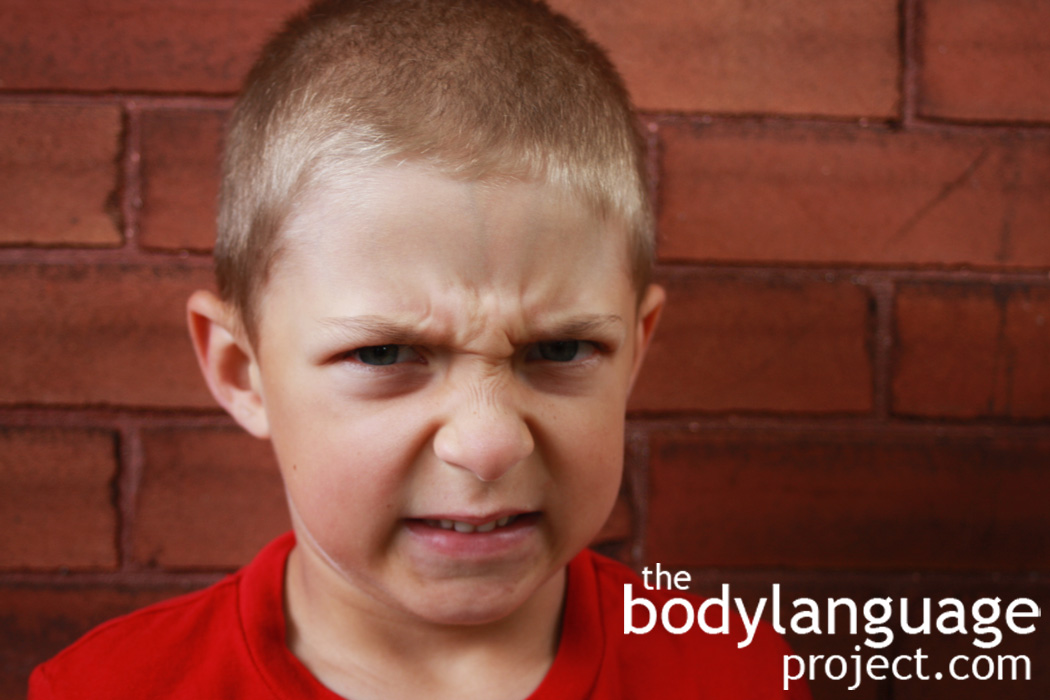
They’re seeing a constellation of at least seven features: a lowered brow, raised cheek bones, thinned lips, raised mouth, squared jaw with flexed chin bun, flared nostrils and so on. It is literally a collection of modifications to the face that enhance the cues that distinguish a strong man from a weak one.
3. If anger is adaptive, then do other expressions such as happiness, sadness or even disgust operate on the same principles? Do all human expressions provide an advantage to the person using them? Does the person reading them receive any benefit at all?
Emotional expressions in general may or may not function on the same principles. Each emotion is its own adaptation and evolved for its own functions. In general, expressions don’t evolve unless they were of reproductive benefit to those that had them. Also, mechanisms for detecting facial expressions won’t evolve if detecting them was not of benefit to the perceiver. For example, there’s some new evidence that mice have distinct facial expressions, but humans can’t “see” them because we haven’t evolved mechanisms for perceiving the subtle changes that constitute mouse facial expressions. There are exceptions to these rules though; sometimes animals will parasitize other perceptual systems with their own displays. For example, butterfly wings will often have black spots that look like the eyes of a much larger animal to some predators. Now the predator species didn’t evolve to see butterfly eyes and flee from them; in fact they reproduce less well because of that (i.e. they go hungry). But they did evolve perceptual mechanisms for perceiving eyes – particularly eyes that are staring at them.
4. Because evolution favored the development of the anger face, does this imply that natural selection has played a role in shaping that anger face? Has the selection process been written into our DNA creating a set pattern of muscular contractions which arise neurologically when you’re experiencing emotions such as anger? Are these muscles arbitrary or did the sender and receive sort of co-agree on what would work best to convey anger?
Natural selection played the most important role in shaping the anger face. An important part of my theory is that the anger face’s appearance is not arbitrary. It’s not just that I need to look angry and you need to see that I’m angry. If that were the case, any old combination of facial muscles would have been fine; e.g. we could touch our nose to our upper lip to indicate anger, or we could blink one eye, or we could stick our tongue in our cheek, or we could smirk to the left. Instead, we lower our brow while raising our cheeks (flaring our nostrils in the process), raise our mouth while thinning our lips and pushing them outward, square our jaw and flex our chin bun, while pressing our lips together and raising our eyelids. These combinations of muscles movements is more complicated than necessary to send a single binary signal (e.g. anger or not anger).
The muscle contractions are the anger systems way of making the angry person appear more physically strong. This is also why they co-occur with an angry body posture that makes you stand taller and puff out the chest.
Importantly, once natural selection designed the anger face to make you seem tougher; other people would then evolve mechanisms to detect that anger face. People who could detect anger would have outreproduced people who blindly ignored angry individuals, after all. So natural selection designed both the anger face and the mechanism for perceiving it. But the anger face wasn’t originally designed as just a signal. After the anger detection system evolved, then the anger face could be used as a signal to let others know that you’re angry. In all it was a three step process: the evolution of the anger face to make you appear physically tougher during anger-based bargaining; then the evolution of a system for detecting that anger; then the use of the anger face as a signal of anger.
Regarding the “(is the anger face) written into our DNA” question. That’s the sort of question that as evolutionary psychologists we can’t really answer without leading to misunderstandings. Suffice it to say that the anger face is universal across cultures and does not have to be taught or observed by children in order to produce it (recall that blind children make normal anger faces).
5. Can men and women both display the anger face equally well? If it has favored one sex over the other, why would this be so?
I don’t have any direct data on this question, but it is an interesting one. So far I’ve been speaking as if there is only one anger face; and while it is true that the closed-mouth anger expression is universal and present in children, there are subtle modifications to the face that are used in different stages in anger. For example, in the anger face that appears before aggression (e.g. the one that accompanies the standing tall and puffed up chest body posture) you see the eyebrows being lowered. This gives the illusion of a larger browridge, a feature more common in strong men. But during some instances of anger in which a person is surprised by your defiance (say a mother confronting a child who talks back) you will sometimes see a raised eyebrow accompany anger; as if to say, “you said what to me?!” And so you may see slightly different kinds of anger expressions adopted by men and women depending on whether they are threatening aggression.
6. What goes into the best anger face, which muscles should be activated in order to project the best image of strength?
You can find the details of the muscles in my 2019 paper in the journal Evolution and Human Behavior. Humans don’t really need instruction on this though; when angry your face will do it.
[Editor’s note: From the paper the Action Units used are 4, 5, 7 10, 17, 22, 23, and 24. As mentioned, the anger face is done by lowering the browridge, lowering the brow, raising the cheekbones, widening (flaring) the nose,, raising the mouth, thinning the lips, raising the chin bun, and raising the chin raised. Follow this recipe and try it in the mirror!]
7. Besides the face, do people read strength from any other part of the body such as by body posture, muscles in the arms, shoulders, or other?
Absolutely. I have published experiments demonstrating that people can assess fighting ability from the body, from the face and from the voice. The body is best and the voice worst, but all three are consistent and can be done across cultures. You don’t need to be familiar with a person’s language in order to judge how strong they are from their voice.
8. Many men spend hours in the gym building strong bodies, is this a wise move? Would it be the case that body-building provides modern men with any specific advantage or would they be better suited to work on their anger face instead?
We are still working on why there are cues of upper body strength in the face. Obviously the face isn’t used in lifting…but nonetheless you can estimate how strong a man is (with good accuracy) from his face. We can assume at the moment though that deploying a good anger face will make you seem stronger, but this is largely a bluff (like a cat whose hair stands up on edge to make him seem bigger). A powerful upper body, though, can actually be used to hurt other people. Ideally you want to be and look strong. Of course the importance of this has dwindled in our society as we’ve moved past the industrial revolution and into an era where interpersonal violence is largely condemned and extremely rare. On the other hand, women’s appreciation for a muscular body does not appear to have diminished. So there are plenty of good reasons to be strong. Whether it’s worth the time and effort depends on what else you have to do I suppose.
9. In your research you found that male action stars, selected for their physical strength, were more likely to vote right, and believe in the utility of war and certain entitlements, but also be more self sufficiency. How could evolution pair political beliefs with a certain body type or body musculature? Does this mean that if I see a person with a big chest, and bulging biceps, I know that he’s likely to be able to take care of himself rather than rely on the government? Is this also the case for women? If not, why hasn’t selection worked on women as it has on men?
All good questions. We don’t believe that evolution paired bicep circumference with political attitudes in precisely that way. Rather, evolution designed a universal human nature that responds to an internal sense of one’s fighting ability such that those who estimate themselves to be tougher will be more likely to respond to outgroup threats with aggression. Meanwhile, men who think of themselves as weaker will be more interested in placating our enemies.
If that sounds implausible, let me make the full case. There is now very good evidence that human kind has fought wars for millions of years. There is good evidence that chimpanzees spontaneously raid other groups and fight wars of attrition wherein one group can literally be wiped out by another. They are not starving when this happens, and they are not under particular undue stress. It appears to be an evolved strategy that chimpanzee groups reliably engage in. Furthermore, we have evidence from archeology and anthropology that shows that warfare has been a part of almost every society that has ever existed. If we take this evidence seriously it means that our species has engaged in cooperative killing for around 10 million years, possibly much longer. If this is correct, it is all but impossible that the male mind (in particular) has not been designed to engage in warfare.
Given that, one of the first strategies that natural selection would reward would be one that calibrated a man’s appetite for war to depend on his personal probability of surviving it. A physically strong man would be more likely to actually win a battle (though he’s still just one man), he would be more likely to survive that battle, and he would enjoy a larger share of the spoils of that war. A weak man would be more likely to cause his side to lose, to die himself, and be denied the benefits of war when it was over. The end result of this situation should be that physically strong men should be more tolerant of confrontation, more comfortable using aggression, less compelled to give in to enemies, more supportive of aggression as a way of resolving conflicts, and so on. We have evidence of all of these predictions, including evidence across several cultures.
Just to get some attention from the press, we also showed the predicted effect in Hollywood. Hollywood is very left wing, but there is an exception: the action stars. Men with large powerful bodies have a hard time thinking the best solution to the war in the Middle East is to understand our opponents or to educate people. That works for Martin Sheen, Tim Robbins and Danny DeVito, but Bruce Willis put a bounty on Saddam’s head, and Arnold Schwarzenegger, the Rock, Stallone, Chuck Norris, Kevin Sorbo, and Clint Eastwood have made their rightwing politics pretty plain. I did a proper study on the matter and looked up political donations by actors to classify them. I could never find out Vin Diesel’s politics though, so if anyone knows him tell him to contact me. I’d love to ask him a few questions.
10. In a hypothetical scenario, what should one of my readers do if they see someone exhibiting an angry face?
Well that depends on many factors; the most important of which is what you want out of it. As a scientist I tend not to tell people what they should want; they tell me what they want and then we can advise them on what to do next. I’ll assume they are just looking to end the encounter safely.
First, find out if the face is pointed at you. This should be easy as the anger face is usually directed right at the eyes of the person they are angry with. If it’s not you, it’s not your problem and you can safely leave trying not to get too much attention. Second, if they are angry at you, the safest thing to do is apologize. Research shows that apologies will work wonders; people will almost always accept the first apology. If you’ve apologized for this in a previous incident and are caught doing it again, it can be much more difficult to defuse anger. You can try apologizing again, but sometimes they won’t hear it. In that case, you could consider getting angry at them in return, using your anger face and threatening them with doom (if they are someone who does not need you) or with abandonment (if they are someone who needs you). Or – even more safely – you can just leave. That usually works (particularly if you are faster than them). If you are not, and they are unwilling to let you leave you might need to prepare for some violence. In that case, size them up (this will come naturally to you). If you think you can beat them, go ahead and try that, but be careful not to kill them because the law treats you pretty badly in those cases. You’ll need to prove you couldn’t run away in most states, and that you couldn’t defuse the situation peacefully. If you don’t think you can take him, you can try begging for your life. Appeals to the vulnerability of your family and any dependent children will usually work on non-psychopaths. If you are dealing with an angry psychopath that you cannot take in a fight and won’t let you leave…well, you should prepare to be murdered. Keep in mind that very few beatings actually result in death. In fact most gun shots and stabbings don’t result in death either. Try to call 9/11 in advance if possible, and remember to protect your neck and chest if possible. You’d be surprised how little of your body has to be intact in order to survive.
For the record, the above is extremely rare. Anger almost never leads to violence (the famous survey by James Averill showed that about 3% of incidents of anger even involved the explicit threat of aggression). And most anger-based violence doesn’t result in death; in fact almost none do. You’ll find that most of the time when someone is angry with you it’s a person who loves you very much; e.g. a spouse, a friend, a family member. The function of anger is to bargain for better treatment; that’s why it evolved. Anger isn’t very likely to kill you. You should be more worried about hatred or jealousy.
11. What areas of research are you looking at next and what can we expect from you in the future?
The next step with the anger face is to identify why there are cues of strength in the face. I listed some possibilities in the 2019 paper, one of which has recently been supported by some archeological evidence. Specifically, it looks like some of the features in the face that indicate strength are thicker bone in parts of the face that are likely to be broken during aggression. In short, a “tougher” face is one that can withstand blunt force trauma, thus making the person a better fighter. I’m checking a few other possibilities as well.
I’m also working on a paper that talks about the function of the anger yell, which wouldn’t be hard to guess if you know my theory of the anger face.
Resources
Petersen, Michael Bang; Daniel Sznycer; Aaron Sell; Leda Cosmides, and John Tooby. The Ancestral Logic of Politics: Upper-Body Strength Regulates Men’s Assertion of Self-Interest Over Economic Redistribution. Psychological Science. 2019. 24(7): 1098-1103. DOI: 10.1177/0956797612466415
http://bodylanguageproject.com/articles/rich-male-vote-left-small-biceps-politics-upper-body-strength/
Sell, Aaron, Cosmides, L. and Tooby, J., The Human Anger Face Evolved to Enhance Cues of Strength. Evolution and Human Behavior. 2019, doi: 10.1016/j.evolhumbehav.2019.05.008
http://bodylanguageproject.com/articles/human-anger-face-signal-strength/
Sell, Aaron; Liana S. E. Hone and Nicholas Pound. The Importance of Physical Strength to Human Males. Human Nature. 2019. 23:30–44. DOI 10.1007/s12110-012-9131-2
http://bodylanguageproject.com/articles/hes-strong-means-believes-war-reading-nonverbals-physical-strength/
Sell, Aaron, Bryant, G., Cosmides, L.,Tooby, J., Sznycer, D., von Rueden, C., Krauss, A. & M. Gurven. (2019). Adaptations in humans for assessing physical strength and fighting ability from the voice. Proceedings of the Royal Society B, 277, 3509-18.
Sell, Aaron, Cosmides, L., Tooby, J., Sznycer, D., von Rueden, C. & Gurven, M. (2019). Human adaptations for the visual assessment of strength and fighting ability from the body and face. Proceedings of the Royal Society B, 276, 575-584.
Sell, Aaron , L Cosmides, J Tooby, D Sznycer, C von Rueden, M Gurven. Human adaptations for the visual assessment of strength and fighting ability from the body and face. Proceedings of the Royal Society of London B: Biological Sciences 276, 1656: 575-584.
Zilioli, Samuele, Aaron N Sell, Michael Stirrat, Justin Jagore, William Vickerman, Neil V Watson. Face of a fighter: Bizygomatic width as a cue of formidability. Aggressive behavior. 6 JUN 2019. DOI: 10.1002/ab.21544.