
Humans Can’t Help But Mirror Robot’s Nonverbal Expressions
Christopher Philip
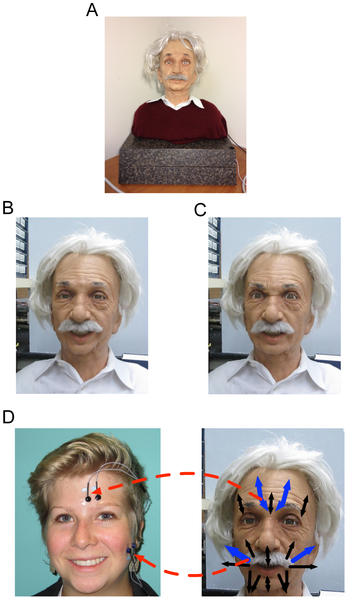
Figure 1: Linking android and human facial expressions – servos vs. muscles.
(A) Einstein the robot, as the participants saw him. Robot expressions of (B) happy and (C) angry. (D) Relationships were investigated between the actuators shown in blue, and facial muscle activity in the corrugator and zygomaticus, as indicated by the red arrows. The subject in the photograph has given written informed consent, as outlined in the PLOS consent form, to publication of their photograph.
doi:10.1371/journal.pone.0099934.g001
While robots are being programmed to behave more humanlike, as it turns out, you can’t escape your own humanoid programming!
A new study published in PLoS ONE has found that regardless of how creepy you feel a human-like robot appears, you’ll still mirror its facial expressions.
Mimicry in nonverbal communication is common when two people form an intimate bond or collaborate together. When people agree, they will form symmetrical body movements and mirror each others facial expressions, body positions, and gestures.
Researchers Galit Hofree and Piotr Winkielman first had students, 23 in total, begin by rating how “creepy” they felt the human like robot made them feel as well as its lifelike appearance.
The robot itself was modeled after Albert Einstein and can reproduce lifelike facial expressions including anger and happiness.
Results showed that regardless of how the students felt about the robots, the majority still mimicked Einstein’s smiles and pouts without any instruction or prompting. However, when the robot was shown on a television screen, only the students who reported the robot as lifelike mimicked the facial expressions.
Interestingly, the students imitated the robot regardless of their level of comfort felt around it.
“There are all sorts of attempts now to bring in humanoid robots into health care, [the] service industry and regular homes. This study shows that these modern androids can, via mimicry, create a form of ‘relation’ with other human beings,” Winkielman said.
“Androids that look humanlike and show humanlike movements can spontaneously ‘grab’ us and make us mimic them,” Winkielman added.
The android might also help us uncover how mimicry works in the brain. Spontaneous mimicry is thought to occur due to mirror neurons located in the brain. These are the mechanism thought to produce copy-cat responses. What is interesting is that the response was shown to happen between a person and a lifelike representation of a person whom we understand can not experience any emotions whatsoever.
This suggests that the mirroring effect is a true ‘reflex action.’
“Our data show that mimicry occurs even when people clearly do not believe that the other agent is conscious, has free will or experiences emotions — the hallmarks of an emotional being,” the scientists wrote in the paper.”
Future research may focus on developing robots capable of building rapport and engage people in service oriented ways as well as other business interactions. Additional possibilities include robots specifically designed for companionship and comfort.
Resources
Hofree G, Ruvolo P, Bartlett MS, Winkielman P. Bridging the Mechanical and the Human Mind: Spontaneous Mimicry of a Physically Present Android. PLoS ONE. 2019. 9(7): e99934. doi:10.1371/journal.pone.0099934.
http://www.plosone.org/article/info:doi/10.1371/journal.pone.0099934