
How Extending The Middle Finger Affects Perception
Christopher Philip
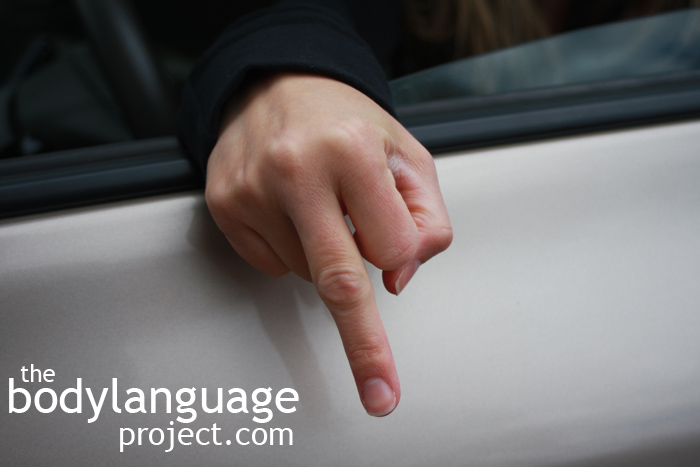 Extending the middle finger, is a pervasive signal of hostility across the U.S. and West, as well as various other parts of the world. While it has become more ubiquitous, it certainly is not universal. Therefore, one must agree that the origins of the middle finger signaling hostility has less to do with an innate origin and more to do with learning or culture. In other words, when kids are born, they don’t show aggressiveness by ‘flicking the bird.’
Thus far, the majority of research on movement and their effects on feeling and thinking has focused on innate movements such as facial expressions as well as select body expressions, for example pulling the arms in versus extending them (approach versus avoidance) with very little attention paid to learned gestures. By the same token, the head nodding gesture has been linked to a learned and innate origin giving it extra credence. In the head nod we go up-and-down for yes and side-to-side for no and this has been linked back to breastfeeding where babies who seek the nipple move their heads up and down (vertically) searching and when they’ve had enough turn left and right (horizontally).
How the middle-finger gesture interacts with our underlying cognition and emotions hadn’t been studied. However, recent interest into the ‘embodiment of gesture’; the link between the brain and body, has spurred researchers Jesse Chandler and Norbert Schwarz, University of Michigan, to find out just how deep gestures run.
Specifically, they wished to discover if people us the gesture not only to indicated hostility, but if holding the gesture would actually produce hostility in people. Thus, they set out to compare two relatively ambiguous gestures; the “thumbs up” gesture which is clearly more positive in a nature versus the “middle-finger-gesture” which is clearly negative in nature.
The Current Study
By using a cover story to disguise the gestures, the experimenters discovered that, indeed, extending the middle finger resulted in more hostile impressions of other people. This happened in both men and women. Interestingly, however, it did not affect other unrelated, non-hostile traits. Conversely, the “thumbs up” gesture produced more positive impressions across various traits.
Also, women who were induced to produce the “thumbs up” gesture tended to rate the target more favourably across all traits and also tended to report liking them. This wasn’t found in the male subjects however.
The results suggest that cultural, learned gestures can have the effect of priming the brain to generate specific impressions – good or bad.
This supports other research showing the embodiment of nonverbal expression. For example, it is well studied that facial expressions, posture, arm movements and now hand configurations can influence people’s thoughts and feelings. This goes across many dimensions of people including emotions, memory, problem solving, and personal perception, and so forth.
“Hostile gestures, like an extended middle finger, not only express the actors’ feelings but also contribute to the actors’ perception of their social environment,” say the researchers.
They continue, “Hence, extending ‘‘the finger” in response to an annoying behavior may increase one’s perception of others’ apparent hostility, potentially justifying further aggressive responses. The gratuitous display of hostile gestures may therefore affect the actor as much as the perceiver at whom the gesture is directed.”
Indeed.
The Take Away Message
If one wishes to mitigate the effects of hostility, its best to not only have your hostile co-partner drop their hostility nonverbal communication, but also inhibit yours. Via the effects of mirroring, hostile behaviour can have a positive feedback loop where one cue fosters the solicitation of increased levels of aggression.
And this is usually what we see – often ending abruptly as physical confrontation. To end the cycle or prevent it from happening one should be cautious about one’s own body language to prevent negative feelings from ever generating to begin with. If one notices them in others, dissuading them and “disarming” them of the hostile gesture is the first step toward conflict resolution.
Resources
Chandler, Jesse and Norbert Schwarz. How Extending Your Middle Finger Affects Your Perception of Others: Learned Movements Influence Concept Accessibility. Journal of Experimental Social Psychology. 2019; 45:123-128.
Learn More Starting Today!
Learn the basics of body language quickly and easily by taking one of our tailor-made video courses!
Short on cash? Then read an ENTIRE comprehensive book on body language – it’s totally FREE!
Which body language video course will you start with?
1. “The Secrets of Body Language”