Here’s a Tip – Don’t Stand Too Far Away
Jenny Galvao
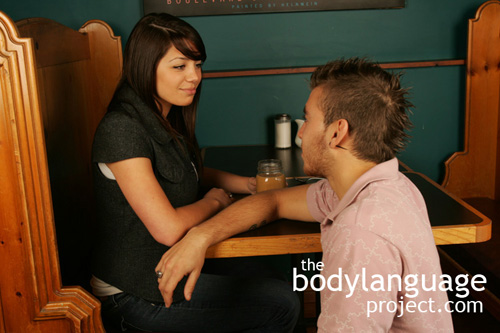
When servers drop next to the table they can create more favourable impressions which lead to greater tips. However, this particular impression boarders on sexual intimacy!
According to research by Céline Jacob and Nicolas Guéguen, University of Bretagne-Sud, a waitresses’ tip will vary depending on how close she stands to the patron.
They found that a server’s nonverbal behaviour can lead them to a larger or smaller tip. Specifically, standing close to the patron led to a larger tip whereas standing too far, led to a smaller tip.
Spatial distance and nonverbal behaviour is a lot more important to us than we may think. A waitress that squats down by your table and is not physically far away is showing more interest in being close to you. She is also better able to hear you. A waitress that appears too distant from the table and its patrons, on the other hand, does not set herself apart in a positive way from any other waitress. Therefore, she is not received favourably.
Jacob and Guéguen point out in their paper that “experimentation with social distances has either been combined with eye contact which in itself is a factor that influences helping behaviour, or has tested only verbal solicitation”.
However, the nonverbal behaviours exhibited by a waitress seem to do more of the “talking” when it comes to the patron’s decision on tipping.
In this experiment, the waitresses were trained by the experimenter to act similar to one another, but the physical distance between the waitress and the patron varied as she took the customer’s food order. The waitresses then recorded the customer’s behaviour; if they tipped, and the amount they tipped.
Results showed that the closest distance of 6” resulted in a 43% tip rate, versus a 23% rate for 29”. The middle condition of 18” resulted in 31% a tip rate.
Closeness also produced more money. The study found that when waitresses stood at a distance of 6”, patrons left 1.41 Euros, at 18” they left 1.17 Euros, and at 29” they left 1.15 Euros. While these tips may seem low, it should be noted that tips are entirely voluntary. In France, legislature requires restaurants to automatically add 12% to the bill, therefore any tip left is above and beyond that required.
The conclusion of this study was simple; the patrons left larger tips and tipped more frequently when the waitress stood closer. The further the distance, the smaller the tip left (if any).
Essentially, shorter distances led to greater tipping in general.
Drawing Conclusions
These findings seem to correlate with many of my own previous restaurant experiences. If a waitress maintains eye contact, and is standing closer to the table, it does create a more positive atmosphere for the patron. It’s easier for the waitress to hear the patron and vice versa, and it is viewed as more friendly and open when the waitress is closer to the table, as opposed to further away.
The waitresses who distance themselves create a barrier by appearing less open, less willing, and less interested in being able to listen to, and converse with the patron. The physical distance from the table is a nonverbal behaviour that certainly affects the likelihood of the waitress receiving a tip of greater value. It is also something that is easy to implement.
The physical distance can be looked at as distance not only from the waitress to the patron, but also as distance of the waitress to a tip!
Physical proximity is important to many people; they like having their space, but want a sense of closeness from those around them.
If you are a server or work closely with people in a service industry, be conscious of distance and how you related to other people. Physical space speaks for itself and if you’re not using it properly you may be distancing yourself from easily earned income.
Standing closer to a patron doesn’t only make sense, it also makes dollars!
 About the Author: Jenny Galvao is an undergraduate student at the University of Guelph studying psychology.
Other Ways Science Has Found To Boost Tips
– Introduce yourself by name (Garrity & Degelman, 1990)
– Mimic their customer’s nonverbal behavior (van Baaren, Holland, Steenaert, & van Knippenberg, 2003)
– Write “thank you” or draw smiley faces on the backs of checks (Rind & Bordia,
1995, 1996)
– Draw a sun on the checks (Guéguen & Legohérel, 2000)
– Give customers big, open-mouthed smiles (Tidd & Lockard, 1978)
– Use appropriate physical contact (Crusco & Wetzel, 1984; Ebesu-Hubbard, Tsuji, Williams, & Seatriz, 2003; Hornik, 1992; Lynn, Le, & Sherwyn, 1998; Stephen & Zweigenhaft, 1986)
– Squat down next to the table (Davis, Schrader, Richardson, Kring, & Kiefer, 1998; Lynn & Mynier, 1993; van Volkinburg, 1998).
Resources
Céline Jacob and Nicolas Guéguen. The Effect of Physical Distance Between Patrons and Servers on Tipping. Journal of Hospitality & Tourism Research 2019. 36: 25 originally published online 15 November 2019. DOI: 10.1177/1096348010388660g