
Gesturing Helps Children Learn Math
Christopher Philip
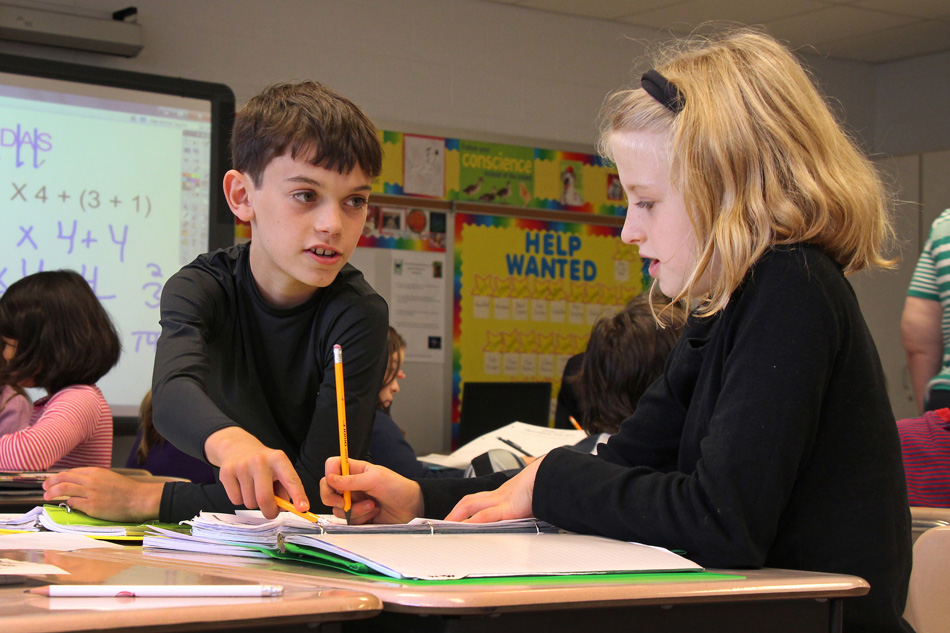 Do people gesture for the benefit of others or for their own benefit? If so, how does gesturing benefit the gesturer?
It’s fairly intuitive to see why gesturing my benefit another people. For example, pointing in a specific direction, or tracing a path in the air can help aim people who are lost in the right direction. However, when people speak to the blind, studies have shown that gesturing still occurs.
Perhaps there is more to gesturing than simple illustrative properties for the benefit of an observer. Maybe gesturing is also good for the person gesturing. Maybe it helps them convey the information better, maybe it improves their clarity of thought, maybe using the body helps to free memories and words to help produce accurate language to describe what we’re thinking or feeling.
Researchers Susan Goldin-Meadow, Susan Wagner Cook, and Zachary A. Mitchell,
University of Chicago devised a study to measure the effects of gesturing on the ability of children to learn math.
Fourth graders aged 9-10 were assigned either a no-gesture or gesture condition.
Children in the no-gesture condition were shown a math problem such as 6 + 3 + 4 = _ + 4. The instructions repeated to the students included “I want to make one side equal to the other side.”
Children in the correct-gesture condition were shown the same problem 6 + 3 + 4 = _ + 4 and were taught the same words plus the correct gesture. They would use a V-hand connecting the number 6 and 3 and point with their index finger to the blank on the other side of the equation. This afforded the students a gesture connecting the two numbers, which when summed, fill in the blank correctly on the opposite side.
Children in the partially-correct-gesture condition where shown the same problem and received the same words, but different gestures. This time the V-hand indicated numbers whose sum did not lead to the correct answer. While the sum of the numbers do not correctly sum to balance the equation on both sides, it did cue that they students need to add two numbers from the left side to find the correct answer.
Children then received a math lesson where the exercise was repeated a number of times.
After the lesson, the students were given a post-test which was compared to their pre-test.
The results showed that the children who were taught gesture were observed using gestures on each of the 12 opportunities whereas those who were not taught gesturing, did not use any gestures.
The children taught to use gestures correctly in the grouping task performed better than those in the partially-correct condition and those in turn, did better than the group not taught to use gesture at all.
Interestingly, even those children who were not taught the correct gestures or rather partially correct gesture, still performed better than the no gesture condition suggesting that they internalized the grouping “idea” or gesture on their own.
Therefore, it appears that the V-shape gesture primed the students on the idea that numbers needed to be grouped in order to correctly solve the problem.
While all the children received an accurate lesson in math, those who received the lesson on gesturing did better because they benefit from an additional technique not afforded to the no-gesture students.
Previous studies suggest that our brains are wired to encode body movement with action oriented tasks. For example when we think of lick, pick or kick, we tend to think of the face, hand, or leg respectively. Studies such as this, suggest that people benefit from using gesture to activate parts of memory which can be retrieved later.
The study is an important step toward understanding how our mind and bodies work to not only retrieve thoughts, but also in how the are produced to begin with.
Image Credit: woodleywonderworks
Resources
Goldin-Meadow, Susan; Susan Wagner Cook, and Zachary A. Mitchell. Gesturing Gives Children New Ideas About Math. Association for Psychological Science. 2019. 20 (3): 267-272.