
Facial Expressions Versus Bodily Expressions In Nonverbal Communication
Christopher Philip
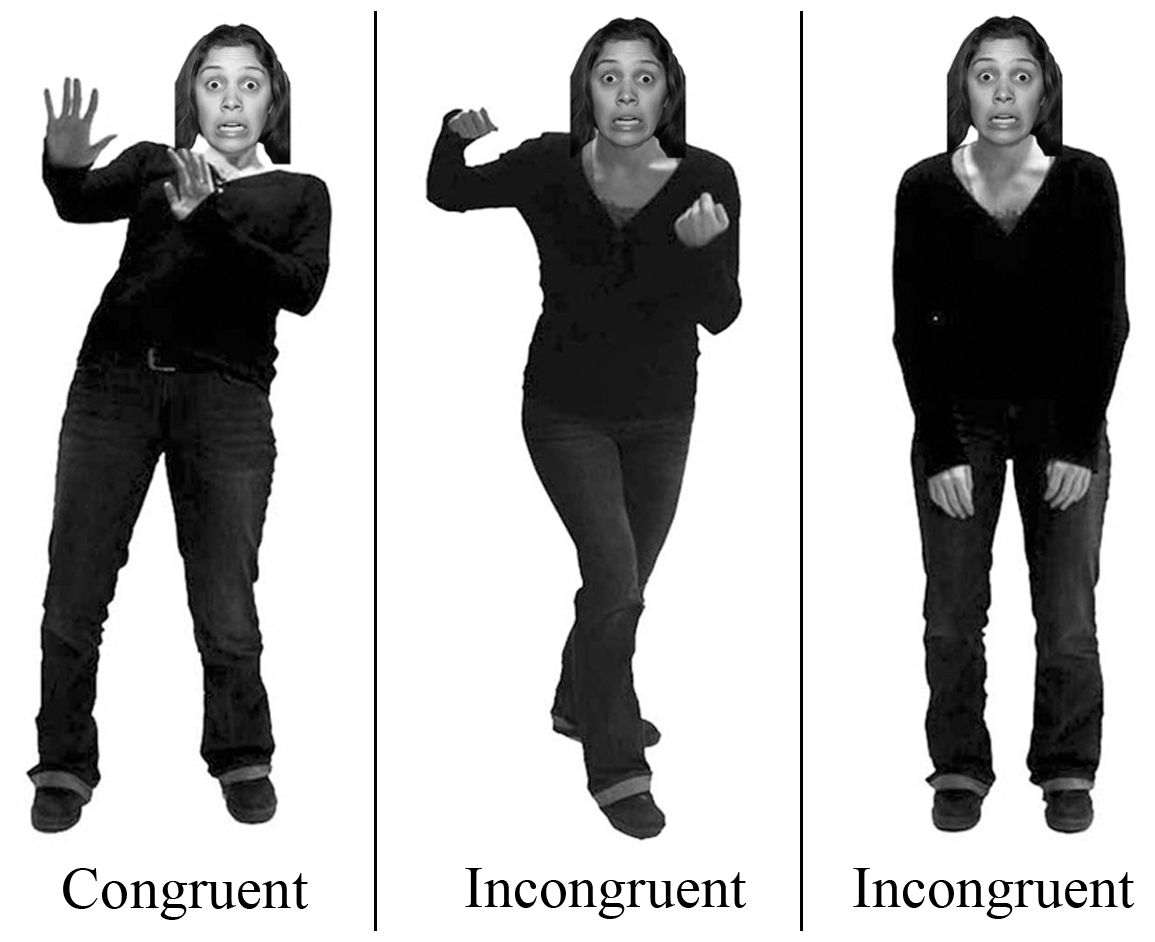 We don’t look at faces in isolation so it’s surprising that much research into nonverbal expression has been done by looking at the face alone. In fact, much of the research has ignored the body entirely. However, this is likely due to the relative complexity surrounding nonverbal communication and the inherent difficulties in its study.
Recent research has found that a disgusted face is recognized with a 65% accuracy rating, but when it is added to a disgusted body, coupled with a dirty diaper, recognition rises to 91%. Obviously, as multiple cues are available, our ability to discern emotion is enhanced dramatically.
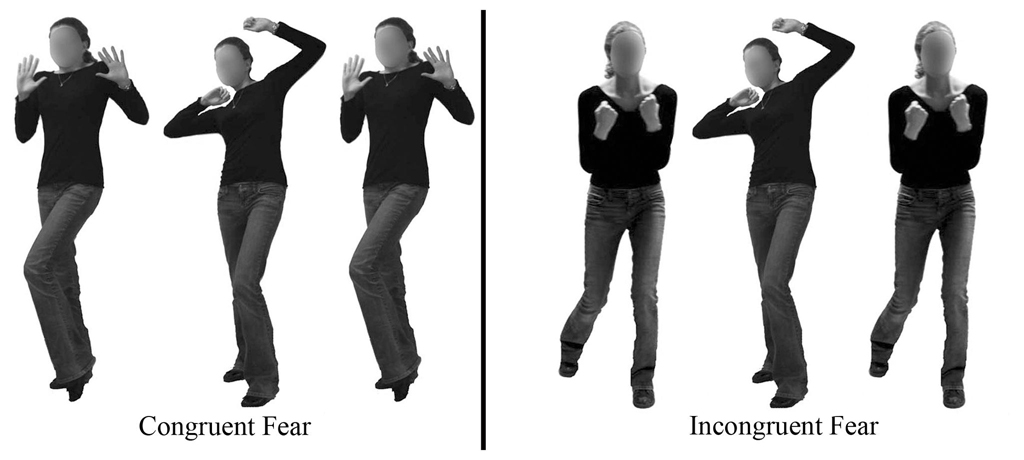
Stimuli presented in flanker task. Examples of Congruent (fearful body flanked by fearful bodies) and Incongruent (fearful body flanked by angry bodies) stimuli from Experiment 2. doi: 10.1371/journal.pone.0073605.g005
Additionally, and by the same token, when facial expressions and bodily expressions are mismatched, the ability of a person to discern true emotion is hampered. This was measured, for example, by placing a fearful face on an angry body.
Even this method of research has been called into question as it does not bear any weight on real world situations. In other words, just because technology permits one to move a face and body around, does not mean it will lead to useful results. That being said, we do note that life, as varied as it is, does provide many mixed nonverbal signals.
Certainly, no signal in nonverbal communication occurs in isolation. We know that context affects body posture recognition, tone of voice and hand gestures influence perception of facial expressions, body posture influences perception of body movements and so forth.
Two competing theories attempt to explain how people read others.
1) The dimensional or circumplex theory of emotion perception: Says that people directly perceive valence (pleasant vs. unpleasant) and arousal (low vs. high) and subsequently infer the underlying emotion.
Example: When a face is negative in valence (unpleasant) and low in arousal we perceive sadness.
2) The emotional seed model: Says that people’s perception of emotions depends on the physical characteristics of the expression. Some physical characteristics are diagnostic of only one emotion, whereas other characteristics are shared among multiple emotions.
Example: We read disgust when we see a wrinkled nose as this is the ubiquitous trait of disgust. Whereas other expressions share expressions for example, anger and disgust share furrowed brows, fear and surprise share raised brows and wide eyes, and fear and sad share oblique eyebrows pulled together.
However, these two models do not always conflict and at times support each theory respectively.
It may be that cues are read in more than one dimension such that people perceive valence (pleasant vs. unpleasant), dominance (strong vs. weak), arousal (high vs.
low), and intensity.
This might help explain why some postures such as anger and fear tend to confuse nonverbal readers as the relative strength of the posture is more salient than others.
Regardless, more research is needed in order to draw solid conclusions about how we are wired to read nonverbal expression.
Resources
Mondloch, Catherine J.; Nicole L. Nelson and Matthew Horner. Asymmetries of Influence: Differential Effects of Body Postures on Perceptions of Emotional Facial Expressions. PLOS one. September 2019. 8(9): e73605.