
Your Face Reacts To Body Anger – How Our Brains Are Wired To Process Emotional Body Language
Christopher Philip
 A team of French researchers have found evidence that the faces of observers react predictably to angry body language by flexing their corrugator supercilii muscles which work to pull the eyebrows together.
Earlier studies have supported this finding by using happiness facial expressions.
Only, in this case, when observers are exposed to happy facial expressions (not bodies), the faces of the observers will flex their zygomaticus major which works to pull back the corners of the mouth and turns the mouth upward forming a smile.
Importantly, these effects are rapid, termed “rapid facial reactions” or RFR which are detectable by electromyography or EMG.
In this specific study, the researchers set out to shed some light on the reason for this mechanism.
To that end, they presented viewers with various intensities of emotional body postures along the angry spectrum. The images used ranged from neutral, mild, moderate, to intense anger. The angry bodily postures were also either aimed at the viewer with eye contact, or away from them with an averted eye gaze and body turned away.
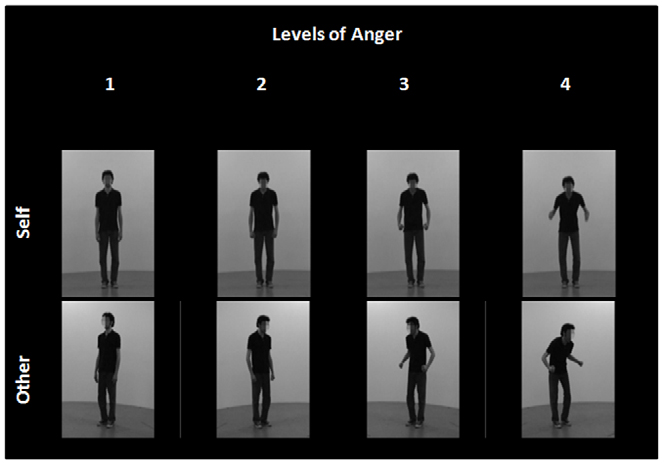
Figure 1. 2*4 factorial design. Short movies of neutral (1), mild (2), moderate (3) and intense anger (4) oriented-to-Self and oriented-to-Other were presented.
doi:10.1371/journal.pone.0055885.g001
Results showed that observers reacted more intensely to the postures when the bodies faced them and also when the angry body expressions where more intense. In fact, reactions to the images were on the order of 300-700 ms after viewing the images.
Self-rating along a felt-emotion continuum for including perceptions of Threatened, Irritated, Surprised, Confused and Sad were also as expected. The more intense the bodily expression, the more threatened and irritated the observers reported feeling.
“We propose,” say the researchers “[that] early RFRs to body expressions of
anger might be related to an emotional appraisal process.”
In other words, the quick and passive reaction people experience to viewing angry body language, especially when that angry body language is directed toward an observer, is the way the brain and body assesses nonverbal signals which it finds to be important.
When we view angry bodies, the muscles in our face produce like-reactions and this helps our brains process what we’re seeing. Since the reactions were more intense when the angry bodies were directed at the viewers, it tells us that people are using these passive reactions to process relevant nonverbal information.
Overall, the study shows that reading body language is quite a passive thing – that our brains are naturally tuned to nonverbal communication and react appropriately despite our conscious awareness.
Image Credit: bark
Resources
Grezes, Julie; Le´onor Philip; Michele Chadwick; Guillaume Dezecache; Robert Soussignan and Laurence Conty. Self-Relevance Appraisal Influences Facial Reactions to Emotional Body Expressions. PLoS ONE. 2019. 8(2): e55885. doi:10.1371/journal.pone.0055885
IMAGE: Figure 1. 2*4 factorial design. Short movies of neutral (1), mild (2), moderate (3) and intense anger (4) oriented-to-Self and oriented-to-Other were presented.
doi:10.1371/journal.pone.0055885.g001