
Emotions Are Read In Context, Study
Christopher Philip
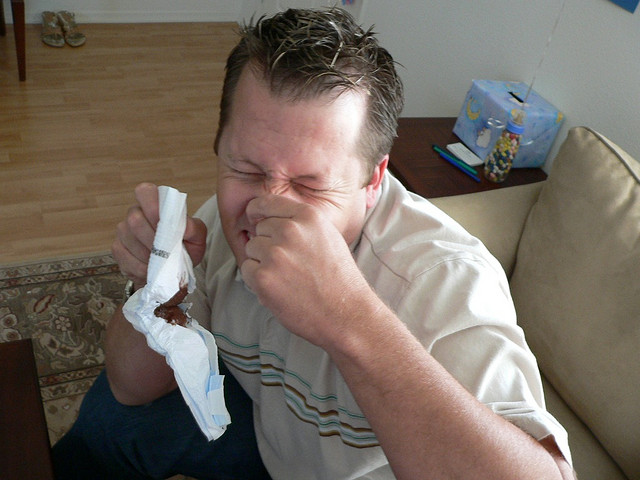 It turns out that facial expressions are not immutable and consisted in time and space. For example, the same facial expression transposed to a different context yields different interpretation. This is according to a study published in the journal Psychological Science.
Hillel Aviezer led a team of researchers through a study which transposed a disgust facial expression across four contexts. They included fear, sadness, anger and disgust. Fear was considered contextually dissimilar to disgust while sadness, medium similarity while anger was high similarity.
The researchers wanted to see if the effect of context had anything to do with how the facial expression of disgust was perceived by subjects.
Experiment #1
In the first experiment images were taken from 5 women and 5 men. The bodily expressions, which outlined the “context”, were produced from 1 male and 1 female body. These had bodies holding up a soiled piece of clothing (disgust), making a fist (anger), holding the hands on the heart (sadness) and hands palm out toward the viewer (fear).
The procedure was simple enough. The images were displayed on a computer screen and the participants were instructed to select the emotion that best fit the expression (fear, sadness, anger and disgust).
Results showed that as the dissimilarity between disgust and the context increased, the tendency to mis-categorize the expression increased. When the disgusted facial expression appeared in the angry context, it was rated as angry as likely as it was rated disgust within the disgust context.
This suggests that people use context when assessing facial expressions and don’t just judge faces by themselves.
Experiment #2
In the second experiment four different sad faces and four different disgusted faces were combined with two sadness contexts and two fear contexts. As well, the disgusted faces were combined with a pride context as well as a disgust context.
Participants were asked to rate the valence (positive or negative) and arousal for the images as well as for anger, fear, pride, sadness, disgust, surprise or happiness.
Sad faces were strongly influenced by context and they were also rated higher on arousal then when the same faces appeared in sadness. Context, as in the first experiment also influenced the accuracy. Sad faces in fearful contexts were less accurately judged than when sad faces appeared congruently in a sad context. Likewise, when sad faces appeared in a fearful context, they were rated as more fearful than when they appeared in a sad context.
Therefore, like the first experiment, context matters when judging faces.
Context also played an effect on valence. Faces showing disgust in a pride context were rated as more positive than when they appeared in the disgust context. When disgust was present in the disgust context, it was rated as disgust, but when it appeared in pride context, none were categorized correctly. This suggests that the bodily expression of pride overrode the facial expression.
Experiment #3
In the third study eye tracking software was used to measure what information the subjects gleaned as they judged the expressions and contexts.
Ten different faces expressing anger, and ten faces displaying disgust were used. Context was created with two poses for anger, two for disgust and two neutral. The facial expressions appeared as such: congruent (e.g. angry face in an anger context), incongruent (e.g. angry face in a disgust context), or neutral (e.g. angry face in a neutral context)
The results mirrored the findings from the previous two studies. When the faces matched the context, they were rated with a high degree of accuracy: anger (86.1%) and disgust (86.9%). However, when the context was not congruent with the facial expression, it dropped to: anger (34.2%) and disgust (12.6%). In this case, the tendency was for participants to judge the expressions as the context in which they appeared, rather than the facial expressions.
When the faces appeared out of context, they were scanned differently then they would be normally. When angry faces appeared in congruent context, more fixations were made to the eye than to the mouth, but when it appeared in the disgust context, the mouth and eye region received about the same number of fixations. This suggests that the eyes are a richer source of information in the angry expression.
When disgusted faces appeared in a disgust context, the mouth and eye received equal numbers of fixations, but when the same face appeared in an anger context it resulted in more fixations to the eye, than to the mouth. This suggests that the mouth is a richer source of information in the disgust expression.
In other words, when anger was congruent with the context, subjects entered the eye region faster. Conversely when disgust was viewed in a congruent context, subjects entered the mouth region faster then when out of context.
Therefore it seems that an incongruent context fooled the participants by drawing the attention of their eyes away from relevant information.
Drawing Conclusions
This study challenges one of the main tenants of facial expressions which says that context and bodily expressions are not important in discerning emotion.
The greater the faces matched the context, the easier it was for participants to read the true emotion conveyed.
As we harp on, context matters in body language reading. While one might misinterpret this study with respect to using context as counter productive as it lead the participants in their interpretation of the emotions conveyed astray, in actual fact, it did no such thing.
The subjects were confused by the body language shown, but in a way that is rational. They used the entire picture including the face and body to make their assessments of the emotions conveyed rather than just the face or just the body. However, as they were not particularly skilled at reading nonverbal communication, the mismatched between the face and body confused them.
The take-away message is to read the body and face separately for congruency or lack thereof. As we know, when bodies and faces don’t match, it’s likely due to the desire to be deceptive.
Had the researchers instructed the participants to examine and rate the face for its emotion and then in a second step evaluate the body for its emotion, they would have shifted their focus in such a way as to point out the relevant differences – their incongruency.
Image Credit: Ewen Roberts
Resources
Aviezer, Hillel; Ran R. Hassin; Jennifer Ryan; Cheryl Grady; Josh Susskind; Adam Anderson; Morris Moscovitch and Shlomo Bentin. Angry, Disgusted, or Afraid? Studies on the Malleability of Emotion Perception. Psychological Science. 2008. 19(7): 724-732.