
Duchenne Eye Constriction Associated With Infant Cries And Smiles, Study Christopher Philip  French neurologist Duchenne de Boulogne and then later Charles Darwin, highlighted the role of eye constriction (orbicularis oculi) in facial expressions of positive Emotion. More modern research has confirmed that indeed, contraction of the muscles at the corners of the eyes, thus producing ‘crow’s feet’ is indeed a marker of truly felt smiles.
Incidentally, fake smiles are done with the lips stretched out and up, but with no involvement from the eyes. “Duchenne smiles” as they have been named, are strong predictors of joy, however, Darwin also proposed that eye constriction plays an important role in weeping and crying, particularly during infancy. As children often demonstrate “ontogeny,” or how facial expressions develop through our development and evolution, the infant cry-face provides a unique opportunity to study emotional facial expressions. Curiously, like smiles, crying may or may not be accompanied by eye constriction. Though, the expression has been readily observe and documented, no studies have measured them empirically in accordance with positive and negative experiences. A team of researchers led by Whitney Mattson, Department of Psychology, University of Miami, Florida, devised a study to observe the Duchenne smile and crying. In the first study, the Face-to-Face/Still-Face (FFSF) was used where for three minutes as the infant and parent interact playfully. This results in more smiles than cry-faces. Following this, two minutes follow in which the parent holds an unresponsive still-face which usually elicits more cry-faces than smiles.
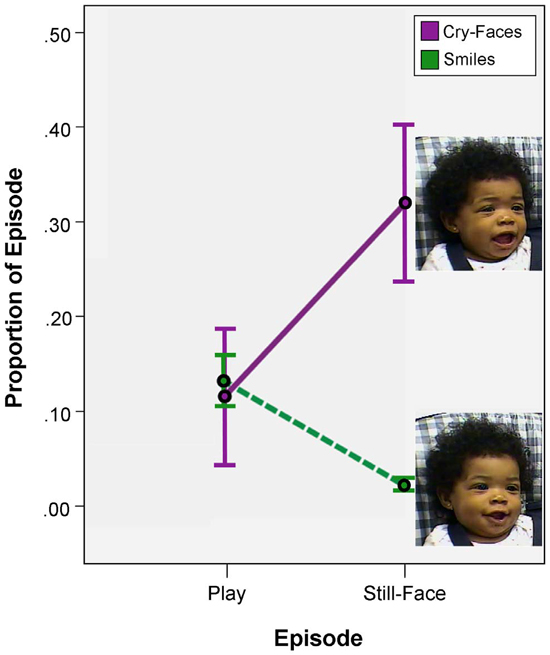
Time in smiling and cry-faces as a proportion of time in each episode of the Face-to-Face/Still-Face (FFSF). Error bars indicate standard errors of the mean. The images are of smiles and of cry-faces without eye constriction. The images are from a six-month-old in the FFSF in the current study. Written informed consent, as outlined
in the PLOS consent form, was obtained for publication of these images.
doi:10.1371/journal.pone.0080161.g001
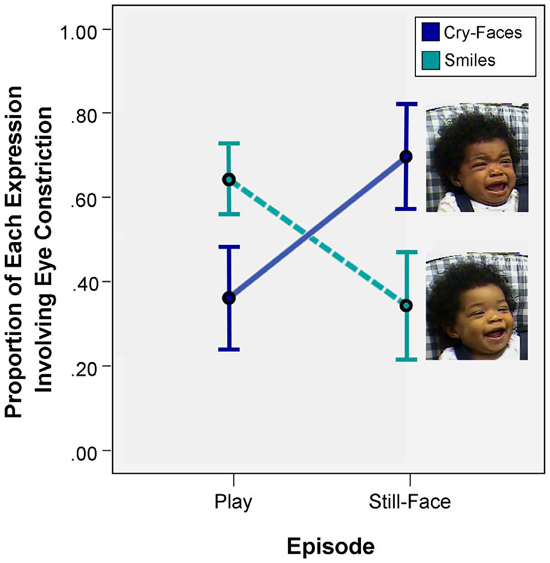
Eye constriction (the Duchenne marker) is differentially associated with smiles and cry-faces in the Face-to-Face/ Still-Face (FFSF). Mean proportions of smiles and of cry-faces occurring with eye constriction. Error bars indicate standard errors of the mean. The images are of smiles and cry-faces with eye constriction. The images are from a six-month-old in the FFSF in the current study. Written informed consent, as outlined in the PLOS consent form, was obtained for publication of these images. doi:10.1371/journal.pone.0080161.g002
Results showed that eye constriction was associated with stronger smiling and stronger cry-faces. As expected, smiles were also more common with the play condition rather than the still-face. Also as expected, the cry-faces with eye constriction was higher during the still-face episode than the play episode. The results confirm that infants do in fact use eye constriction during cry-faces and smiling.
In the second study, cry-faces were observed at 6 and 12 months of age during vaccination injections. Again, eye constriction signaling Duchenne distress was common suggesting that eye constriction signals both negative and positive emotion. Overall, the results show that similar units of actions are used in various contexts to signal emotion. That is eye constriction signals pain and also joy. The researchers note that eye constriction using the obicularis occuli muscle partially but does not completely block vision. This may serve to reduce exposure to intense negative emotions from the outside world.
Interestingly, Duchenne marker signals both positive engagement and an intense need for comfort and as the researchers point out, smiling and crying are the most commonly used facial expressions in babies. This tells us how important eye constriction is to early emotional expression and communication. The researchers say that adults also mirror this expression, thus intense constriction of the eyes during pain may actually signal the intensity of felt pain. Incidentally, intense eye constriction is also present during orgasm suggesting that it also function in intense positive emotions. Previous studies have shown that eye widening is associated with a biological route to add more sensory input which is the case for the fear expression. Likewise, disgust is characterized by facial constriction though eye and nose constriction to avoid unpleasant stimulus. Therefore eye constriction and degree of nose constriction may signal degree of disgust. In summary, eye constriction is present in both positive and negative stimulus and the degree of eye constriction may serve to signal overall intensity.
Image Credit: Andrea Rose
Resources Mattson, Whitney I.; Jeffrey F. Cohn; Mohammad H. Mahoor; Devon N. Gangi and Daniel S. Messinger. Darwin’s Duchenne: Eye Constriction during Infant Joy and Distress. PLOS one. November 2019. 8(11): e80161. doi:10.1371/journal.pone.0080161.g001