
Children Read Your Body Language, Study
Christopher Philip
 Only a few studies have looked at the ability of children to read body language. Much focus however has been placed on children’s ability to read facial expressions.
In the current study, researchers Nicole Nelson and James Russell, Department of Psychology, Boston College, looked at the ability of children to read facial expressions, bodily expressions, and voice traits for their emotion.
In the study, the children, aged 3-5, were shown video clips of a professional actor displaying happiness, sadness, anger and fear. The clips were 13 seconds in length and displayed only one emotion at a time. In the “face-only” condition, only the head and neck of the actor was present. No sound was included in this condition, though the actor was seen speaking.
In the “body-posture-only” video clip the actor’s head and body was framed, but the face was blurred. The emotions were expressed as follows:
a) Happiness: Expanded posture and arms raised over the head.
b) Sadness: Slumped posture, lowered head, and arms at the side.
c) Anger: Rigid posture leaning forward with fists clenched
d) Fear: Rigid posture leaning back with arms raised defensively.
A voice only condition was also produced for all four emotions as well as a “multi-cue” video clip, which combined the face, body and voice.
In the study, the children were not forced to choose one expression over another. In other words, the study employed a “free labeling” procedure which permits the children to select the emotion on their own. This reduces experimental bias and is considered superior to a “forced choice” condition.
Results Of The Study
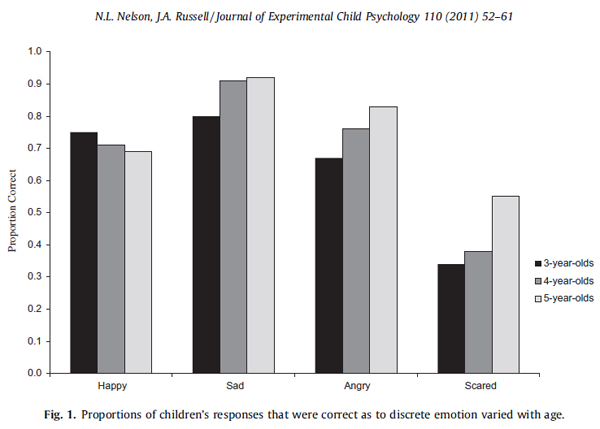
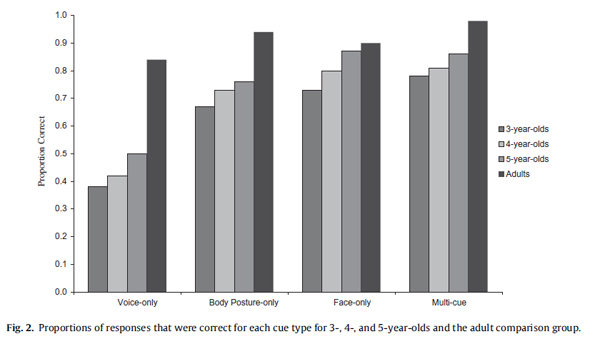 The results showed that the Face-only, Body Posture-only, and Multi-cue (face, body, and voice) conditions were all well recognized. Rates for each condition were around 70%.
However, the voice only condition only produced a high rate for sadness at 72%. All the other emotions including happiness, anger and fear, were recognized at a much lower rate of around 34%.
Children also improved with age. The 5 year-olds scored best, followed in sequence with the 4- and 3-year olds. However, the results, even for the youngest aged children, were comparable to the scores of adults. The notable exception, of course, was that the adults scored much better on the “voice-only” condition.
Drawing Conclusions
The “voice only” condition proved to be less valuable to the children in assessing emotion. This suggests that parents and teachers should couple, or at least emphasis vocal emotion with associated facial expressions and body posture when trying to convey emotion accurately to children.
Amazingly, however, the children were quite adept at discerning emotion from facial expressions and even body posture and scored comparatively to adults.
Children were also successful with the “face-only” expressions, and overall, it was similar to the multi-cue condition. This tells us that children, like adults, tend to focus most on the face over the voice and body. Therefore, in a worst case scenario, accurately demonstrating emotion to children should be done first by the entire body, then by the face-only. In no circumstances should the voice, by itself, be relied upon to communicate emotion to children.
In other words, yelling “Can’t you see I’m upset!” is highly unproductive and possibly even emotionally damaging as children don’t readily decode angry voices. As tensions rise, children should be reprimanded with angry faces and postures before resorting to loud or angry voices. While voices my release tension for adults and teachers, it does nothing to rectify the issue at hand.
Demonstration of a relevant angry facial and body expression will go a long way in conveying to children that their behaviour is less than acceptable.
Resources
Nelson, Nicole L. and James A. Russell. Preschoolers’ Use of Dynamic Facial, Bodily, and Vocal Cues to Emotion. Journal of Experimental Child Psychology. 2019; 110: 52-61.