
Body Posture, Physical Environment, Determine Feelings And Behaviour, Study.
Christopher Philip
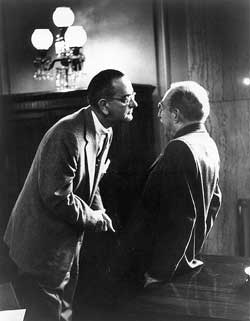
Hawklike pose famous in a 1957 photograph of Lyndon Johnson bullying a colleague
“The Ergonomics of Dishonesty” published in the journal Psychological Science co–authored by Andy Yap, a former PhD student at Columbia Business School and currently a visiting professor at MIT Sloan School of Management, Abbie Wazlawek, a PhD student at Columbia Business School, Brian Lucas, a PhD student at Kellogg School of Management; Amy Cuddy, a professor at Harvard Business School, and Dana Carney, a professor at the University of California, Berkeley says that while individuals pay very little attention to their surroundings and body postures, these can have a significant impact on our thoughts, feelings and behaviours.
This new study says that expansive physical settings such as having a big desk or stretching out and do work or a large driver’s seat in an automobile can cause people to feel more powerful and that these feelings of power can elicit more dishonesty such as stealing, cheating, and even traffic violations.
“In everyday working and living environments, our body postures are incidentally expanded and contracted by our surroundings — by the seats in our cars, the furniture in and around workspaces, even the hallways in our offices — and these environments directly influence the propensity of dishonest behavior in our everyday lives,” said Andy Yap, a key author of the research who spearheaded its development during his time at Columbia Business School.
Get a free start in learning body language today! Click here: Getting Started.
Building upon previous research showing that expansive display postures such as placing the hands on the hips, arms akimbo, placing the feet on the desk, placing the palms down fingers spread on the desk, leads to an increase in testosterone and a decrease in the stress hormone cortisol, the researches sought to measure the effects that expansive environments, which create expansive postures, had on individuals.
In the real world, people pay very little attention to the seemingly innocuous shifts in bodily posture and environment. The research found that postural shifts can have a tremendous impact. “This is a real concern. Our research shows that office managers should pay attention to the ergonomics of their workspaces. The results suggest that these physical spaces have tangible and real-world impact on our behaviors,” said Andy Yap.
The Research
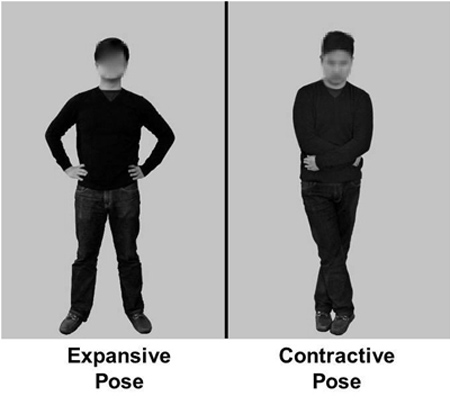
Image courtesy of Columbia Business School.
The researchers conducted four studies. The first experiment involved 88 subjects recruited from a train station in Boston, Massachusetts and from outside a library at Columbia University. Participants were asked to hold either an expansive posture by placing their hands on their hips or a contractive posture by wrapping their arms around themselves in a self embrace. They were told to do so for 1 minute. On the onset of the study, the participants were told they would receive $4 in compensation, but in reality they were presented $8. It comprised 3, $1 bills and a $5 bill. The “accident” was made obvious to the recipient by fanning the bills out so they would notice the misplaced $5 bill. The results showed that the subjects who held expansive postures were significantly more likely to keep the extra money. The researchers termed this “stealing by omission.”
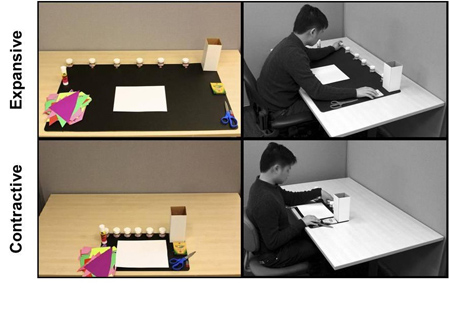
Image courtesy of Columbia Business School.
The second experiment manipulated the expansiveness of work place settings. The researchers wanted to see if “incidentally” (shaped by the environment) expanded or contracted bodies produced similar results of dishonesty. Here, they had subjects work at either a small, constrained work place, or a large expansive work place. They were given a set of anagrams to solve during a set amount of time. They were offered $1 for each one they solved. At the end of the study, the experimenter provided them a score sheet and explained that they needed to attend to other matters so they would have to grade their own performance. As predicted, those who had expansive workplaces and were able to expand their bodies were significantly more likely to cheat and alter their scores over those who worked in constrained workspaces.
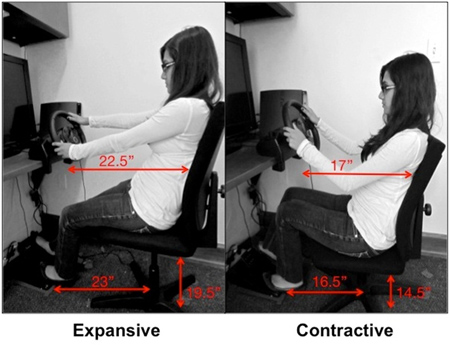
Image courtesy of Columbia Business School.
In the third experiment, subjects were invited to play a realistic driving video game at either a constricted seat with controls close to the body and seat lowered or one where the seat was higher and the controls moved away from the body. They were told they could win $10 if they completed the course in under 5 minutes. This incentivized cheating. During the race, they were told to give themselves a 10 second penalty for each hit-and-run accident. The researchers wanted to see if the posture of the subjects influenced their desire to cheat the penalty. Once again, they found a trend indicating that posture affects the likelihood of cheating as more racers failed to follow the self imposed penalty.
In the final experiment, the researchers wanted to test these findings in the real world. They did so by locating vehicles that were double-parked in downtown New York and compared this with their relative seat sizes. Allocations were made to control for the effect of vehicles size. They also found significant differences between the size of the seat and the propensity to double-park.
What It All Means
“Taken together, the results suggest that, first, environments that expand the body can inadvertently lead people to feel more powerful, and second, these feelings of power can cause dishonest behavior.”
The findings are interesting because everyday our bodies are being continually stretched and contracted by the environments we find ourselves in, as well as the voluntary postures we use. So whether by accident or by purpose, we are at the whim of the relative level of expansiveness we are permitted to use.
Putting a subordinate in a cramped workspace might be beneficial in keeping him in line while using a large desk and big office might lead him to boost his confidence but also his desire to cheat. The results advance the knowledge we already have that says that our bodies and its body language form an intimate relationship. Not only this, but a person who habitually spreads out on his desk, clasps his hands behind his head and chucks his feet up on his desk in a “power pose” will be more likely to stage his increased strength through dishonest behaviour. His desire for expansive body language, thus, is a strong indicator of his strength, desire for such, and his resultant potentially toxic demeanor.
Like anything though “Power is like nuclear energy, it can be used for good or bad,” says co-author Andy Yap. The research tells us that expansive physical environments might trigger expansive postures and we can control for this. For example, a casino may choose to offer larger chairs with arm rests to bolster more gambling. “If you already work in an expansive environment like an architect at a drafting table, be mindful that our social environment can hijack that,” says Carney. “We don’t really think about our environment unconsciously pushing and pulling our body into positions that can really have an impact on our behavior.” However, by understanding the effects of expansive body language it might encourage us to control the effects consciously simply by resisting certain postures, but when not possible, we can restrict expansiveness through changes in the environment.
Get a free start in learning body language today! Click here: Getting Started.
Resources
Andy J. Yap, Abbie S. Wazlawek, Brian J. Lucas, Amy J. C. Cuddy, Dana R. Carney. The Ergonomics of Dishonesty: The Effect of Incidental Posture on Stealing, Cheating, and Traffic Violations, 24(11); 2281-2289.
Learn More Starting Today!
Learn the basics of body language quickly and easily by taking one of our tailor-made video courses!
Short on cash? Then read an ENTIRE comprehensive book on body language – it’s totally FREE!
Which body language video course will you start with?
1. “The Secrets of Body Language”