
Body Language Cues Of Dominance And Submission In Children
Christopher Philip
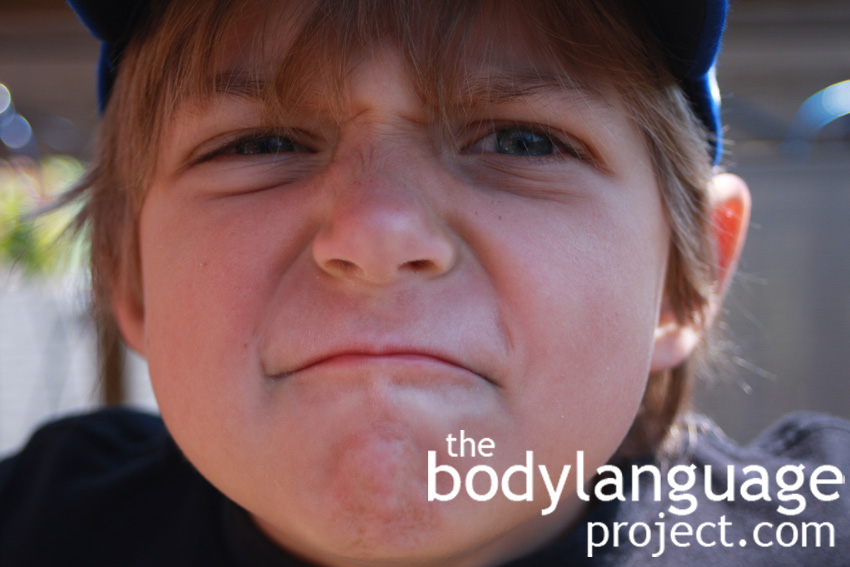
The anger face is a constellation of features, each of which makes a person appear physically stronger.
As a parent, teacher or caregiver, you may wonder about how a particular child is fairing with respect to other children in his or her cohort. In review of the literature, I have noted some common themes that arise in children to delineate their position and rank with respect to their peers.
The following are some cues noted that indicate dominance in children:
The Facial Expressions of Dominance in Children
Lowered Brow: Lowering the brow is an attack behaviour in nonhuman primates but has been noted in children. The recipient of the signal usually flees or submits. When viewed in adults, they are rated as more dominant.
Small Mouth: A tense mouth has been noted in primates and is linked to attack. It has also been noted in children during aggression.
Lower Lip Drop: The expression is not unlike the tense-mouth face of primes also associated with attack.
Lower Lip Drop: Occurs when the jaw is thrust forward and the lower lip dropped to expose the teeth. It has been called an “intention bite” in children. It has been observed and described in children when taking part in challenge encounters with other children. It has also been noted in primates. In children and other primates, the teeth are sometimes exposed by retracting the upper lip. This is sometimes called the “sneer” related to scorn or contempt as the canine teeth are exposed.
Staring: Prolonged direct eye contact is the presages of attack and either elicits combat or submission. It has been observed in chimps, gorillas and children. First grade boys have described the ability to win staring contests as “toughness” and thus a measure of dominance. When visual contact is broken first, it is usually the result of submission.
Attention: Subordinates attend more to dominance displays and so may pay attention more to visual cues around them. Thus the more submissive will tend to gaze more and pay more attention to what dominant children are doing.
Postural Expression in Dominance in Children
Key postures in dominance include standing taller relative to subordinates whom will crouch or slink. This has been noted in primates. Strutting and swaggering is also characteristics to gorillas and chimps as it is for humans. In primates, the dominant are described as exhibiting relaxed, expansive movements. Subordinates on the other hand, show inhibited movements. Some studies have even found that successful subjects have larger handwriting and make larger drawings. They may also command more space or use space more liberally.
Humans, like animals will also lower their head, slump their shoulders. Observations of young children have found analogous behaviours. Studies have found that head bowing, shoulder slumping, combined with supination and kneeling can inhibit further attack in children. Observations of children losing staring matches, for example, will often lower their heads and is similar in appeasement to crying. The converse posture is to throw the head back. Having sway in arms while walking rather than more stiffly is also a signal associated with dominance in children.
Resources
Weisfeld, Glenn E. and Jody M. Beresford. Erectness of Posture as an Indicator of Dominance or Success in Humans. Motivation and Emotion. 1982. 6(2): 113-130.