
The Body Language Of Checking Your Cell Phone – The Nonverbal Perils Of Checking Your Mobile Phone
Christopher Philip
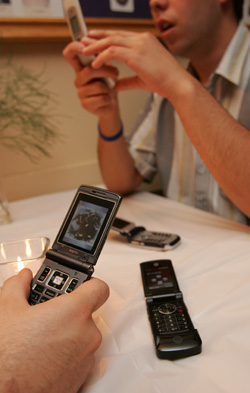 Reported mobile cell phone use in 2019 has exploded to 6.8 billion users which encompasses 96% of people globally.
This has lead to an increase in mobile phone users looking at or actively communication with their phones either by texting, sending emails, watching or reading media or actually using them to speak direct to another person.
Previous research has focused on the physical perils of cell phone use, for example, while walking, which may lead to injury and even death, however the current discussion centers around the nonverbal perils of cell phone use which may interfere with normal face-to-face communication.
Since current technology permits users to navigate their phones silently such as by typing or flipping, users can become distracted by these tools to the detriment of those in their near vicinity.
Since looking at a mobile phone is considered nonverbal communication, we deal with it here.
In a recent paper Takashi Nakamura, Niigata University, Japan advanced four main concerns for users whom focus on their phones rather than the real people that surround them.
1. Looking at the cell phone can communicate to observers that one is busy and/or that one is part of another particular social context or physical location.
2. When phone users are with one or more acquaintances or friends, looking at the phone can communicate rejection of these acquaintances. It says that their other communicating partner is more important.
3. The behaviour of checking the phone says that the user wants those in their vicinity to “hold” or wait. This may signal that they desire to control or even halt the flow of speech.
4. The phone user may “catch up” with observers by supplying them with information to add to the conversation such as movie times or restaurant locations. This may be a valued asset to a conversation, however, if one does not notify others as to their current use, it may be assumed that they are doing one of the three mentioned above.
Naturally, this list is not exhaustive, but nevertheless is likely to be nearly universal.
As Nakamura describes in his paper, one may wonder, why they have been moved aside behind this “fourth wall.” The fourth wall is an imaginary wall which separates an audience from actors on a stage during a play. The fourth wall is a way to unequivocally provide the user with a way to manage and control social encounters. In most cases, the observers can not understand what has distracted the user and so they are left in a status of limbo which can be particularly offensive and leave them with a sense of helplessness.
This can even be the case if no new data is present on their phone!
The issue as described is that the observers are at an inherent disadvantage because they have no understanding of the reason the user has averted their gaze. The user, on the other hand, is afforded full empowerment over the situation because, unlike the observer, the user is not ignorant of the reasons.
Naturally, culture and cultural norms are working to rectify this new social construct, however, in the short term, our inherent wiring about eye contact norms and requirements are in a state of confusion. Eye contact is a powerful influence in communication especially that which occurs face-to-face.
As we know, the inability to use proper nonverbal cues can lead to poor social outcomes and most will readily admit that cell phone use serves to interrupt rather than facilitate normal human communication.
For this reason, we advise that people reserve cell phones use for times when one is in private. When sharing one-on-one time it would be advised to use that intimate and therefore valuable time to actually connect with others.
In direct contrast, however, one might use cell phones to nonverbally discount and shun another person in a Machiavellian sense.
Resources
Nakamura, Takashi. The Action of Looking at a Mobile Phone Display as Nonverbal Behavior/Communication: A Theoretical Perspective. Computers in Human Behavior. 2019. 43: 68-75.