
The Benefits Of Power Posing Before High Stakes Performance
Christopher Philip
Research Primer
 Researchers Amy J. C. Cuddy and Caroline A. Wilmuth, Harvard University and
Dana R. Carney, University of California at Berkeley have produced a follow-up study to their study “Power Posing: Brief Nonverbal Displays Affect Neuroendocrine Levels and Risk Tolerance” (Carney et. al. 2019).
In the first study (Carney et al. 2019) it was found that testosterone increased in participants after power brief power posing while the stress hormone cortisol simultaneously decreased.
The current study is titled “The Benefit of Power Posing Before a High-Stakes Social Evaluation” (Cuddy et al. 2019, in preparation).
The Current Study
As an extension Cuddy, Wilmuth and Carney have re-examined the findings of their original work from a more results based approached. In this study, the researchers looked at 61 participants (40 women and 21 men) on their performance on a high stake’s mock interview task.
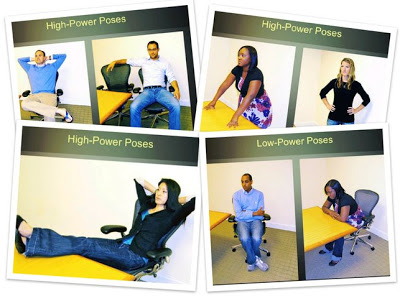
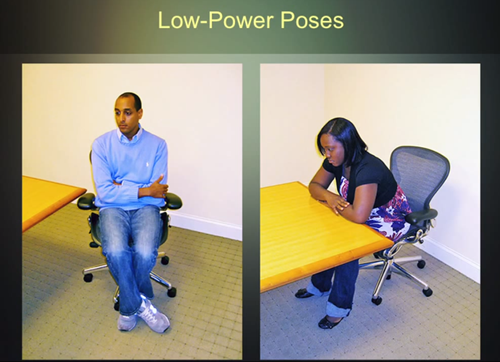
As part of the procedure, the subjects adopted either a high power open or expansive ‘power posture’ or a low power contractive closed posture (descriptions of the poses are included below). The subjects performed the postures while sitting and standing for 1-minute each.
Next, the participants were asked to imagine that they were preparing for an interview for their dream job and were asked to prepare a 5-minute speech detailing their strengths, qualifications and why they should be chosen for the job. As they drafted their speech, they were instructed to maintain the second high- or low-power pose.
The speeches were all videotaped and coded for performance and hirability including scores on speech quality, content, structure and presentation quality including captivating and overall confidence.
How To Power Pose
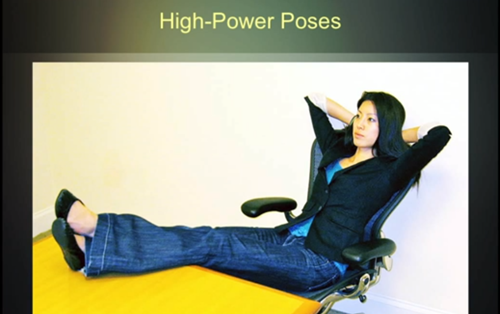
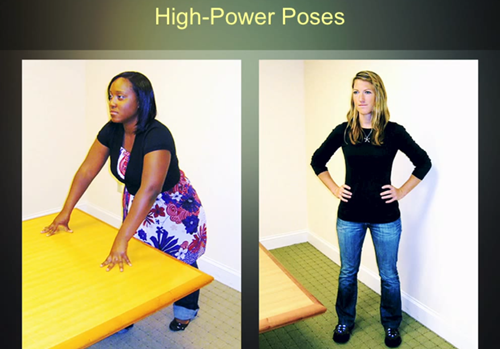
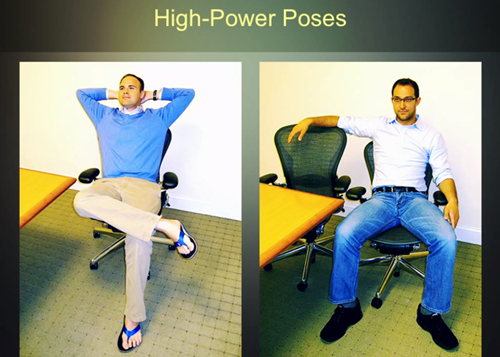
 High-power Condition: “Please stand up and stand with your two feet apart and hands on your hips like this [experimenter demonstrates for participant]. You will maintain this pose for one minute and then after one minute is up, I notify you to get into a second pose. The second pose involves you sitting in the chair with your hands behind your head and your feet up on the table like this [experimenter demonstrates for participant]. While you are maintaining these positions, you will be viewing pictures on the computer screen. Please form an opinion or impression of the people in the pictures.
Low-power Condition: “Please stand up and stand with your two feet crossed over one another and your hands crossed over your hips like this [experimenter demonstrates for participant]. You will maintain this pose for one minute and then after one minute is up, I notify you to get into a second pose. The second pose involves you sitting in the chair with your hands crossed over your knees and your feet crossed at the ankles [experimenter demonstrates for participant]. While you are maintaining these positions, you will be viewing pictures on the computer screen. Please form an opinion or impression of the people in the pictures.”
Results Of The Study
Results showed that ‘high power’ posers performed better and were more likely to be hired. This was mediated, say the researchers, by the presentation quality and not the speech quality.
Participants who adopted the high power posture also reported feeling more powerful than those in the low power posture.
Additionally, the presentations were coded for body posture during the presentation to rule out nonverbal posture as a possible influence over evaluations. The power pose condition had no effect on body posture during the social evaluation.
Discussing The Findings
“The high-power posers, in contrast to low-power posers,” say the researchers, “appeared to better maintain their composure, project more confidence, and present more captivating and enthusiastic speeches, in turn leading to higher overall performance evaluations.”
The research provides some interesting and unique findings as research has shown previously, that holding positive nonverbal expressions during a presentation including good posture, gesturing, eye contact and so forth are highly beneficial, while little has been done showing the effects of positive posture prior to undertaking and important task.
The authors clarify by saying that “As reported, high and low-power posers did not differ in the extent to which they adopted expansive vs. contractive postures during the interview; it was preparatory power posing that impacted perceivers’ evaluations of and responses to the actor.”
Drawing Conclusions
Naturally, high power postures are something simple easy, free and can be enacted briefly before a high stakes task to boost confidence and performance.
I have raised objections in the past with respect to the findings in the study. I would have like to have seen the male and female participants analyzed separately as previous studies have found that there may be a gendered effect with respect to high power dominance postures and low power submissive postures in that women were not found to benefit from the postures as men.
Hopefully future research will examine the gender effects with respect to posture and confidence in more detail.
Resources
Carney, Dana R.; Amy J.C. Cuddy; Andy J. Yap. Power Posing: Brief Nonverbal Displays Affect Neuroendocrine Levels and Risk Tolerance. Psychological Science, 2019; 21 (10): 1363-1368.
Cuddy, Amy J.C., Caroline A. Wilmuth, and Dana R. Carney. The Benefit of Power Posing Before a High-Stakes Social Evaluation. Harvard Business School Working Paper, No. 13-027, September 2019.