
What Is An Attractive Body? The Ideal Male Body And Ideal Female Body Based On 3D Morphing Study
Christopher Philip
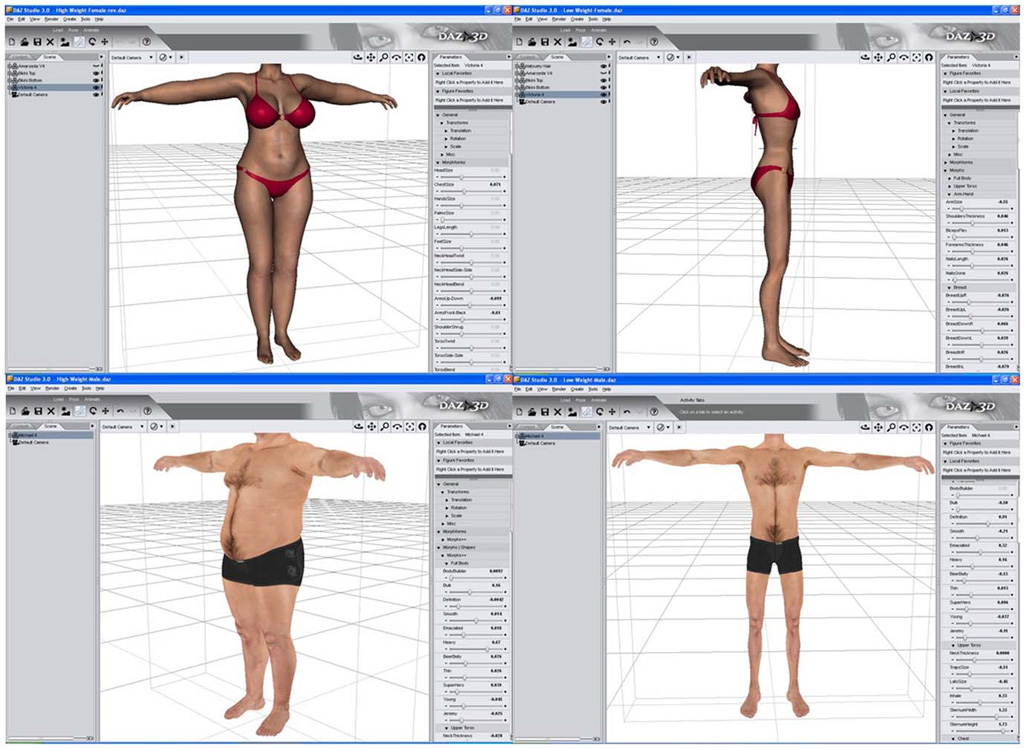
Figure 1. An example of the Daz3D interface, with examples of male and female bodies created in the software package. The bodies are displayed in slightly different viewing angles, and each body could be rotated though the whole 360u. Along the right of the picture are some of the 94 sliders which allowed different parts of the body to be independently altered. doi:10.1371/journal.pone.0050601.g001
What dimensions predict the ideal male and female body? Certainly, science has been puzzled with the concept for some time with some trends resurfacing time and again. We do know that much predictive value comes from a sexy body. We know that it is healthy, fertile and not to mention desirable with a likelihood of passing on this desirability to offspring.
Previous studies have been limited due to the fact that graphic applications were rudimentary as in line drawings or rough 2D images. However, with recent technology, it is possible to modify a body in real time with 3D software. This permits participants to create their ideal body and adjust it according to their desires.
Scales can be modified to adjust the waist-to-hip ratio (WHR), waist-to-chest ratio (WCR). Additionally, these measure can be converted back to numeric figures to be analyzed.
Previous studies have shown that women’s bodies are most desirable when they are highly curvaceous. Thus, those with a curvy lower torso (WHR) and those with a curvy upper body (WCR) are ideal. However, the results have been questioned when measured against overall body mass index (BMI).
Were a highly curvaceous body (WCR and WHR) in women points to optimal fat distribution for high fertility, an optimal BMI points to better health and reproductive potential.
Likewise, men show certain criteria that exemplify attractiveness including a broad upper body and a narrow waist producing a V-shape. Though, like women, an optimal BMI also shows up as a key determinant. The V-shape represents a muscular, strong body type well suited in ancestral competition. However, a healthy BMI and a narrow waist in men (WHR) predicts male health and mortality.
The Current Study
Researcher Kara Crossley Institute of Neuroscience, Newcastle University, United Kingdom, led a team in assessing the ideal male and female body through 3D imaging.
Specifically, they wished to discover if men and women share ideal body types and if their own body type affected their preferences.
Previous studies, as noted by the researchers, have shown differences between men and women. Specifically, men tend to prefer a more curvy female body that is heavier that that which women believe men do.
However, this notwithstanding, women should correctly understand the preferences of men, such that they can best work toward matching his ideals. Likewise, men should also correctly understand the ideals as set out by women.
With everything working optimally, men and women can both properly assess their own mate-value in dating and attraction.
The study recruited 40 male and 40 female participants.
The subjects worked to create a total of four 3D bodies, two that represented their ideal body and two that represented their ideal partner’s body. The software permitted the subjects to adjust the model over 94 graphic sliders while viewing it in 360 degree. The sliders work in real-time permitting the participant to visually see the changes.
Results showed that male and female participants created an ideal body that was significantly different than their own body. While the men significantly increased their body size, the women significantly decreased their body size.
Changes To Women’s Own Bodies
While other studies have shown that BMI is the primary predictor of female attractiveness, the results of this study show that shape is also highly important.
The women’s ideal female BMI was much lower than their actual BMI but the range fell roughly in the middle of the normal BMI range (18.5-24.9) but just above the underweight category. Only 1 out of 40 of the female participants wanted to increase her BMI. The results are consistent with BMI of those found in the media.
The bust size was increased overall which is consistent with previous studies. This may suggest a desire for higher estrogen levels as a predictor of fertility.

Figure 2. Figure 2 shows examples of the bodies set by the female participants (A & B) and the male participants (C & D). Body A and C are the ideal female bodies set by the female and male participants respectively and Body B and D is the ideal male body set by the female and male participants respectively. doi:10.1371/journal.pone.0050601.g002
Changes To Men’s Own Bodies
Men preferred to boost their overall body size moving closer to the overweight category on the BMI. However, the important factor was not raw size, but rather muscularity.
Male participants increased their chest circumference relative to their actual body and reduced their waist and hips to better mirror the V-shape upper body. Similar to women, men have been shown to prefer a male body that is more muscular than what they actually possess.
Do Men And Women Share Ideals?
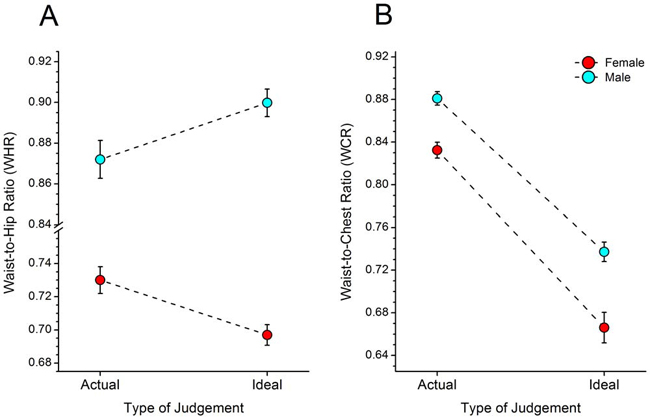
Fig. 3A shows a plot of the average actual and ideal WHRs of male and female observers. Males appear to prefer a more tubular shape in their lower torso (as indexed by a higher WHR) as their ideal. In comparison, females appear to desire a curvier lower torso shape (with a lower WHR values) for their ideal. Fig. 3B shows an equivalent plot for WCR. Both male and female participants preferred a lower WCR (more curvaceous) in their ideal than they actually possessed. doi:10.1371/journal.pone.0050601.g003
The ideal female body appears similar for both men and women. Both genders prefer a more curvaceous body with WCR and WHR of around 0.7.
Similarly, men and women also tended to prefer similar male bodies with a V-shape upper torso and a narrow waist and hips.
According to the researchers, “This can be explained by mate selection theory which suggests that individuals will not only be able to judge the attractiveness of members of the opposite sex, but will also know their own attractiveness relative to other members of the same sex (i.e. their competitors). This information allows an individual to concentrate on potential partners of the same attractiveness as themselves, thus avoiding both unsuccessful courtship of a more attractive partner (potentially wasteful in time and resources) and accepting a less attractive partner (with a potentially negative impact on future reproductive success).”
This means that men and women must both be able to assess their own bodies on the criteria as set out by the opposite sex. This indicates that the ideal body type as preferred by the opposite sex is understood by both men and women.
Alternatively, as described in the research paper, the media may push these ideals onto men and women, were men and women assimilating them into their own ideals. However, rightfully, this is dismissed, as men and women’s specific magazines do not exactly match the ideals of the opposite sex. Instead, male target magazines tend to inflate the male muscle physic for their consumption whereas women target magazine tend to deflate the female body as well as the bust. When magazines are aimed at men, on the other hand, the bust size is increased.
The results of this study bears this out. Men select more muscular physic in male bodies and women select slim bodies and generally these are inflated versions of the ideal as determined by the opposite sex.
Other studies have shown that when women are not asked to judge female bodies on what they think men will prefer, the results show that men’s and women’s preferences for body attractiveness tend to be more aligned.
That men and women prefer exaggerated versions of the ideals as set out by the opposite sex, say the researchers, may speak to the effects of runaway natural selection. In their quest for status and prestige against members of their own gender, men may wish to boost the size of their bodies, and women may wish to shrink the size of theirs.
Summary Of The Findings
Women’s Bodies
Female body set by women: BMI = 18.9, WHR= 0.70, WCR= 0.67
Female body set by men: BMI = 18.8, WHR= 0.73, WCR = 0.69.
This was a lower BMI than the actual BMI of 39 of the 40 women.
Men’s Bodies
Male body set by men: BMI = 25.9, WHR= 0.87, WCR = 0.74
Male body set by women: BMI = 24.5, WHR= 0.86, WCR= 0.77.
This was a lower BMI than the actual BMI of roughly half of the men.
Drawing Conclusions
An ideal female body has a low BMI, is curvaceous including a WHR and WCR whereas the ideal male body is on the heavy size with muscularity and a specific V-shaped upper body.
Generally, men and women converged on their preferences. The men and women tended to exaggerate their perceived ideals onto their own sex’s body such that women tended toward a slimmer version of their own body and men preferred a larger more muscular version of theirs.
That only 1 out of the 40 women could achieve the proper BMI to suit their own perception of attractiveness and that of men suggests that they are much more likely to suffer from body dissatisfaction issues. This is especially salient when women’s reproductive value and hence desirability is entrenched in their body appearance.
However, this being the case, it is remarkable that BMI still remained within (albeit at the low end) of the scale for healthy BMI.
The good news is that if women can reach a healthy BMI, one which only 1 out of 40 (as in this study) was able to attain, the ability to have first choice of the most healthy and desirable mates should be nearly guaranteed. Data such as this is not necessarily all bad news for girls, it suggests a wide open niche for which women can more easily exploit, with few active competitors.
It also suggests ideal proportions which men could seek if they wish to stack the odds in their favour. For men, the V-shape upper body with wide shoulders and deep chest, is the mainstay.
Resources
Crossley, Kara L.; Piers L. Cornelissen and Martin J. Tovee. What Is an Attractive Body? Using an Interactive 3D Program to Create the Ideal Body for You and Your
Partner. PLOS one. November 2019. 7(11): e50601. doi:10.1371/journal.pone.0050601.g001