
Arm Crossing Makes It More Difficult To Take Your Perspective
Christopher Philip
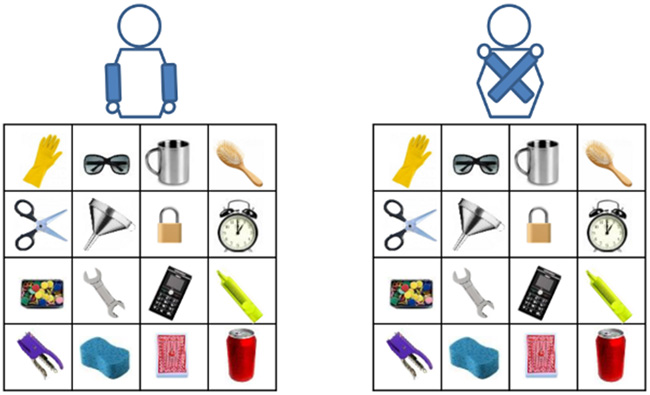
Schematic representation of the set-up and stimuli of Experiment 1.
Left and right panels represent uncrossed and crossed arm posture conditions, respectively. Please note that the objects shown and their displacement are illustrative and do not reflect those actually used.
doi:10.1371/journal.pone.0095748.g001
A team of researchers have found evidence that how you hold your arms, either crossed, or uncrossed, can affect the ability of others to take your perspective.
In the first experiment, subjects were asked to describe the location of various everyday objects in relation to their own body while adopting either an arm crossed or uncrossed posture.
Results showed that participants were generally slower to respond when they adopted a crossed posture. In other words, when people crossed their arms, it was harder for them to decide where that object was located in relation to their own body; their posture specifically affected their ability to relate to it.
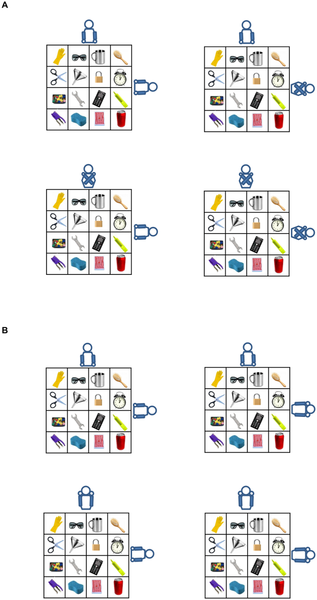
Schematic representation of the set-up and stimuli adopted in Experiments 2 and 3.
doi:10.1371/journal.pone.0095748.g003
In the second experiment subjects were to describe the location of objects with respect to another person who adopted or did not adopt a crossed-arm posture. This person was placed to their right.
This time the researchers found that left/right judgments were affected. Right responses were slower when taken from the other person’s perspective, but only when the other person adopted a crossed posture.
I specifically asked Cristina Becchio, Department of Robotics, Brain and Cognitive Science, Fondazione Istituto Italiano di Tecnologia, one of the studies co-authors, if this was proof that arm crossing body language meant that we were “blocking out the perspective of others.” She drew my attention to the third experiment to answer this question.
In the final experiment, subjects held their arms in an “unusual position” but not crossed. They were instructed to hold their arms on their respective same-side shoulders. Results showed that responses were generally slower but no specific effect occurred with on left/right judgments.
Overall, Becchio related to me two main take-away messages from the study:
1) “Arm crossing has a specific effect on the mapping of left-right relations” and
2) “Adopting an unusual posture makes it more difficult for other people to take your perspective.”
While this falls short of the explanation that arm crossing serves to block out the perspective of others, it does say that viewing someone cross their arms, makes it more difficult for us to assume their perspective. As we’ve seen throughout the nonverbal research, the body and mind are intimately wired. Small changes in the body can produce real changes in the brain. The long-held conclusion that crossing the body off is “bad” body language because it closes our body to the perspective of others isn’t supported or denied by this study, though it does indicate that perspective taking is directionally and negatively affected. Therefore, as commonly claimed, arm crossing should be generally avoided, especially if one wishes to keep the signals from sender to receiver ‘un-crossed.’
Resources
Tiziano Furlanetto; Alberto Gallace; Caterina Ansuini and Cristina Becchio. Effects of Arm Crossing on Spatial Perspective-Taking. PLoS ONE 9(4): e95748. 2019. DOI: 10.1371/journal.pone.0095748