
Men’s Body Movement More Extroverted And Emotionally Stable, Says Research
Christopher Philip
 Previous research has shown that women are more nonverbally involved than men. They have a greater range of facial expressions and more expressive body movements. However, men, show higher levels of activity and more expansive movements coupled with more relaxation cues. However, what is the cost of each strategy in terms of other’s perception?
Researchers Markus Koppensteiner and Karl Grammer, Department of Anthropology, Human Behavior Research, University of Vienna, Austria in a paper entitled “Body movements of male and female speakers and their influence on perceptions of personality” published in Personality and Individual Differences sought to answer this very question.
The authors of the study note that in pervious research “simple animations of a body moving can betray someone’s sex.” This was ascertained by using the “point light” approach. This study technique attaches reflective markers to the joints of people to trace their gait. In turn, the dots are transformed into a movie animation. Interestingly, in these studies, the sex of the subjects we easily detected. That is men and women could be determined simply by the motion of their joints.
In other research body motion has been ascribed across the five factor model personality dimension. That is, body motion is a predictor of personality and disposition. Politicians have also been linked to personality, judgment and health based on the movement patterns their bodies make. This in turn, has a great effect on voter behaviour.
The Experiment
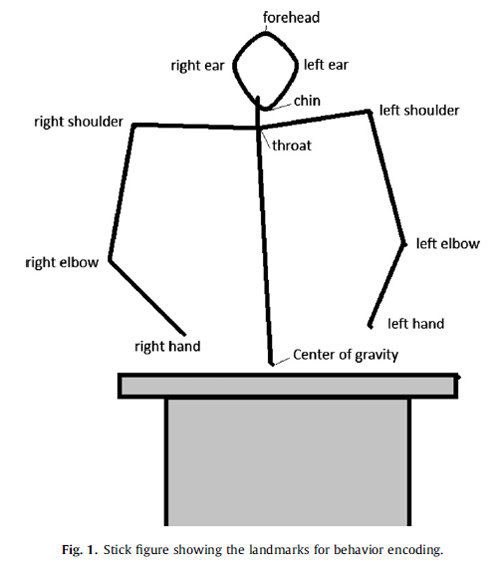
In the current research lead researcher Markus Koppensteiner wished to observe the differences between male and female public speakers and analyze their communicative body movements. In order to do so, the researchers first converted speaking performances of men and women into ‘point light’ for review. The speaking performances were collected from public speeches made in the German Houses of Parliament. In total, 20 female and 20 male speakers were used in the study.
Dots were placed on the forehead, the hollow of the throat between the collar bones, the ears, the shoulders, the elbows, the hands, the corners of the lectern, and onto a spot
in the middle of the body near the navel (i.e. the center of gravity).
The figures were the assessed for extraversion, agreeableness (e.g. hostile versus cooperative), conscientiousness (e.g. careless versus meticulous), neuroticism or emotional stability (e.g. nervous versus balanced) and openness (e.g. unimaginative versus imaginative). These were assessed on a 7 point sale.
The Results
The results showed that people can take a great deal of information from the human body – even when it is reduced to point sources. In previous gait research, it was possible for subjects to ascertain the sex from the point sources, but not in this case. The absence of information below the torso might explain this. Previous research relied heavily on the distance between the left and right shoulder and the hips. In this study, those measures were not given as the figures only had shoulders with one long narrow line depicting the torso.
The researchers did however find sex differences. Specifically, they found that stick figures animations of male speakers were rated highly for extraversion and emotional stability (or neuroticism). Previous research has shown that men rate higher also on assertiveness and excitement seeking though as suggested by the authors “it seems
obvious that presenting oneself in front of an audience is a demanding activity which will favor people who are assertive and crave for excitement.” Previous studies has also shown evidence that women are higher on agreeableness but this again was not found.
The authors continue, “When analyzing our findings in more detail, we came to several conclusions. First, motion behavior displayed during a speech conveys information that influences people’s judgments. Second, variance in motion behavior leads to different attributions of personality. Third, male and female speakers presented themselves differently in some ways and these differences affect ratings of certain personality traits. Finally, ratings are influenced by gender stereotypes.”
“Our findings indicate that differences in the personalities of men and women are visible in nonverbal behavior.”
Future Research
In future research, the authors recommend teasing apart the body motions that link to various personality traits. How dominant is the role of body motion in person perception? How does body motion interact with the rhetorical skills of a speaker, does it affect judgments of trustworthiness and competence, and as consequence voting behavior and media presence? Do men and women differ in their abilities to present themselves and how does this influence a potential voter’s opinion about a person?
Resources
Barclay, C. D.; Cutting, J. E.; and Kozlowski, L. T. Temporal And Spatial Factors In Gait Perception That Influence Gender Recognition. Perception & Psychophysics. 1978; 23, 145–152.
Kozlowski, L. T., and Cutting, J. E. Recognizing The Sex Of A Walker From A
Dynamic Point-Light Display. Perception & Psychophysics. 1977; 21, 575–580.
Markus Koppensteiner; Karl Grammer. Body Movements Of Male And Female Speakers And Their Influence On Perceptions Of Personality. Personality and Individual Differences. 2001; 51: 743–747.
Pollick, F. E.; Kay, J. W.; Heim, K.; and Stringer, R. Gender Recognition From
Point-Light Walkers. Journal of Experimental Psychology: Human Perception and
Performance. 2005; 31: 1247–1265.
Learn More Starting Today!
Learn the basics of body language quickly and easily by taking one of our tailor-made video courses!
Short on cash? Then read an ENTIRE comprehensive book on body language – it’s totally FREE!
Which body language video course will you start with?
1. “The Secrets of Body Language”