
What’s More Powerful? – NonVerbal Power Or Real Power
Christopher Philip
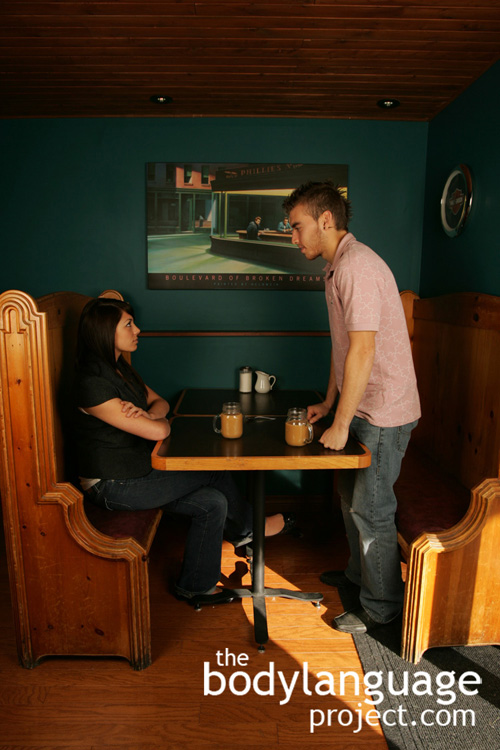
When it comes to power, hierarchical role and physical posture often reinforce one another — but when they diverge within an individual, posture may be more important in determining whether people act as though they are really in charge.
Researchers Li Huang, Adam Galinsky out of Management and Organizations, Kellogg School of Management, Northwestern University and Deborah Gruenfeld and Lucia Guillory Organizational Behavior, Stanford University sought to understand whether the nonverbal expression of power through expansive postures or being given a high status role was the better predictor of perceived power.
According to the researchers “When it comes to power, hierarchical role and physical posture often reinforce one another — but when they diverge within an individual, posture may be more important in determining whether people act as though they are really in charge.”
It had been previously demonstrated that expansive postures on their own increase a person’s perception of power and even the hormones related to dominance – testosterone, while simultaneously decreasing the stress hormone cortisol. Expansive postures are related to dominance across animal species, from birds, to fish, to reptiles, and mammals. Even research on children has shown that relative level of body expansiveness predicts dominance and submissiveness.
When we find members of the species in dominant postures we understand that they are feeling superior – body openness is a significant predictor of dominance.
Research has also indicated that holding a powerful position also increases the sense of power felt. Being assigned to a managerial role in one experiment lead people to take more decisive action, take risks, think more abstractly and behave more optimistically. It has been shown that by simply recalling a high-powered role that it was enough to produce action. In one study, recalling a high-power role motivated subjects to independently move an annoying fan that was blowing right in their face. Further studies have shown that high ranking roles induce people to make first offers in negotiations and even consider risky sex without a condom. Interestingly, these effects happen whether people are in the role or simply recalling it from memory.
The Experiments
To tease the two apart, posture from role, the researchers set up 3 experiments.
In the first experiment 77 undergraduate students where randomly assigned 2 postures (expansive or constricted) and hierarchical role (high or low power). The participants then filled out a questionnaire assessing them on their leadership.
As they waited for their results, they were instructed to sit in a chair while adopting either an expansive posture or constricted posture. The expansive posture was created by having subjects place one arm on the armrest of the chair and the other arm on the back of a nearby chair. They were instructed to cross their legs in the figure-four-leg cross where the ankle of one leg is placed over the thigh or knee of the other leg. In the constricted posture, the subjects were instructed to place their hands under their thighs, drop their shoulders and hold their legs pressed together.
Role was manipulated for power based on a two person task. They were either instructed to act as subordinate or manager in completing a puzzle. The “subordinate” was told they’d be evaluated on their performance whereas the “manager” was instructed to evaluate the performance of the subordinate.
The subjects were then assessed on their activation of power. Here, they were instructed to complete seven word fragments, “power,” “direct,” “lead,” “authority,” “control,” “command,” and “rich.” The number of words they could complete provided the researchers with a score for their level of powerful. Finally, they were asked to rate how powerful they felt, which they rated on a scale from 1-11.
Interestingly, role and posture both independently affected participants sense of power, but only posture affected the implicit activation of power. In other words, posture alone made people act as if they had more power.
The second experiment had subjects carry the same contracted and expansive postures. Following this they were asked to complete various tests and tasks. First, they were asked to play a hand of blackjack. They were duped into a hand showing 16 with the dealer a hand of 10. As you know the closest total to 21 in blackjack is deemed the winner. The participants were assessed based on whether or not they took another car or stuck with 16. The participants where also asked to identify a series of fragmented pictures where part of the image was missing. All objects contained actual objects.
It was found that those who took on the expansive postures where much more likely to take another card in the blackjack scenario – 81% versus, 58%. Once again, role nor role and posture affected action. Participants in the expansive posture correctly identified more pictures that did participants in the constricted posture condition.
Yet another win for posture over role.
In the final experiment, researchers wanted to test the effects of recalled memory on power. They followed the same procedure as the previous studies except while seated, they had subjects recall a high-power or low-power memory such as teacher-student, coach-player, manager-subordinate. The subjects where then asked to decide (a) whether to speak first in a debate. (b) whether to leave the site of a plane crash to find help, and (c ) whether to join a movement to free a prisoner who was wrongly imprisoned.
Again, participants in the expansive-posture condition decided to take more action than did participants in the constricted-posture condition.
Conclusions
The researchers conclude that “Across three experiments, posture mattered more than role in determining thought and behavior. Compared with being in or recalling being in a high-power role, embodied power consistently had stronger effects on two of the key outcomes of power—action in behavior and abstraction in thought.”
“The current findings further bolster the notion that power is embodied, or grounded in bodily states. To think and act like a powerful person, people do not need to possess role power or recall being in a powerful role.”
The tight link between posture and role may be so deeply wired into us that the effects role has in us may be “muted.” Expansive postures, where we see them and when we permit ourselves to take part in them are so linked that they have practically become synonymous. An expansive posture, even if faked, is experienced by the body as real dominance, real victory, and real triumph.
Resources
Li Huang, Adam D. Galinsky, Deborah H Gruenfeld and Lucia E. Guillory. Powerful Postures Versus Powerful Roles: Which Is the Proximate Correlate of Thought and Behavior? 2019, Psychological Science; 22(1): 95–102.
Learn More Starting Today!
Learn the basics of body language quickly and easily by taking one of our tailor-made video courses!
Short on cash? Then read an ENTIRE comprehensive book on body language – it’s totally FREE!
Which body language video course will you start with?
1. “The Secrets of Body Language”