
Fear – It’s In Your Amygdala
Christopher Philip
 The recognition of emotion, especially fear, seems to be largely processed and recognized by the amydala. Individuals with lesions to the amydala show deficits in recognition of fearful faces. Neoroimaging studies have also found increased activity in the amydala when viewing fearful faces.
Differences between people with respect to the size of the amydala may explain why some people experience certain stimulus differently. For example, those with spider phobia, posttraumatic stress disorder, and other specific phobias seem to have smaller amydala volume compared to normal adults. Thus, those suffering from specific phobia may be related to the relative size of the amydala. Therefore a smaller amydala may be more sensitive to fear and this may be a marker for specific fear related behaviour including low extraversion and high introversion which is marked by increased levels of fear sensitivity.
In the current study, Chinese researchers led by Ke Zhao measured amydala volume and related amaydala size back to the ability to recognize specific emotion including fear.
In the study, subjects were shown images depicting six types of facial expressions including anger, disgust, fear, happiness, sadness, and surprise. Prior to the study, the subjects also filled out an inventory measuring their level of anxiety.
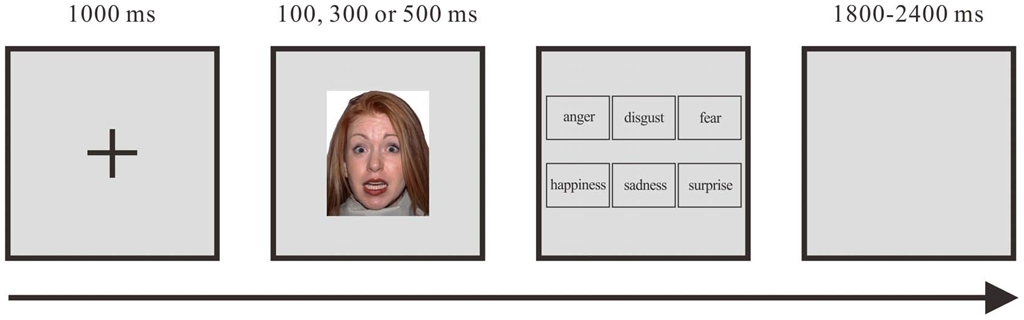
The procedure for a single trial of the facial expression test.
doi:10.1371/journal.pone.0074096.g001
Results showed that the volume of the left amydala negatively correlated with the accuracy on fearful face recognition. Additionally, the left amydala volume also positive correlated with misinterpretation of fearful faces as surprise faces. No correlation existed between the amydala and recognition of any of the other facial expressions.
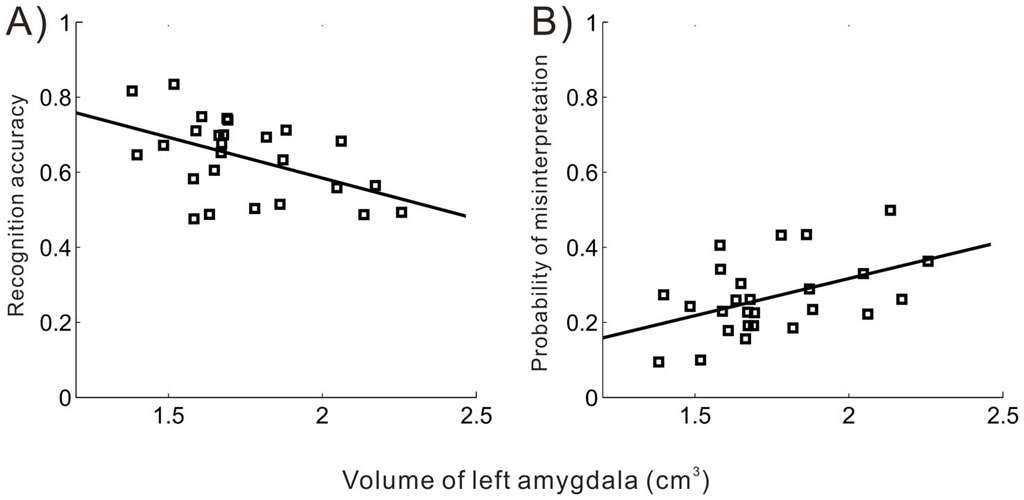
The left amygdala volume was correlated with the mean accuracy for recognizing fearful faces and the mean error rates for judging fear as surprise. A) Scatter plot of recognition accuracy for fearful facial expressions (y-axis) versus the total adjusted left amygdale volume (x-axis, cm3). B) Scatter plot of the probability of misinterpreting fear as surprise (y-axis) versus the total adjusted left amygdala volume (xaxis, cm3). The best-fit lines are plotted based on the average results of the two experiments. The correlation coefficients between amygdala volume and performance in fearful face recognition were obtained while controlling for total intracranial volume.
doi:10.1371/journal.pone.0074096.g002
In summary, the volume of the amydala negatively predicts recognition of fearful faces. Thus, the smaller the amydala, the greater the chance that a person will properly read fearful faces leading to fewer mistakes overall, but will misread surprise as fear.
This notwithstanding, fear is one of the most difficult facial expressions to read and universally confused with surprised – even by normal adults.
“This might be because both surprised faces and fearful faces are ‘wide-eyed, information gathering’ facial expressions,” say the researchers.
However, those with specific deficits more easily confuse the expression stemming from trauma or development.
“Our results support the speculation that the amygdale responds most specifically to fear when subjects attend to the stimuli and are highly sensitive to fearful faces, as demonstrated in studies showing greater amygdala activation for fearful faces in comparison to angry faces, happy faces, and neutral faces. Therefore, it is possible that subjects with smaller amygdala volumes are more sensitive to fear-relevant stimuli, and these subjects had higher accuracy scores in fearful face recognition.,” say the researchers.
On the other hand, those with larger amydala volumes are less sensitive to fear stimuli and thus a higher probability of misreading fear as surprise.
Image Credit: epSos.de
Resources
Zhao, Ke; Wen-Jing Yan; Yu-Hsin Chen; Xi-Nian Zuo and Xiaolan Fu. Amygdala Volume Predicts Inter-Individual Differences in Fearful Face Recognition. PLOS one. August 2019. (8): 8: e74096. doi:10.1371/journal.pone.0074096.g001