
Can Children Read Pride Body Language?
Christopher Philip
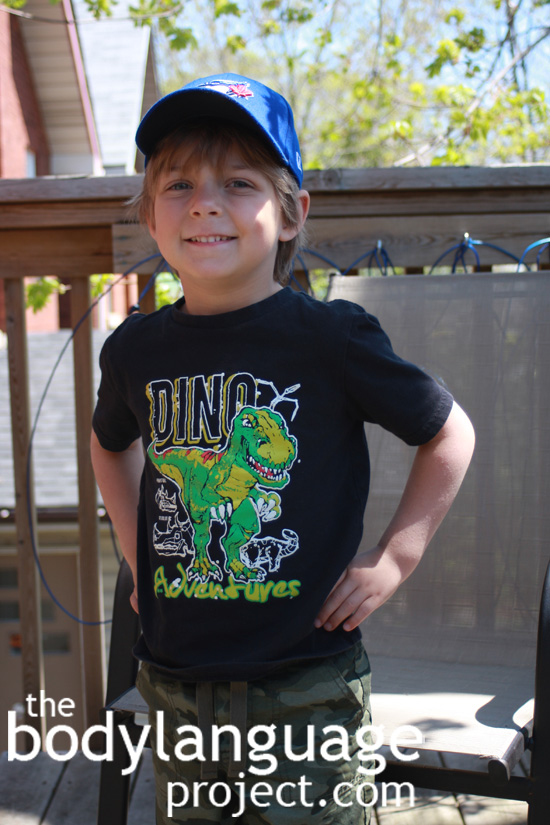 Children as young as 2-years of age have been shown to display the nonverbal expression of pride. However, little is known if the expression is read and interpreted by children in the same way that is by adults.
Very little is known, too, about the effects of facial expression and bodily expression and their contribution to the child’s understanding of emotions conveyed.
Researchers Nicole Nelson and James Russell, Department of Psychology, Boston College set out to measure the ability of children aged 4-11 to correctly attribute the nonverbal emotion of pride. The research is published in the Journal of Experimental Child Psychology.
The study had a professional female actor pose in such a way as to produce dynamic 5-second video clips of pride as well as fear, surprise, disgust and embarrassment. The cues included head, facial expressions, as well as postural cues. For each emotion, 5-second clips were produced for a) head-and-face-only, b) body posture-only and c) both head-and-face body posture.
The results showed that the accuracy of labeling the nonverbal emotions increased with age, as expected. Pride was attributed correctly by the 8-11 year-olds at a rate of 62%, followed by the 6-7 year-olds at 40% and the 4-5 year-olds at only 4%.
As the children were provided more cues, that is, when the clip presented the head, face and body, the children were more successful at discerning the nonverbal expression, than when provided with just a single cue. The multi-cue clip was accurate up to 48%, head-and-face at only 37%, and body-posture-only at 18%.
As age increased, the children began to show adult-like patterns of accuracy from fewer cues. The 8-11 year-olds were able to attribute pride to the head-and-face-only expression as accurately as the multi-cue expression. However, the 8-11 year-olds were not as successful as the adults in the body-posture-only expression.
This suggests that children use the face as a more salient source of information in reading overall emotion. This is congruent with prior research which has shown that facial expressions are habitually read more accurately than bodily expressions even in adults. However, the research suggests, that with age, people begin to incorporate bodily expressions into their nonverbal dictionary.
Interestingly, much like adults, children used “anger” to describe the body-only-posture whereas the multi-cue or head-and-face produced more positive expressions such as happiness (47%) and pride (47%). So like adults, when the body is presented by itself, it is normally attributed to negative cues whereas the face or multi-cues to positive emotions.
The researchers point out that while pride is a positive emotion, it is the face that modulates the effects. Without the face, the pride expression turns out to be a negative expression.
Drawing Conclusions
Children and adults behave in similar ways when they read emotions from nonverbal expressions. They both rely on a combination of head, face and body. As more cues are added, the accuracy of assessments increases. The face is the most relevant source used in adults and children, but as age increases, the body becomes used more often and more accurately.
Also, when children aren’t given appropriate facial expressions, body expressions of pride are misread as meaning anger – a negative cue, rather than accurately, as a positive cue.
It is possible, according to the researchers, that children see the bodily expression of pride, absent of facial expression as a cue signaling dominance – which when performed for their benefit, signals a negative cue – anger.
It is not known whether age produces more accurate assessments of emotion due to maturation – in a natural process, or if people simply become better with practice and experience.
Regardless, it is important to understand that children require multiple channels to truly understand emotion from nonverbal channels. If one wishes to be read accurately by children, such as within teacher-student or parent-child interactions then one should be careful to include congruent facial and bodily expressions with emphasis on the face.
Resources
Nelson, Nicole L and James A. Russell. Children’s Understanding Of Nonverbal Expressions Of Pride. Journal of Experimental Child Psychology. 2019; 111: 379-385.