
Nonverbal Submission In Men And Women In Depression – A Critical Examination Of The Use And Disuse Of Submission
Christopher Philip
 Animals that form dominance hierarchies are highly beneficial to those who are able to achieve higher status as they reap the lion’s share of resources and mates. Thus, status and dominance is highly coveted. When such arrangements exist, order is created through competition.
Submissiveness, on the other hand, is thought to have evolved to signal a desire to opt out of competition and escape from the wrath of more dominant individuals. In other words, submissive nonverbal cues, signal to others that they wish not to participate in competition. Depressive symptoms, via prolonged submissiveness has been linked to a failure to “ritualize competition.” In other words, depression is linked to submissiveness in an exaggerated sense rather than from a brief loss during a single failed battle.
It should be noted that submissiveness in a general sense, is not harmful. In fact, it can be beneficial in setting up constructive hierarchies. For example, being submissive with respect to an employer is the correct way to fall in line in order to maintain your position (rank) in the company. A failure to submit, almost always results in either being fired, or if done correctly, promoted!
In animals, the process has been described as “involuntary” as it is highly important for a losing animal to submit so as not to reengage the victor possibly resulting in death or serious injury. The losing animal may be casually defined as “depressed.” Animals will slink, slump, or cower, become withdrawn, lower their gaze, and turn away.
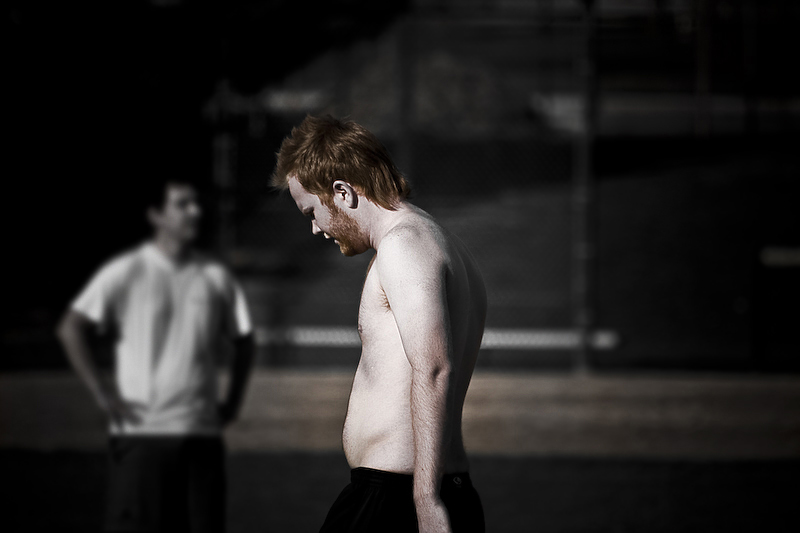
These same patterns are seen in humans who lose in ritualized competition such as sporting events. The losers leave the field with bowed heads and shame.
This is an adaptive strategy and usual. However, when life becomes a losing proposition generally, and submissiveness is prolonged, as is defeat, major depression can set in. We see this when people are unable to escape from loss – feel entrapped and in turn withdraw totally from life’s “competition.”
Perfectionists and those who are highly self-critical are thought to be most vulnerable to “involuntary subordination.” These people are highly competitive and achievement oriented, but in a maladaptive way. They are also usually highly neurotic and unable to accept defeat. In contrast, those with high levels of self-efficacy carry a more adaptive response to defeat. They perceive loss more positively and are less likely to suffer from involuntary subordination.
Therefore, involuntary subordination is a marker for major depression.
Involuntary subordination is characterized by entrapment or feeling stuck or trapped and wanting to escape as well as feelings of perceived social inferiority.
As this is a longer summary, you may wish to skip directly to “The Fourth Study.” In so doing, understand that various surveys and questionnaires were used to assess involuntary submission toward a new questionnaire (the ISQ) and this is then linked to nonverbal behaviour with some interesting gender based conclusions.
 The Current Study
In the current study researcher Edward Sturman, State University of New York, Plattsburgh wished to extend the definition of involuntary subordination to include perceived defeat and submissive behaviour.
The questionnaires used throughout the studies and their results are not terribly important for our current discussion, however, they will be briefly described.
DS (Gilbert & Allan, 1998): A 16-item questionnaire designed to “capture a sense of failed struggle and losing rank” Perceived defeat is rated on a 5-point scale which links to the frequency of feeling defeated in the past week.
Example: “I feel that I have not made it in life” and “I feel that I have lost my standing in the world.”
ES (Gilbert & Allan, 1998): A16-item questionnaire designed to measure the escape motivation of people with regards to the outside world or their thoughts and feelings. It also measures the degree to which participants feel trapped and unable to escape either their circumstances or self. The two scales are external and internal entrapment.
Example: “I am in a situation I feel trapped in,” and “I would like to escape from my thoughts and feelings.”
SCRS (Allan & Gilbert, 1995): The SCRS is an 11-item scale designed to measure how people perceive themselves in relation to others with items rated on a 10-point scale. The SCRS is divided into three dimensions of social comparison: social rank, relative attractiveness, and the degree to which one fits into the dominant group.
Example: In this questionnaire, participants rate the degree to which they feel inferior or superior, incompetent or competent, unlikeable or likeable in comparison to others.
SBS (Gilbert & Allan, 1994): It incorporates the 16 most agreed-upon submissive behaviours. Participants are asked to rate the frequency of each submissive behavior on a scale from 0 (never) to 4 (always). The scale items predominantly reflect involuntary submission.
Example: “I agree that I am wrong, even though I know I’m not.”
The First Study
The first study reviewed a previous study (in a novel way) which was based on questionnaires assessing depression symptoms.
In the study 90 depressed patients were compared to 299 undergraduate students. Results of the questionnaires showed that defeat, internal and external entrapment, social comparison, and submissive behavior all point and exacerbate involuntary subordination (IS). Each symptom added to the overall effect of IS.
The Second Study
This study served to replicate the first study, except with a healthy population of psychology students.
The findings of the first study were replicated and each of the questionnaires lead to higher IS.
The Third Study
The third study employed a battery of questionnaires in the creation of a new assessment, the involuntary subordination questionnaire (ISQ).
Those who scored high on the ISQ had highly neurotic personality styles, scored low on dominance including low self-efficacy, extraversion, and self-esteem.
The Fourth Study
The fourth study was more interesting in that it employed a nonverbal assessment to detect depression. Here, 45 undergraduate students were video recorded and analyzed for their body language.
Before the interview, the students filled out the ISQ. The experimenter then asked the subjects to another room where they were interviewed about their past performance in a job. The exercise was meant to have them interact in a way that their nonverbals could be captured. The interview lasted 3.5 minutes.
They were asked the following questions:
1. In what ways do you think you were good at your last job
or current job?
2. In what ways have you recently been competitive in
school, sports, or work?
3. Describe the nature of your current job or past job.
4. Describe a typical day at your job.
5. What did you like most at your past job or current job?
6. What is your ideal job?
After the second question was posed, the interview leaned forward so that his elbows rested on his knees. This was designed to be a behaviour challenge toward the participant as it reduced their personal space.
The video was then coded for nonverbal behaviour including
a) Nonconfident behaviours: unsure tone; quiet tone, wavering voice, could not find the right words, brief response, guarded posture, shrugging, fidgeting, lips in or biting lip, not, meeting gaze of interviewer, looking down, nervous laughter or smiling, rocking.
b) Confident behaviors: sure and assertive tone of voice, loud tone of voice, frequently meeting the gaze of the interviewer, open, nonguarded posture, elaborating on points, calm manner, and able to answer questions effectively.
The videos were also coded for eye gaze where the duration of time the participant looked at the interviewer or looked down was calculated.
The Results
The results showed that the ISQ was significantly correlated to nonconfident behaviours. The ISQ was also negative correlated with proportion of time the subject looked at the interviewer.
When men and women were examined separately, it was found that the ISQ and unconfident nonverbal behaviour was much more predictive. In women, the results were no longer found to be significant. Therefore ISQ did not predict nonconfident behaviours in women.
It was therefore concluded that “It would appear that involuntary subordination was fairly strongly related to subordinate nonverbal behaviors in men but was weakly related to these kinds of behaviors in women.”
Drawing Conclusions
The major finding is that women do not demonstrate involuntary submission to the same extent as men. It seems as though men use their nonverbal communication more readily to submit whereas women do not. The study predicts that men should be easily spotted for their overall level of depressive symptoms from simple body language of unconfident behaviours when compared to confident behaviours.
That women don’t show involuntary submission and hence depression the same way that men do, is not exactly surprising. As more research is added, we are finding that men and women use body language differently.
When women use submissive body language effectively, it can actually boost power. Men have been known to perform extraordinary feats for women who display submissively toward them. While this may present as a case of helplessness, the actual results, the things men (and other women) do for women, speak for themselves.
This might seem sexist, however, if we reverse the roles, should men have a ‘super power’ which permits them to manipulate others for their benefit, they would employ it with fervor, and it would be deemed empowered.
What is known, however, is that a sector of women does understand the powers of submissive behaviour, and they do use it to their advantage in their manipulation of others, not just men. I will not get into the specifics here, but take the act of crying for example – it does much to provide women in courts much more lenient sentences. On the other hand, men are not afforded sympathy for their tears.
This points to the fact that for men, the power of submission is not readily useful. For men, dominance is the active force in their lives – it is their ‘super power.’ It’s what gets things done. Unlike women, when men can not master confident behaviour, as measured in this study, then they are submitting to defeat in a real way.
It is my contention that submission is a powerful tool for women, whereas in men (and in most cases) it is a tool that is no conducive to power.
Women, it seems, have much more latitude with respect to nonverbal communication. They can benefit from both submissive and dominant body language. Men can also benefit from submissive bodily language, but in a more narrow fashion – certainly a topic for later discussion.
Image Credit: Utah, Salt Lake City
Image Credit: sacks08
Resources
Sturman, Edward D. Invluntary Subordination and Its Relation to Personality, Mood,
and Submissive Behavior. Psychological Assessment. 2019. 23(1): 262-276 DOI: 10.1037/a0021499