
Large Than Life – Nonverbal Dominance Affects Perception of Size
Christopher Philip
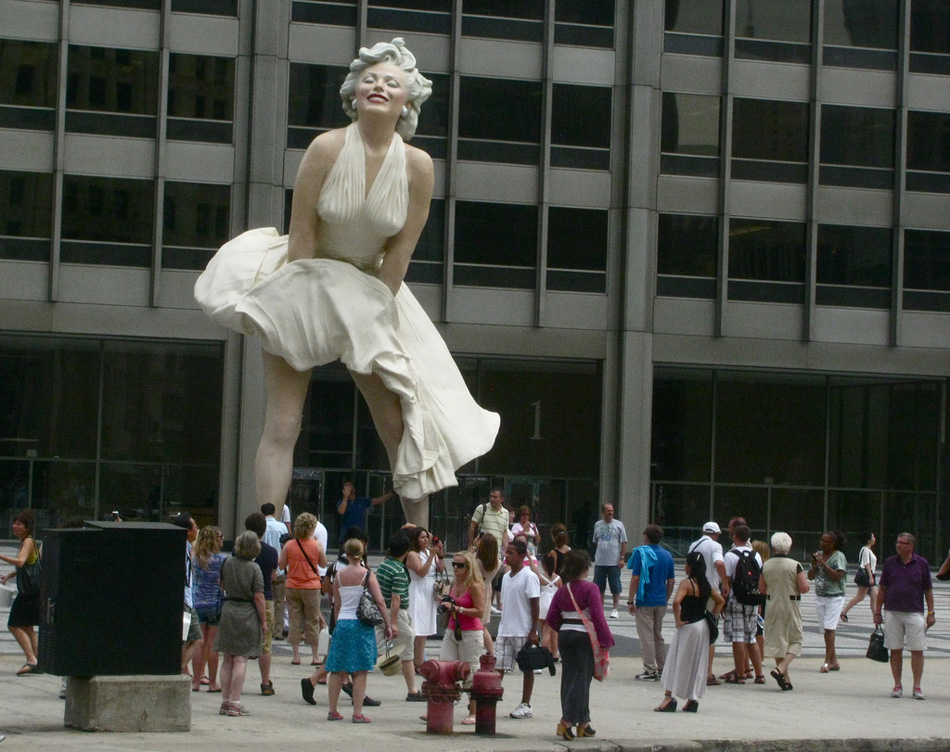 Researchers led by Abigail Marsh, Georgetown University, Washington, have found evidence that size perception is closely related to dominance. Specifically, postural body “openness” is perceived by others as a display of dominance and dominance, in turn, affects the perception of size and status.
Humans are known to display in similar ways to animals. When individuals compete, they puff up, serving to both draw more attention to themselves, like a peacock, and also to boost their overall perception of size in the eyes of others. It is important to note that postural displays do not actually change the actual size of the body, but rather alters an animal’s appearance of size. This emphasizes the intention of the posture – that is, to display a larger than ordinary body frame due to specific intent.
In most cases, dominance displays are due to competition within the species, though, at times, bluff displays emphasize size where an animal may puff up by drawing air into its lungs so as to appear to be a more formidable prey item than originally thought. Many non-poisonous snake species will flair their necks when threatened and animals will often gap their jaws open to display their teeth. For example, a garden variety snap pea brought to the glass containing my son’s beta fish will evoke the fish’s territorial response and he will flare his gill plates while vigorously flapping his pectoral fins. If that doesn’t thwart the pea’s “attack,” then he’ll flick his head aggressively from one side to the other. In this fantasy world, I eat the pea, and so save the beta, but in real life, the beta fish expands its body to display dominance to other male beta’s to defend and protect its territory.
Even you may have felt the effects during a fear response as the hair at the back of your neck rises due to specialized erector pili muscles which puts the hair on end. Dogs and cats habitually display in this way when faced with challenges. Cats will rump up and walk on their toes from side to side. Lizards are known to do pushups seemingly in effort to showcase both strength and aggression, but also increased vertical height.
In contrast, low status is displayed by making the body appear smaller. Here, submission is shown by making the self appear weak, helpless and otherwise convey a lack of threat. Your cat also does this by showing his stomach for a scratch – his desire to expose the most vulnerable part of his body indicates his trust. Dogs will tuck their tail in between their legs in submission, while lowering their eyes. Humans also shrink their body size in effort to avoid attack by lowering the head, averting the gaze and slumping the shoulders.
If an attack persists despite dominance displays, then a war will ensue which is certain to crown a victor. The risk, as always, is permanent injury or worse. Therefore, displays of dominance are certainly favoured in the animal kingdom. Naturally, the same goes for the human species today and through our evolutionary past. In fact, it is likely that they are hardwired into our human genome.
Social dominance is highly important to people and animals as it is involved in competition for territory, reproduction and ultimately survival. Prior studies have shown that taller men earn more money and even achieve higher job status. Height even helps to win elections. Thus, height and size is ubiquitous in achieving status.
The authors note that a variety of nonverbal signals can lead to changes in apparent status including head nodding, shifting the legs and body, raising and lowering the brows, moving closer, and physically touching.
Additionally, nonverbals are associated with greater status and also linked to greater perceptions of apparent size including postural openness, outwardly directed hand or arm gestures, face orientation, and reduced interpersonal distance. Recent research has found that athletes who win a competition thrust their arms upward, their chin back and puff out their chest. Not only does it draw attention to the victor, but is also makes them appear larger. The losing opponent, on the other hand, shrinks his posture and bows his head.
One might wonder why expansive postures are not held continuously if they are so beneficial. The simple answer is that they are costly and require regular maintenance and additional energy requirements. For example, it’s far easier to slouch in a chair than hold a rigid upright posture indefinitely. Also, there is a social consequence to holding an upright posture, as it commands respect, but also attention. This yields a social cost as it invites attack and challenges from others interested in usurping power.
However, it would appear that the display is the entire message. When faced with an attack, simply ‘rising’ to the challenge and ‘standing tall’ is enough to create the impression that one wishes to stand ones’ ground rather than flee or concede.
In their paper, the authors say that “Appearing larger may enhance social dominance because larger-appearing opponents are more likely to spur an opponent to withdraw and thus win by forfeiture.”
However, this idea has not yet been empirically tested in humans and whether indeed dominance postures are successful in altering the perception of size is the source of question in the currently discussed study.
Stimulus Materials (Dominance and Submission)
The photographs used in the study included brow position, gaze direction, body posture and gestures.
In total 8 high status poses, 8 low status poses, and 8 neutral poses were created using male and female actors. Half of the poses were seated and the other half standing.
The photographs were produced as follows:
High status: Lowered brows, direct gaze, open body posture, and outwardly-directed gestures, such as pointing.
Low status: Raised brows, averted gaze, closed posture, and self-directed gestures, such as touching one’s own neck.
Neutral: Brows were in the neutral position rather than being raised or lowered, gaze was past the camera rather than directly at it, posture was neither opened nor closed, and no self-directed or outwardly directed gestures were employed. Variations included standing weight shifted to one side, hands in the pockets or sitting with hands on the knees.
Experiment #1: High status nonverbal cues increase apparent height
Subjects were asked to judge the target’s height, weight and age. It was found that targets appeared physically taller in high status and neutral poses than low status poses. Additionally, men were judged to appear taller than women but no effect was found between gender and status posture. Targets were also judged to be heavier in high status poses and neutral poses than in low status poses. Age was unaffected by posture.
Take Away #1: High dominance status postures influence people’s perception of height and weight such that they make people believe them to be taller and heavier.
Experiment #2: Status cues enlarge objectively measured height and silhouette
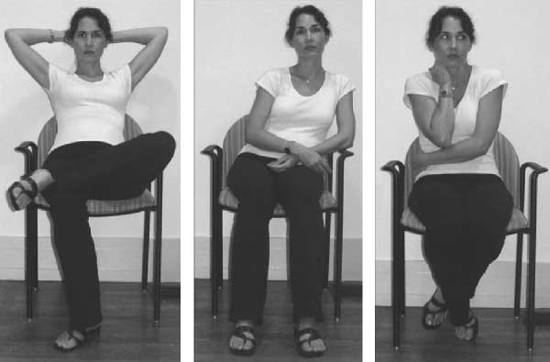
Sample stimuli showing high (left), neutral (center), and low (right) status poses.
This study was designed to assess the effects of expansive dominant posture and contractive submissive postures to determine if they actually increase and decrease target’s apparent size.
Stimulus images used for the study including seated, standing, low, neutral and high status poses. Using a program function from Adobe Photoshop the researchers were able to calculate target’s height and width of each target as well as the pixel area they occupied. Negative space, that is, space enclosed by the body such as when the hands were on the hips were incorporated into the calculation.
The results confirmed that targets in high status poses took up more space and were taller than those in low status poses. Targets also appeared wider in high status poses than neutral poses and wider in neutral poses than low status poses.
Take Away #2: The study confirms that increases in perceived status also increases a participant’s actual size as measured by area occupied including height, width and area of the silhouette.
Experiment #3: Effects of specific cues on perceptions of size and dominance
In this final study, participants judged the size and dominance of the targets (on a 7-point scale) including measures such as “Very small,”, “Very large”; “Very dominant”, “‘Very submissive.”
Results showed that targets were judged to appear larger in high status poses than neutral or low status poses. On the other hand, low status poses were judged to appear significantly smaller than neutral poses, and neutral poses were judged to appear significantly smaller than high status poses.
Additionally, the targets were judged to be larger when standing than when seated. Further analysis showed that posture, that is, open versus closed, was the most strongly associated factor with respect to perceived size. Following overall postural expansiveness, the effect most salient was seated versus standing.
Take Away #3: The study confirms that when people adopt high status expansive postures, rather than low status contractive postures they are judged to be larger rather than smaller. Expansiveness, that is open versus closed, has the biggest effect on perceived size followed by seated versus standing.
Experiment #4: Altering apparent size by manipulating environmental cues influences perceived status
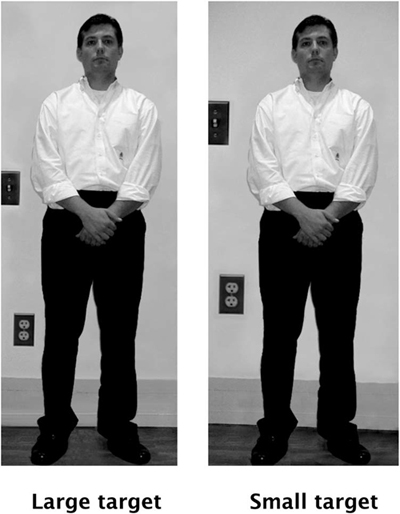 Targets were judged once again based on height, weight and dominance (7-point scale). However, the images were modified to make the targets appear smaller or larger by modifying an electrical outlet and light switch panel on the wall.
Results showed that when the outlet and light switch was modified to make the target appear larger, he or she was rated as more dominant and bigger than when they were modified to make the target appear smaller. In other words, when the background was changed to make the target appear larger, they were judged to be taller and more dominant than when they were made to appear smaller.
Take Away #4: The study demonstrates that altering the perception of cues effectively creates the appearance of size and therefore dominance.
Discussing The Findings
Collectively, the studies confirm that nonverbal behaviour, specifically, postural openness or expansive postures are read by others’ as status cues and that they lead others’ to read the displayer of the posture as physical larger.
In other words, expansive postures serve to demonstrate a larger body size which in turn mediates the impressions of others.
As reported by the researchers, this links the status cues of people, to that of many non-human animals.
Over four experiments it was found that status cues affect estimations of targets’ height and weight. Additionally, when measured, it was found that the areas that the bodies took up was also larger in the high status over the low status postures. Those carrying high status postures were also rated to be more dominant than those carrying low status postures.
One possibly hypothesis advanced by the researchers is that status cues are aimed at misleading the viewers of the postures into misperceiving the target’s actual body size. In other words, dominant expansive postures may be a trick or an illusion to fool others into think that one is bigger than one really is.
We are also familiar with common metaphors about height and power and this speaks to our ingrained ideals about how we deal with the physical world of power. For example, we often “look up to people” who are “elevated”, having reached the “height of power” whom “stand head and should above their peers” or are “giants amongst them.”
It naturally follows that a larger body is one that has good genes and is able to secure enough resources to supply it with energy and defend it from attack. Therefore, it is possible that people whom mimic these open postures also desire the benefits that greater size confers.
Conversely, making the body appear smaller can also convey certain advantages by reducing aggressive challenges and blending into the surroundings. This reduces the chances that one may suffer from injury. Crouching or cowering, rolling the shoulders inward and dropping the head are effective ways that many animals including humans display submission.
Image Credit: Satish Krishnamurthy
Resources
Marsh, Abigail A; Henry H. Yu; Julia C. Schechter and R. J. R. Blair. Larger than Life: Humans’ Nonverbal Status Cues Alter Perceived Size. PLoS ONE. 2019. 4(5): e5707. doi:10.1371/journal.pone.0005707.
Marsh, Abigail A; Karina S. Blair; Matthew M. Jones; Niveen Soliman, and R. J. R. Blair. Dominance and Submission: The Ventrolateral Prefrontal Cortex and Responses to Status Cues Journal of Cognitive Neuroscience. 2019. 21:4, pp. 713–724.