
Be Careful! Infants Perceptive At Reading Body Language
Christopher Philip
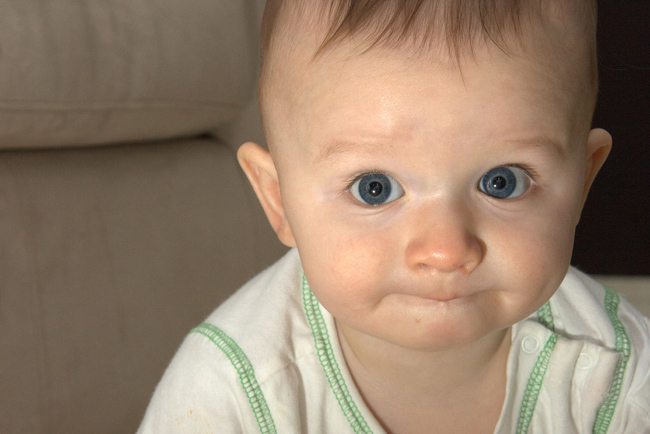 The research suggests that you might want to not only watch your mouth when around infants, but also watch your body.
A team of researchers out of the University of Kentucky have found that 6.5 month old infants prefer looking at happy rather than angry or neutral bodily expressions.
The study had infants focus on a screen in which one of three videos were shown either upright or upside down. The conditions included a person with a happy, neutral or angry posture coupled with a voice quality that matched. The faces of the actors were covered.
The results found that when the videos were inverted, the infants did could not discern the videos based on the actors body language suggesting that they couldn’t tell the difference in emotional expression. Since the infants preferred the happy emotional body language video in the upright condition, this suggested that infants could actually read the actors body language.
In the second experiment, it was found that the infants were capable of matching happy and angry videos with corresponding emotional vocalizations but only when the videos were upright rather than inverted. Overall, the data suggests that infants are not driven by information of the covered face and head but rather the emotion conveyed through the bodies.
“Thus,” say the researchers “young infants are sensitive to emotions conveyed by bodies and match them to affective vocalizations, indicating sophisticated emotion processing capabilities early in life.”
The study mirrors other findings for adults.
However, what is amazing with this study is that young infants seem to have an inborn knack for reading emotional body language without any training. This suggests that reading emotional body language is innate rather than learned.
The study extends many previous research studies which have found that infants as young as 3-4 months of age can readily discern happiness, sadness, anger, fear and surprise from facial expressions. Infants as young as 5 months also seem to be able to tell the difference between happy, sad, and angry voices.
While we might naively believe that much of what we do around our babies goes unnoticed, this might be quite far from the truth. Our babies, it seems, are hardwired to pick up on voice and facial expressions, and as shown in this study, body language.
Image Credit: Eric Fleming
Resources
Zieber, Nicole; Ashley Kangas; Alyson Hock; and Ramesh S. Bhatt. Infants’ Perception of Emotion From Body Movements. Child Development. 2019. 85(2): 675-684.