
Loser’s Nonverbal Behavior Boosts Confidence Of Winners, Study
Christopher Philip
According to research by Philip Furley, German Sport University Cologne and Geoffrey Schweizer, University of Heidelberg, when you’re down in a match not only is it written in your body language, but your ‘losing language’ also boosts your opponent’s confidence.
In a recent study published in the Journal of Sport & Exercise Psychology, the researchers found that when teams are losing in a competition, players show signals of defeat. Opponents pick up on these signals boosting their confidence resulting in them believing that they will ultimately win the match.
In an evolutionary context, nonverbal dominance and submissive behaviours are an indication of fitness or lack thereof. For example, primates display dominance signals when winning a fight, and display submissive nonverbal signals when losing a fight. In humans, dominance often results in “pride” and is characterized by a raised chin, head held high and puffed chest. It says, I’m superior and deserve respect and one should reduce present and future aggression toward me. Submissive signals or “shame,” serve a wholly different purpose. People and animals display shame and submission to avoid further potentially life-threatening attacks. It says; I’m unwilling to advance further challenges and I concede to you.
Based on this evolutionary premise, the researchers predicted that athletes change their nonverbal behaviour in response to winning and losing – and that opponents not only perceive this, but also incorporate it into their level of confidence in winning the match.
The Current Research
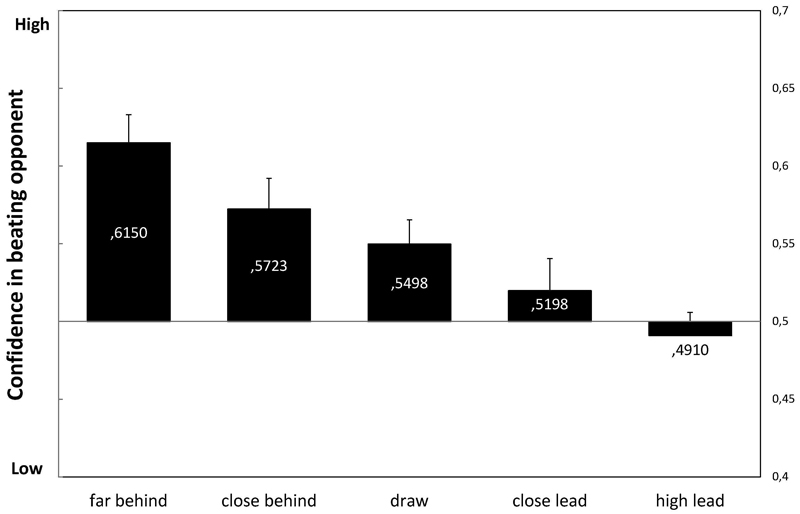
The current study had 40 male amateur and semiprofessional basketball players view stimulus videos prepared by the researchers. The video clips consisted of breaks in the play such as time-outs and free-throws from the NBA and the top German league. The researchers were careful not to use explicit nonverbal signals of pride or shame such as raising the fist above the head or hiding the face behind the hands. The videos were played back silently to eliminate crowd noise and chants. Clips were produced where the athletes were (a) far behind, showing a team trailing substantially (at least 15 points behind); (b) close behind (no more than 5 points behind); c) a draw, in which the score was equal; (d) close lead, (no more than 5 points ahead) and; (e) high lead (at least 15 points ahead).
The participants were then shown the video and asked a single item (on an 11-point scale) – “How confident do you feel about winning the game against the athlete or team.” The actual scores from the game when the clips were taken represented the measure by which the confidence ratings would be compared.
The Results
The results indicated that subjects were able to detect subtle changes in nonverbal behaviour linked to current scores of the game and use the information in their assessments of their ability to win the game – their confidence. In fact, the greater the discrepancy in score against the team, the more confident the subjects were that they would be able to beat the athletes. In fact, the results showed a linear relationship – the higher the lead, the greater the felt confidence.
Discussing The Findings
The study clearly shows that not only are athletes attuned to the nonverbal behaviour of their opponents, but they also use the information in their assessments of their ability to win. Thus, confidence is not based solely on one’s own capabilities, but also reflected in the current behaviour of an opponent.
When a team is currently leading, the nonverbal cues given by the team reflect their level of confidence and this is something that helps continue the winning streak. However, when the team is losing, the nonverbal expression provides cues to the winning team resulting in an overall boost in their confidence.
Over evolutionary history, displays of submission after a challenge from a rival was beneficial, as submission indicates to an opponent that one is prepared to relinquish power rather than persist in the challenge. This is beneficial because reduces the chances of severe injury or even death. While not specifically catalogued in this study, body language such as rolling the shoulders over, bowing the head and glancing away, tell opponents that we admit defeat. Winners on the other hand, lift their chin, hold their head high, roll their shoulders back, and puff out their chest. Thus, losers, by displaying submissive postures accept defeat and so, in theory, effectively reduce the persistent insult delivered by the winners.
However, while these nonverbal mechanisms may have served our ancestors well in the past to reduce future challenges and injury, it (may) serve as a handicap in today’s sporting matches. As we live in a fairly safe environment where sports are played for amusement rather than life and death, succumbing by submission early in the match can serve to handicap an athlete’s position.
The Take Away Message
While the research only looked at sporting events, these results are also transferable across other contexts including any and all dominance competitions including job interviews, during office politics, amongst friends, parent-child relationships and so forth.
When we indicate submission, we indicate defeat. This serves to boost the confidence of our opponents.
Depending on what one wishes from an encounter will determine how one should display. It is not always advantageous to display dominance. Certainly, submission is an important and effective cue to use when looking for assistance – say at a hardware store when one wishes to learn more about a product. Puffing out one’s chest may create feelings of confidence, but it is unlike to garner sympathy from a store clerk of whom you may wish to hear their honest opinion. Rounding the shoulders and avoiding eye contact and direct challenges can ensure that the clerk is relaxed enough to speak candidly. One should also avoid dominance displays when being reprimanded by police or an employer – these can be grounds for arrest or job termination!
Regardless, life often demands of us various nonverbal communication and we should be aware of the purpose of each posture. Should we wish to display strength and confidence through dominance, or should we desire to display weakness and shame through submission, will be wholly dependent on our end goals, the context and our opponent.
Resources
Furley, Philip and Geoffrey Schweizer. “I’m Pretty Sure That We Will Win!”: The Influence of Score-Related Nonverbal Behavioral Changes on the Confidence in Winning a Basketball Game Journal of Sport & Exercise Psychology. 2019. 35:316-320. http://dx.doi.org/10.1123/jsep.2019-0199