
Low Waist-To-Hip-Ratio Predicts Female Desire For Male Masculinity, Study
Christopher Philip
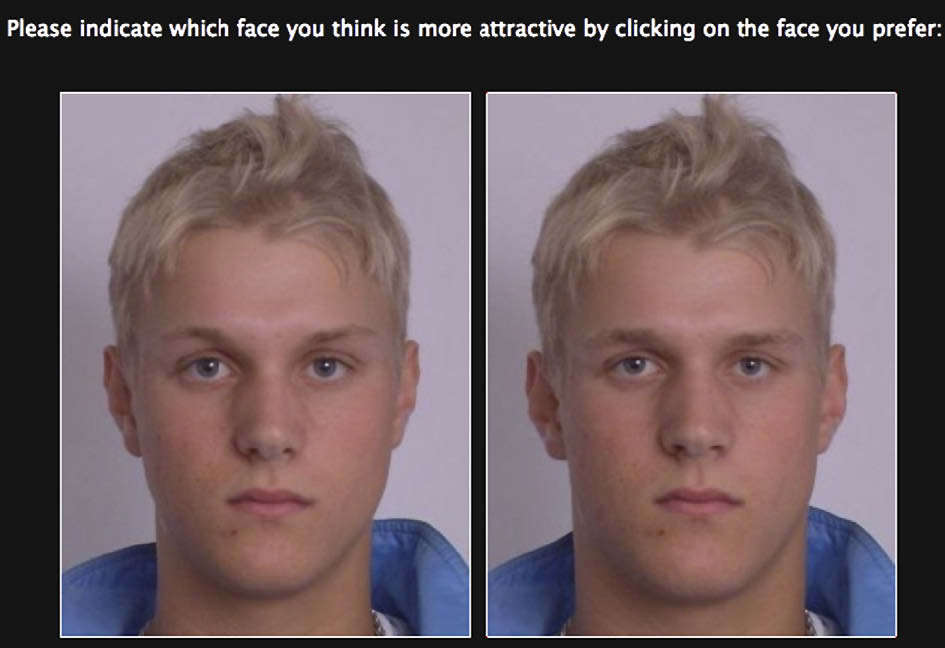
The interface used to test masculinity preferences. Participants chose the more attractive face from pairs of feminized (left) and masculinized (right) versions of the same identity.
A-team of researchers led by Finlay G. Smith University of Aberdeen have found that women with an attractive (low) waist-to-hip ratio (WHR) prefer more masculine men and find them to be more attractive than women with a high WHR.
The researchers note that WHR is an indicator of women’s overall health, attractiveness and reproductive potential, so it is a key area of interest to men especially within courtship.
In the study, researchers assessed the BMI and WHR of 42 women aged 18-26. They were then asked to judge the attractiveness and trustworthiness of 20 pairs of men’s faces each of which was either a masculinized or feminized version of the same face.
Results showed that, on average, women chose the masculine face as more attractive than the feminine face 42% of the time and as more trustworthy than the feminine face 38% of the time. Analysis of the data showed that women preferred feminine to masculine faces overall, and perceived feminine faces to be more trustworthy than masculine faces. Also, attractiveness and trustworthiness scores were positively correlated meaning that as attractiveness scores increased, so did trustworthiness scores.
Interestingly, attractiveness was predicted by WHR such that preferences for masculine faces were associated with low (attractive) WHR’s. In other words, as a woman’s WHR become more attractive, she preferred more masculine faces. BMI, nor age predicted preferences for facial masculinity.
The results are in line with previous research showing that attractive women show stronger preferences for masculine men, than unattractive women. The researchers explain that it may be that attractive women are more able to mitigate the risks associated with dating more masculine men. It has been noted that masculinity comes with certain other negative attributes including lack of commitment and less interest in parenting.
By the same measure, previous studies have shown that masculine men also prefer more feminine women. Thus, there is general alignment where the more masculine men and more feminine women tend to pair with each other. This then reduces wasted mating effort.
In other words, courtship is expensive and also potentially risky, and while, in a perfect world, men and women would maximize their potential with ultra masculine and ultra feminine counterparts to their own benefit. However, as the world is not perfect, certain trade-offs exist whereby men and women must ascertain risks associated with various decisions.
If relatively unattractive woman should pair with an attractive masculine man, she may find that he is difficult to keep interested or rather he is like to stray to a more feminine women. It is well known that more attractive men (and women) are presented more unsolicited mating opportunities than less attractive men (and women). The overall situation also reverses itself with respect to unattractive men dating and pairing with attractive women.
Overall, the researchers suggest that “attractive women may show less aversion to masculine men because they can offset the costs of choosing a masculine partner by being able to replace or retain a partner more easily than unattractive women can.”
This is evidenced by the fact that women with a more attractive WHR rated more masculine men more trustworthy than women with a less attractive WHR.
Resources
Smith, Finlay G.; Benedict C. Jones; Lisa L.W. Welling; Anthony C. Little; Jovana Vukovic; Julie C. Main and Lisa M. DeBruine. Waist–Hip Ratio Predicts Women’s Preferences for Masculine Male Faces, But Not Perceptions of Men’s Trustworthiness. Personality and Individual Differences. 2019. 47: 476-480.