
How You Sit Can Embody Depression – Body Language Postures Control Mental Processes
Christopher
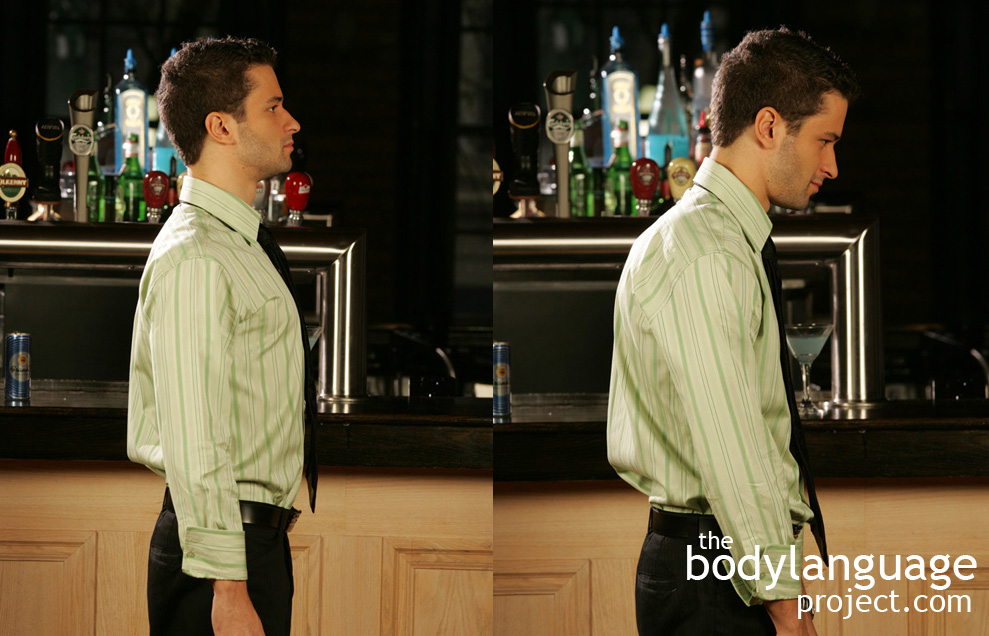
Think of the entire person as being comprised of head and body on mass; a total being. To decide how one feels emotionally, the brain takes in outside factors such as “That person hates me” in conjunction with proprioceptive information such as ‘gut feelings’ or posture (being slumped over) or dowdy movement, to create the feelings of sadness or hopelessness.
German researchers have found further evidence that posture is linked to emotional state.
In fact, they found that subjects that adopted a slumped or slouched (depressed) posture recalled more negative words in a memory recall test than those in an upright erect posture. In fact, those that adopted an upright posture tended to be more unbiased in their recall of words; they remembered both positive and negative words equally.
This is not the first study to link posture with mental functioning.
“The findings indicate that relatively minor changes in the motoric system can affect one of the best-documented cognitive biases in depression,” say the researchers in their paper published in the journal Clinical Psychology and Psychotherapy.
According to the emotional theory of embodiment, experiencing emotional states “affects or controls somatovisceral and motoric systems.”
In simple terms, our mood affects our posture.
But this isn’t just a one-way-street, as other studies, in addition to this one, have found that posture (even our gait or our walking style) tends to affect our mood.
However, this is one of the few studies that have linked posture to a clinical application.
One theory called the Interacting Cognitive Subsystems or ICS says that proprioceptive and kinesthetic inputs from the body (these sense where the body is in space), produce important emotional inputs entirely separate from intellectual and rational processes.
To put things into perspective, think of the entire person as being comprised of head and body on mass; a total being. To decide how one feels emotionally, the brain takes in outside factors such as “That person hates me” in conjunction with proprioceptive information such as ‘gut feelings’ or posture (being slumped over) or dowdy movement, to create the feelings of sadness or hopelessness.
If a person feeds this information back in over an over again then a person can become stuck in a never ending depressive cognitive feedback loop.
Obviously these findings have relevant implications. First, they show that body and emotional processes are linked and work cooperatively, and second, they show that modifications of posture and movement may help mitigate, correct, or possibly interrupt, depressive states. In short, these factors say that it may be possible to use posture modification to correct depression.
So how did the researchers modify sitting postures?
Here are their instructions:
Slumped Posture
Sit back in your chair.
(Pause) Plant your feet flat on the floor underneath your knees, shoulders’ width apart.
(Pause) You should feel no tension in your legs or feet.
(Pause) Now fold your hands in your lap, just sort of loosely cupping one hand in the other.
(Pause) Now please drop your head, letting your rib cage fall and letting the rest of your body go limp.
(Pause) You should feel just a slight tension up the back of your neck and across
your shoulder blades.
Upright Posture
Sit back in your chair.
(Pause) Plant your feet flat on the floor underneath your knees, shoulders’ width apart.
(Pause) You should feel no tension in your legs or feet.
(Pause) Lift up the upper part of your body.
(Pause) Bring your shoulders back slightly.
(Pause) Elevate your chin.
(Pause) You should feel just a slight tension up the back of your neck and across your shoulder blades. To ensure that both groups of participants had a clear view of the computer screen, it was placed on the floor for patients in the slumped posture position and at eye level for patients in the upright position.
Resources
Michalak, Johannes, Judith Mischnat and Tobias Teismann. Sitting Posture Makes a Difference—Embodiment Effects on Depressive Memory Bias. Clinical Psychology and Psychotherapy. 2019. 21, 519-524. DOI: 10.1002/cpp.1890
Oosterwijk, S., Rotteveel, M., Fischer, A. H., & Hess, U. Embodied emotion concepts: How generating words about pride and disappointment influences posture. European Journal of Social Psychology. 2019. 39, 457–466.
Michalak, J., Troje, N. F., Fischer, J., Vollmar, P., Heidenreich, T., and Schulte, D. Embodiment of sadness and depression— Gait patterns associated with dysphoric mood. Psychosomatic Medicine. 2019. 71, 580–587.