
The Cry and Laugh Face In The Human Fetus
Christopher Philip
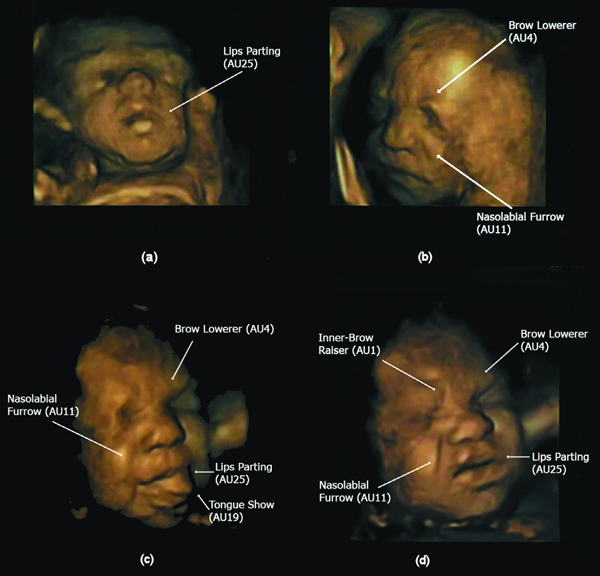
Figure 1. Illustration of developmental progression in number of action units (AUs) over gestational age. (a) One AU at 24 weeks (b) Two AUs at 27.5 weeks (c) and (d) two different combinations of 4 AUs at 32 weeks. doi:10.1371/journal.pone.0024081.g001
U.K. researchers led by Nadja Reissland have found, through 20 4D ultra sound scans that the developing fetus perform facial movements similar to crying and laughing done by adults. In all, 7 distinct facial movements were seen.
The scans were made in the second and third trimester. The researchers found that between 24 and 35 weeks, the occurrence of 3 or more facial movements increased from 7-69%. Also, recognizable facial movements were discernible, rising from 0% to 42%. This led to specific facial expressions increasing from 0-35%. The frequency with which the changes occurred also increased with age.
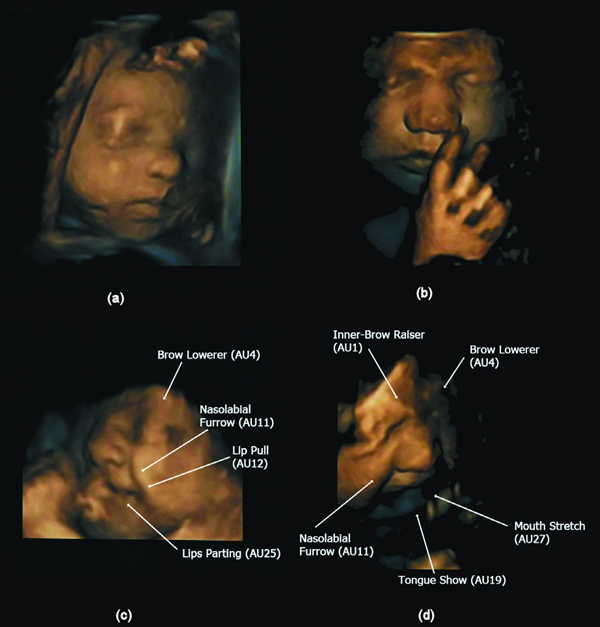
Figure 2. Illustration of neutral faces over gestational age and combinations of action units (AUs) for the laughter and cry gestalts. (a) neutral face at 28 weeks and (b) at 33 weeks. (c) 4 AUs contributing to the laughter gestalt at 32.5 weeks and d) 5 AUs contributing to the cry gestalt at 33 weeks. doi:10.1371/journal.pone.0024081.g002
The researchers point out that assessing the human fetus for facial expressions might be advantageous in testing for developmental health. A fetus that is not growing properly, might not show proper facial expressions indicating underlying health risks or concerns.
Facial muscles are important to a baby, as they form the basis of suckling while feeding and also crying to show discomfort. As the baby develops, he or she will use their face to display emotion.
Previous research has found evidence in the fetus for grimacing, smiling, eye blink and mouth movements, cry movements and scowling.
The present study confirms that over the second to third trimester fetuses develop a large amount of facial action units producing movements that near emotional expressions including those found in the cry and laugh face.
The complexity of the movements also increased over time.
The researchers note that more work will be done including the examination of other facial expressions.
The results of the study may also help health officials determine the difference between a stressed and non-stressed fetus possibly providing an early indication of functional or structural brain disorders.
Resources
Reissland, Nadja; Brian Francis, James Mason, Karen Lincoln. Do Facial Expressions Develop before Birth? August 2019. 6(8): e24081. doi:10.1371/journal.pone.0024081.g001