
Are Expansive Postures Of Power Universal Or Cultural?
Christopher Philip
 A new study published by a team of researchers in the U.S. and France have found evidence suggesting that expansive body postures may not be universal, but rather, have a cultural element.
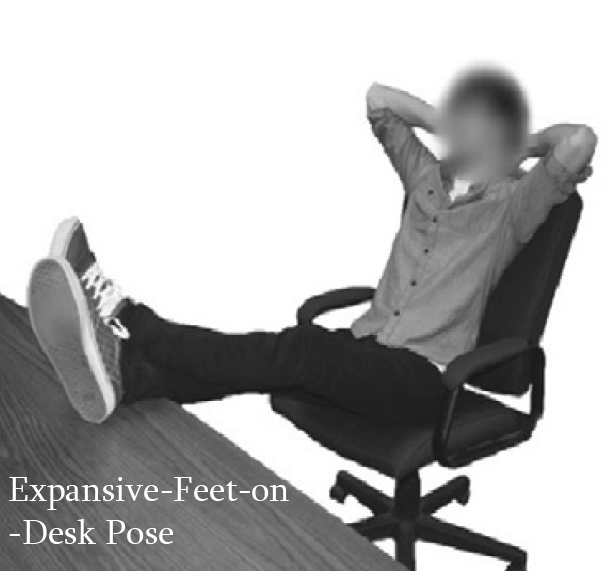
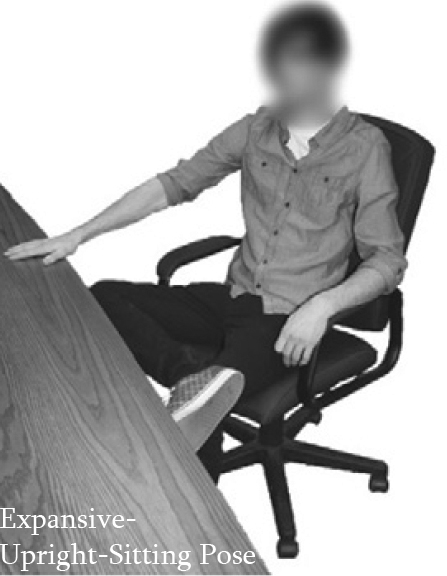
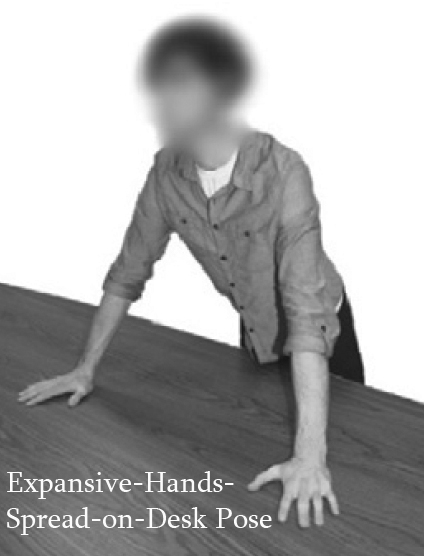
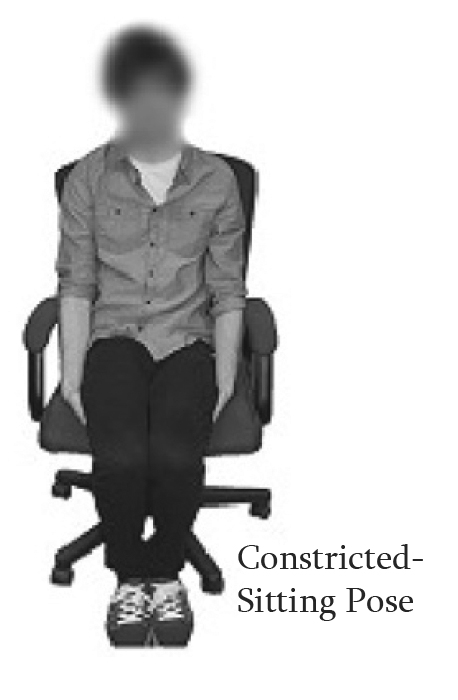
In the study, three expansive nonverbal body postures were examined including the expansive-hands-spread-on desk pose, the expansive-upright-sitting pose, and the expansive-feet-on-desk pose. Also examined as a control was a fourth constrictive-sitting-posture – sitting-with-hands-under thighs.
In the first study two groups of participants, one from East Asian (including China, South Korea, Taiwan, Vietnam) and the another of Western origins, examined photographs of the previously listed postures and rated them on a scale of 1-7 for various traits. The photographs were rated for humble–proud (reversed), arrogant–modest, impolite–polite, rude–wellmannered, respectful–disrespectful (reversed), responsible–irresponsible (reversed), restrained–unrestrained (reversed), disciplined–undisciplined (reversed), careless–careful, and cautious–reckless (reversed).
Of the three expansive postures, the researchers found that only the expansive-feet-on-desk posture differed from cultural norms of dominance. This led the researchers to conclude that the feet-on-desk posture in incompatible with the cultural norms and values of East Asians.
East Asian populations, it is known, have a collectivistic culture rather than an individualistic culture. Therefore, East Asians value modesty, humility, and restraint much more than Western cultures which is likely why they frown upon putting the feet up on the desk in display of dominance.
 In the second study expansive and constricted postures were examined for their effects on feelings of power. Specifically, the researchers wished to test whether the expansive-hands-spread-on-desk posture and the expansive-upright-sitting posture would boost feelings of power for both Americans and East Asians.
In the first part of the study, they had participants adopt the posture for 3-minutes. Here they told one group to adopt the expansive-hands-spread-on-desk posture by standing up, placing their hands on the desk in front of them so that their hands were slightly more than shoulder-width apart, and to keep their elbows straight. In the constricted-standing posture condition, participants were asked to stand up, cross their legs at the ankles, and cross their arms across the chest so that their hands touched their back.
After 3 minutes the participants were given a power scale with ranges from 1-11 and asked to rate how in control or dependent they felt, powerful or powerless, and dominant or weak.
Regardless of cultural background, both the U.S. born and East Asian born participants experienced greater feelings of power in the expansive-hands-on-desk posture than the constrictive-standing posture.
The procedure was repeated for the two sitting conditions – expansive and constrictive postures. In the expansive-upright-sitting posture, the subjects were told to cross their legs so that the ankle of their right leg rested on top of their left knee, their left arm rested on the armrest of the chair, and their right hand rested on the right corner of the desk in front of them. In the constricted-sitting posture condition, participants placed their hands under their thighs, placed their legs together, and drooped their shoulders.
After 3 minutes, the experimenter had the subjects fill out a rating scale as done in the previous condition. Again, they found that certain expansive postures, the expansive-hands-spread-on-desk posture and the expansive-upright-sitting posture – produced a greater sense of power than constricted standing or sitting postures for both Americans and East Asians.
 The third study was aimed at detecting any differences between the expansive-feet-on-desk posture between the two cultures. The researchers predicted that cultural norms would predict how the posture affected perceived power when they were adopted.
Once again, the subjects were asked to adopt one of two postures for 3 minutes. The expansive-feet-on-desk posture had participants lean back in their chairs with their feet on top of the desk in front of them, cross their legs at their ankles, placed their hands behind their head, interlock their fingers and spread their elbows out wide. The constrictive-sitting posture condition was done by placing their hands under their thighs, pressing their legs together, and droop their shoulders.
Once the three minutes had expired, the subjects were asked to perform a “word-completion task.” This is a way for researchers to assess various emotional attributes indirectly. To do so, the subjects were given incomplete words such as “l_ad” which was accurately completed as lead. If it was completed as “load” it didn’t receive a positive score on the power-scale. The more words completed, the higher the assessed power-activation. Other words included were “direct”, “authority”, “power” and “command.”
The results showed that only the U.S. born subjects experienced greater power activation from placing their feet on the desk over placing their feet together on their hands under their thighs. In fact, East Asia subjects felt less powerful than those from the U.S. The researchers concluded that certain expansive postures, namely the feet-on-desk pose do not universally make people feel more powerful.
 In the final study the researchers wished to test the effects of the sitting postures on the desire to take action. This, as explained in the paper is an important behavioural consequence of feeling power. As above, the postures were adopted for 3 minutes, after which they were presented three scenarios and asked if they would take action or not.
The scenarios included (a) whether to leave the site of a plane crash to find help, (b) whether to join a movement to free a prisoner who was wrongly imprisoned, and (c) whether to choose a sure loss of $750 or a 75% chance to lose $1000 and 25% chance to lose nothing.
As predicted, the East-Asians showed less action-orientation than those from the U.S. The U.S. participants also produced more action when in the expansive-pose than the constrictive-pose while the East-Asians did not differ in action orientation from the expansive-pose over the constrictive-pose.
Discussing The Findings
Overall, the expansive hands-spread-on-desk and expansive-upright-sitting posture led to a greater sense of power than the constrictive posture for both Americans and East Asians. However the expansive-feet-on-desk pose led to greater power activation for Americans only.
“Whereas previous research implied that there was a fundamental and universal link between expansive postures and power, we found that postures differ in how compatible they are with cultural norms and values, and as a result, cultural background predicts when a particular posture is linked to power,” say the researchers.
This presents an interesting factor in the link between the brain and body (embodiment) of nonverbal communication. Specifically, that our culture plays an important role in determining postural meaning and how it is coupled with our underlying emotional sense about the posture. In other words, posture and its hidden meaning have some degree of malleability.
“Across the globe”, the researchers say, “it appears that “sitting/standing up tall or spreading one’s limbs can make people feel more powerful. Making oneself
look big on the vertical or horizontal dimension is designed to signal dominance across a range of animal species.” Therefore, they say “It is not surprising, then, that the expansive postures most linked to dominance in the animal kingdom are also the ones that appear to be universally linked to power among humans.”
However, as shown in this study, expansive postures that are more tailored to humans, such as putting the feet up on the desk, which may also violate cultural norms, might therefore not make individuals feel more powerful.
Thus, “It is therefore the symbolic meaning of a posture, rather than the posture itself, that ultimately shapes the psychological experiences of individuals from different cultural backgrounds.”
The Take Away Message
While expansive postures are likely universally read as dominant, like all nonverbal communication, there is always a certain element of culture mixed into the picture.
We have long known that people use gesture differently across culture, but this study suggests that certain postures might be read differently, even as offensive, in some cultures. I would argue that in many cases, putting the feet up on the desk is offensive under most circumstances, even in the West, but that is not the subject of this paper.
That power is activated via putting the feet up on the desk in the West suggest that we’re not only culturally permitted to do so, in some instances, but that it also produces power.
It would be wise to study all nonverbal cues with a degree of caution, but at the same time understand that some postures, as shown in this study, do hold their meaning around the world.
Additionally, the study confirms what other similar studies have found – that power postures produce feelings of power. By simply adopting dominant body language, one is able to produce positive action-oriented thoughts.
In other words, using power language in many situations can produce desired outcomes.
Resources
Park, Lora E.; Lindsey Streamer; Li Huang and Adam D. Galinsky. Stand Tall, But Don’t Put Your Feet Up: Universal and Culturally-Specific Effects of Expansive Postures On Power. Journal of Experimental Social Psychology. 2019; 49: 965–971.