
Sit Big To Eat Big – How Constrictive Postures Reduce Food Consumption
Christopher Philip
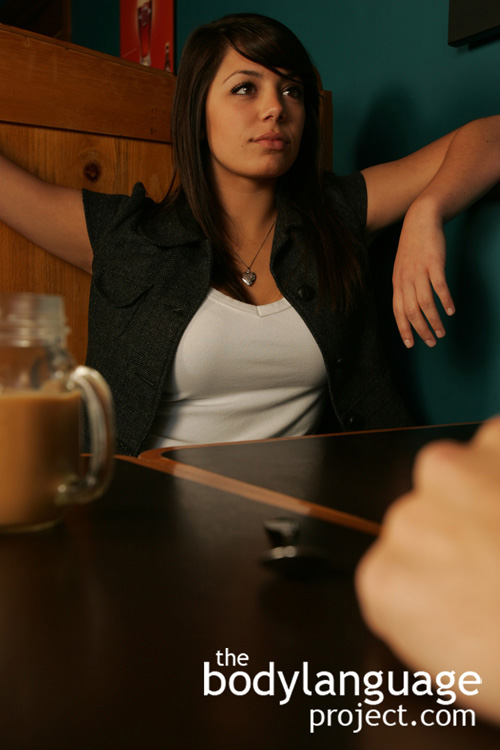 Body posture and its affects on our behaviour is becoming increasingly more obvious. Recent research published in the journal Psychology of Women Quarterly found that the posture that women took on, strongly affected their level of food consumption.
To be feminine is to act small, speak softly, use restrictive postures and movements and even be small. To be masculine is to act big, speak with a booming voice, use expansive postures and movements and even be big.
When it comes to posture however, how one sits, be it expansive or constrictive wouldn’t usually cross one’s mind when it comes to how one comports themselves at the dinner table. However, this couldn’t be further form the truth according to researchers Jill Allen, Sarah Gervais and Jessi L. Smith who found that those taking up the most expansive postures also tended to consume the most calories.
The researchers note that previous methods of restraining eating tended to focus on clinical intervention. However, their main goal was to test nonverbal expression to see if it would disrupt the link thereby helping to restrict caloric intake. Previous research however, has shown that wearing tight fitting clothing or looking in a mirror bring attention to body shape thereby bringing body image to consciousness. In one such program, participants worked through an 8-week course aimed at bringing self-consciousness to eating habits. Overall, it was found to be successful.
However, the goal of this research was to explore the idea of posture as a daily method for disrupting harmful eating in more moment-to-moment fashion.
“Because they have internalized the feminine stereotype that women should be small, women high in body shape concern are chronically worried that their bodies and body parts are too fat,” say the researchers.
“These women may restrain their eating when their self-perception is inconsistent with the amount of space their body actually occupies; the discrepancy from feeling fat, but occupying a small, constrictive space signals a gender violation, causing women to perform gender by restraining their eating to reduce the discrepancy between the self- perception and space occupied.”
By this theory, when women feel fat, but occupy more expansive space, such as by spreading out in a more masculine way, the discrepancies should not emerge.
This therefore will “free women from restraining their eating. “
“In sum,” say the researcher “the effect of women’s selfperceptions of the shape of their bodies (thin vs. fat) may depend on posture, which frees or constrains eating in line with feminine prescriptions.”
The researchers set up a study to test whether expansive (non-feminine) and restrictive (feminine) seating postures would affect women’s overall eating habits.
The Current Study
Ostensibly, the study was told to be aimed at marketing and physiology. To back this story, subjects were fitted with a “medial monitor” on their wrist and ankle for the duration of the experiment. The subjects were then asked to either take up a constrictive posture by placing their feet on pieces of tape either 4.5 inches apart or 31.5 inches apart as in the expansive posture. Those in the control condition were asked to sit naturally. Subjects were also asked to sit with their backs to the chair to avoid slumping or slouching. The subjects sat in this fashion for 30 minutes.
Restrained eating was assessed by having the subjects rate pretzels including chocolate or plain in the “marketing” portion of the study. They were given 10 pretzels and told they could consume as many as they wished over a 3 minute interval. Thus, the number of pretzels remaining served as the variable to be measured against the posture manipulation.
The Results

Figure 1. Restrained eating (number of pretzels left over after eating) as a function of body posture (BSC) and body shape concern. BSC is graphed at _2 standard deviations and þ 2 standard deviations (BSC range: 34–177).
The results supported their hypothesis in that the expansive postures reduced restrictive eating habits and constrictive postures did not. Those in the control group which were able to sit more natural and hence decide their own sitting posture also tended to consume food relative to their posture. That is, those who sat more constrictive tended to eat less than those who tended to sit more expansively.
“Consistent with our rationale,” say the researchers “women with lower body shape concern perceived themselves more in line with feminine prescriptions for appearance, and when they were seated in constrictive postures, the space their body occupied was
consistent with self-perceptions, and therefore restraint was released; they felt thin and sat small, and thus, ate more.”
This showcases the link between body and perception. When the body takes up lots of space, but doesn’t fit the ideal self perception, it behaves in a way that puts it more in line with its desired goals.
Discussing The Findings
I will begin the discussion and take-away message both from my perspective and that of the authors such that you may see two relevant outcomes of the study.
First, the authors conclude that the results show that “if a woman feels fat or negative toward her body size or shape, she could expand her body outward in order to minimize the salience or importance of feminine appearance prescriptions. In turn, she may not feel guilty for having more to eat in that situation.”
They continue “It is possible that “sitting big” might also be a longer-term solution for developing healthy eating habits in girls and young women, but sitting big all of the time may also result in negative backlash toward girls and women for violating their expected gender roles.”
I speak more to the results driven approach which they word in the second half above rather than the self-esteem approach mentioned first. This is worth clarifying as with all results, one must assess what exactly one wishes to achieve.
As the researchers conclude, one can adopt expansive postures to immediately quell negative body images and free the self to consume as much food as one wishes. This is particularly practical for those suffering eating disorders such as anorexia, but not particularly constructive for those suffering from overeating. While the immediate negative feelings will be set aside permitting over-consumption, it will not remedy the underlying health issues, not to mention the relevant negative feelings produced by others from not fitting in to norms with respect to body mass.
In this case of obesity, therefore, one might wish to adopt a more constrictive and feminine posture to reduce over-consumption, but this is not specifically mentioned by the authors.
Another important message is that those women who spontaneously choose constrictive postures tend to eat restrictively. This says that constrictive posture in nonverbal communication tells us much about a person. Expansive or constrictive postures tell us about a person’s overall demeanor which also, curiously, tends to affect their eating habits or their preferences to act feminine or to not act feminine.
The researchers say that “female mentors may advocate awareness of this culturally prescribed phenomenon and its negative consequences and instead encourage female mentees to behave in a more empowered manner, requesting a larger chair, opting to wear looser clothing, or consciously uncrossing their legs and arms in order to practice expanding their bodies outward.”
While this might help women in the short term (in the case of anorexia), it will not help others who suffer from being over-weight escape negative pressures from their peers in the long run and their culture as well as the biological implications of overeating, though it will certainly help those who under eat.
The authors also write the women “felt fat, but sat small, and thus, ate less.” This assumptions says that the women ate less because the felt fat, but why would they feel fat if they took on a more feminine posture? A small posture should activate the “feminine ideal” thus, a feminine constrictive posture should produce feminine eating habits.
Thus, I believe that rather than reading “[women] felt fat, but sat small, and thus, ate less” it should read “women sat small, felt feminine, ate less.” By my assessment sitting small activates submissive embodiment thus activating the feminine archetype requiring women to eat small.
Applying The Findings
It is my contention that eating a proper amount of food to fit normal body weight is constructive and it’s preference as determined by our culture is biologically driven and also adaptive. That some women over- or under-eat or otherwise can not maintain the ideal standard due to medical issues is unfortunate. It also very likely affects self-esteem and produces overall unhappiness. However, that being said, when it does occur, it will lead to negative outcomes as society at large will apply negative pressure. This is something real and immutable and something we should adjust our behaviour in order to maximize our fitness and therefore our happiness.
It is my opinion that one should work with, rather than against the realities we face. However, give here are tools one can use to either incentivize or deincentivize eating to achieve a healthy weight.
As I read the assertions of the authors who speak from a feminist perspective, it reads as if they wish to rid all concerns from eating or the negative emotions from being overweight, period. I do not subscribe to this view as it is short sighted and will ultimately fail – as the world, and the human organisms living on it, with their inherent biology and psychology, are not something that will, or can be changed. Not to mention the fact that we live in a world of overabundance of calories, for which our bodies were not specifically designed to cope with naturally, resulting in the condition we currently find ourselves – chronically obese.
In other words, it’s far easier, in the long run to fit the ideal than complain to no effect or try to change gender roles which have been long ascribed and vigorously maintained actively by both men and women equally throughout millennia.
Fitting the ideal is, in the long run, is far easier and more fun than dealing with negative emotions and negative results. I’m not much for conformity, but at times, conforming to social norms produces more pleasant results.
In this case, it is more enjoyable to fit the gendered prescription for beauty, but only in so much as one desires output from others – meaning positive confidence emotion building (?) including (empty!) compliments and even production of envy amongst peers. While this is weak and shallow, it is part of the world we live in.
Life is a game. Play your cards in a way that best matches your ultimate desires.
Resources
Allen, Jill; Sarah J. Gervais and Jessi L. Smith. Sit Big to Eat Big: The Interaction of Body Posture and Body Concern on Restrained Eating. Psychology of Women Quarterly 2019. 37(3): 325-336. DOI: 10.1177/0361684313476477pwq.sagepub.com
Learn More Starting Today!
Learn the basics of body language quickly and easily by taking one of our tailor-made video courses!
Short on cash? Then read an ENTIRE comprehensive book on body language – it’s totally FREE!
Which body language video course will you start with?
1. “The Secrets of Body Language”